

Architecture Should Follow Business Evolution—Not Technology Trends
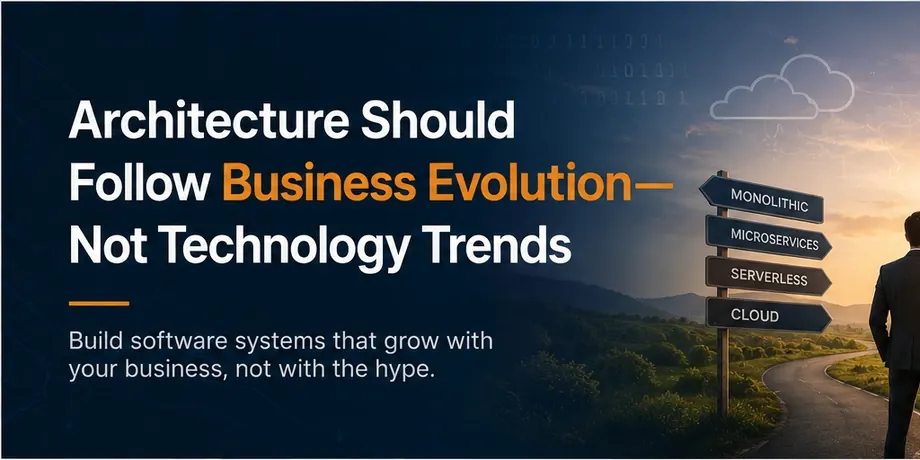
Technology trends change rapidly, but business evolution follows a different pace. Learn why software architecture should be driven by business strategy rather than technology trends, and how incremental modernization helps organizations build sustainable, adaptable software systems. […]
Early Migration Conversations Often Reward Certainty More Than Honesty

In migration work, confidence should come from honest discovery — not from how clean the proposal looks. Why Early Certainty Feels Reassuring When a potential partner walks in with a confident timeline, a clean delivery plan, and no major concerns flagged, that usually feels reassuring. But in a complex migration, early certainty is often a […]
Why Dual-Running Needs Reconciliation in Legacy Migration
Dual-running can sound reassuring in a legacy migration. Both systems stay available.A fallback still exists.Cutover feels less dramatic. But dual-running only reduces risk when the team can prove that both systems are still aligned. Without reconciliation, parallel run can create false confidence. Data may look close enough.Business flows may appear intact.Users may assume the migration […]
Why “Make It Work Like the Old System” Can Create Risk in Legacy Migration
One of the most common requirements in legacy migration is also one of the most dangerous: “Make the new system work exactly like the old one.” The request is understandable. It protects business continuity.It reduces disruption.It gives users confidence that daily operations will still run after the change. But it also creates a hidden risk. […]
Why Post-Go-Live Ownership Matters in Legacy System Migration
A migration program can define cutover in great detail and still leave one critical question unanswered: Who owns the new system after go-live? This gap shows up more often than many teams expect. During delivery, ownership may appear clear because the project team is still active. There are regular meetings, issue tracking, testing cycles, and […]
Why Migration Timelines Should Be Built Around Risk Visibility
In complex migrations, a timeline is only as reliable as the risks behind it. One of the most common mistakes in migration planning is treating the initial timeline as if it already reflects the real execution risk. At that stage, teams may know the target platform, the high-level scope, and the delivery goal. But they […]
A Migration Plan Can Look Solid — And Still Miss the Logic Your Business Runs On.
A migration plan can look solid on paper. The proposal is structured.The timeline seems reasonable.The team has relevant technical experience. But none of that necessarily tells you whether the team has identified the parts of the system the business still depends on. In complex migration projects, risk does not always sit in the code itself. […]
Why Most System Migrations Fail And How to Do It Safely
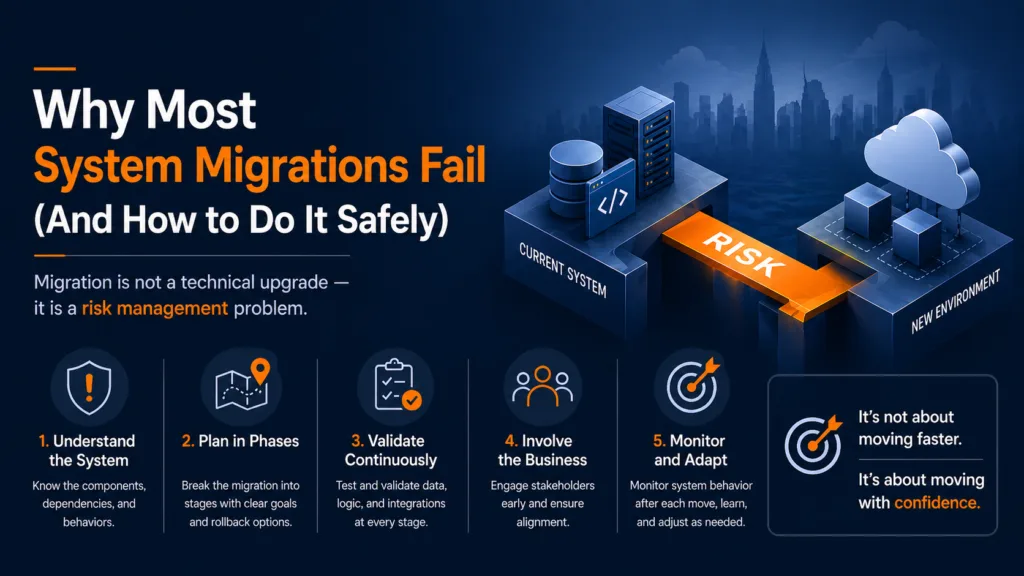
Most system migrations fail not because of technology, but because of hidden risks. Learn why migrations fail and how to manage risk safely.
Why Migration Risk Depends on Business Understanding, Not Just Technical Discovery
Migration risk goes beyond reading the system In migration projects, the real risk is not whether a partner can read the system. It is whether the right people can understand what the business still depends on. In long-running systems, the biggest risks are rarely just technical. A workflow may look outdated.A rule may look inconsistent.A […]
If your software partner is using AI, do you know how your source code is being handled—and where it could end up?
It is a question every CTO, VP of Engineering, and technology decision-maker should be asking development partners right now.AI can accelerate software delivery. But not every AI workflow offers the same level of data control, retention policy, or training protection.And if client code is being pasted into unsecured public AI tools, IP, product logic, and […]
Accelerating AI Development with Splunk’s Comprehensive Data Platform
As artificial intelligence (AI) becomes increasingly integral to business operations, organizations are seeking ways to streamline their AI software development processes. One platform that has emerged as a powerful tool for this purpose is Splunk. In this blog post, we will explore how Splunk can enhance AI software development, the types of services it offers, […]