


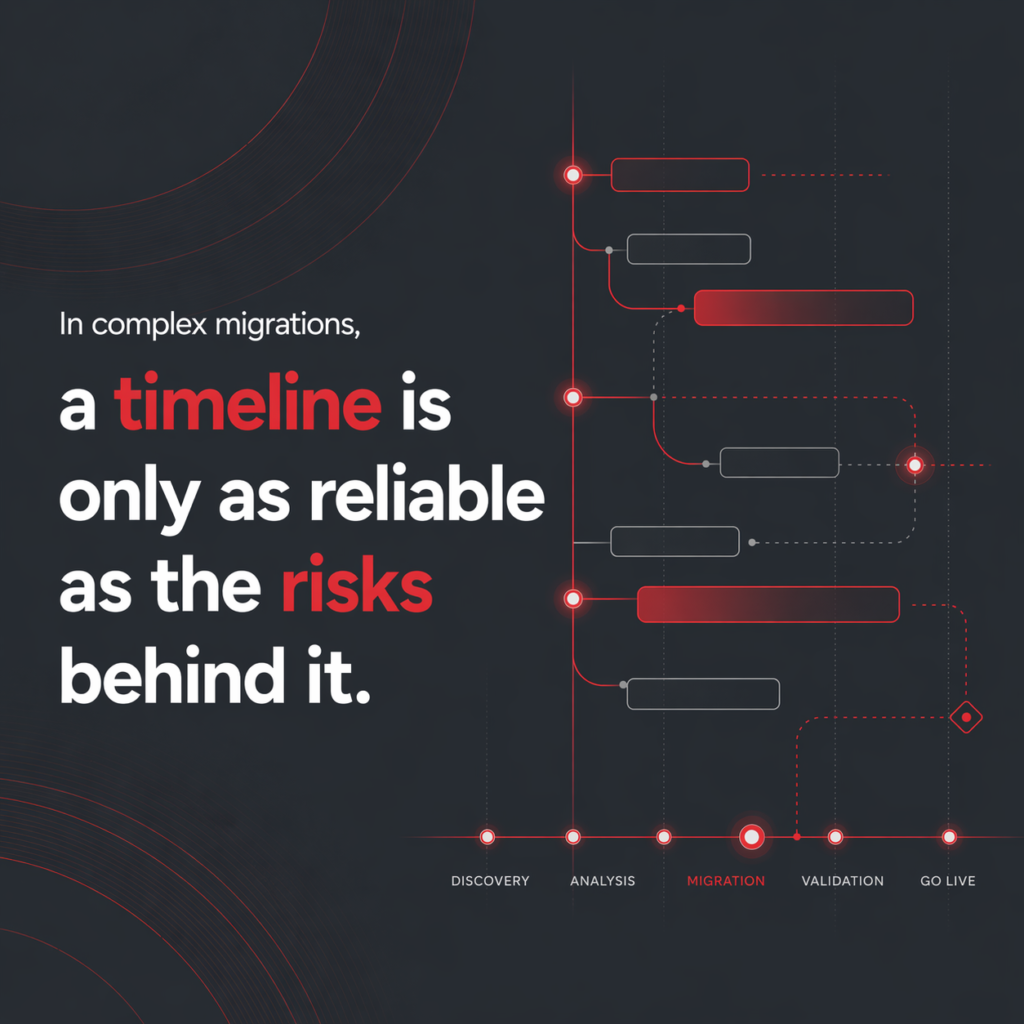
In complex migrations, a timeline is only as reliable as the risks behind it.
One of the most common mistakes in migration planning is treating the initial timeline as if it already reflects the real execution risk.
At that stage, teams may know the target platform, the high-level scope, and the delivery goal.
But they often do not yet have enough visibility into critical workflows, high-risk data transitions, integration dependencies, cutover constraints, or post-go-live support exposure.
That is why strong migration teams do not just build a schedule.
They first build a risk view.
A Precise Timeline Can Still Be Fragile
A migration timeline may look clear and well-structured on paper.
Milestones are defined.
Phases are sequenced.
Delivery dates are mapped out.
But precision does not always mean reliability.
If the timeline is built before key risks are understood, it may underestimate the areas that are most likely to affect delivery, stability, or business continuity.
This is especially true when the plan is based mainly on technical architecture rather than the operational realities of the system.
Not Every Part of the System Carries the Same Risk
In migration work, different parts of the system carry very different levels of risk.
Some areas are technically difficult.
Others are operationally sensitive.
Some may look minor from a system perspective, but have an outsized impact on pricing, approvals, reconciliation, reporting, or customer-specific processes.
These areas often require earlier visibility because they can affect not only development effort, but also validation, sequencing, stakeholder alignment, and support planning.
Until they are identified and prioritized, a timeline may appear realistic while still being fragile.
Strong Migration Teams Build a Risk View First
A strong migration plan does not begin with dates alone.
It begins with a clear understanding of where the greatest uncertainty sits.
That includes questions such as:
Which workflows are most critical to daily operations?
Which data transitions carry the highest risk?
Which integrations could disrupt downstream processes?
Which cutover constraints could affect business continuity?
Which areas are most likely to create support pressure after go-live?
By answering these questions early, teams can build a timeline that reflects real execution complexity rather than only planned delivery stages.
Speed Matters, but Sequence Matters More
In migration work, speed matters.
But sequence matters more.
Moving quickly in the wrong order can create more risk than moving carefully through the right priorities.
A migration plan becomes more reliable when high-risk areas are surfaced early, validated early, and sequenced deliberately.
This does not mean slowing the project down unnecessarily.
It means making sure the timeline is shaped by risk visibility, not just by architecture, assumptions, or desired launch dates.
Related case study: Migrating e-commerce and connecting ERP operations