Data ownership
The team had to define which platform controlled each commercial and operational record.


E-commerce integration case study
An e-commerce business needed a more scalable storefront and dependable exchange with its ERP so online growth did not create more manual operations.
The situation
The existing WooCommerce site supported online sales, but product, customer, order, inventory, and financial information still crossed system boundaries through manual or fragile processes.
The client chose Shopify for the storefront while retaining Dynamics GP as a core operational system. Success depended on more than moving pages: the business needed dependable data flow and a cutover that protected active commerce.
The challenge
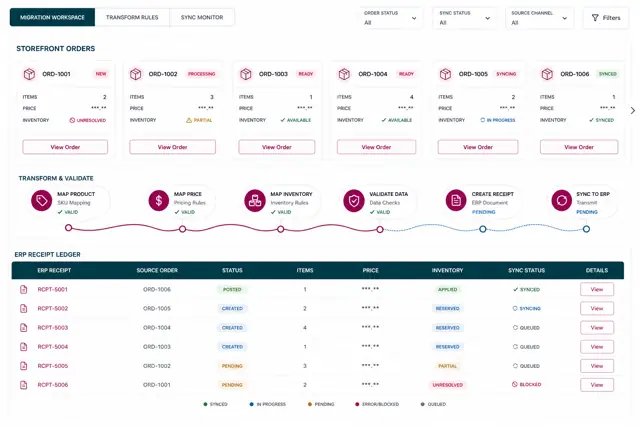
Catalog, customer, order, inventory, and fulfillment data needed clear ownership and recovery behavior across two platforms.
The team had to define which platform controlled each commercial and operational record.
Storefront and ERP fields, identifiers, statuses, and timing did not always align directly.
Active orders and inventory could not be left in an ambiguous state during migration.
The solution
The team mapped data responsibilities, created transformation and synchronization workflows, and rehearsed cutover around real commerce scenarios.
Define record ownership, identifiers, status mappings, and exception paths.
Connect Shopify and Dynamics GP for products, customers, orders, inventory, and fulfillment.
Validate migrated data, active order states, and operational recovery before launch.
How we worked
Migration and integration work shared the same acceptance scenarios so storefront actions were verified through downstream operations.
Exception handling and reconciliation were designed into the exchange rather than treated as manual aftercare.
Cutover planning included active orders, inventory updates, and post-launch monitoring.
Define data ownership and cross-system rules.
Prepare catalog, content, and customer records.
Connect orders, inventory, fulfillment, and finance.
Rehearse, launch, monitor, and reconcile.
The result
The migration improved the commerce foundation while ERP integration reduced manual transfer and supported more consistent order and fulfillment work.
The new storefront improved the basis for merchandising and checkout experiences.
Structured exchanges kept commercial and ERP records aligned.
The integration reduced the need to add manual processing as online activity increased.
Case taxonomy
Connect commerce to the systems behind it
Get in touch
Tell us what you need to build, modernize, automate, or augment with AI. We can start with a focused discussion or a no-risk 1-week trial.

“A fantastic company to work with.” After the initial rapid development project, American Shipping Co. kept two Shinetech developers embedded for nearly four years, supporting internal and external tools and new AI initiatives.
 CEO, American Shipping Co. - 5-star Google Review