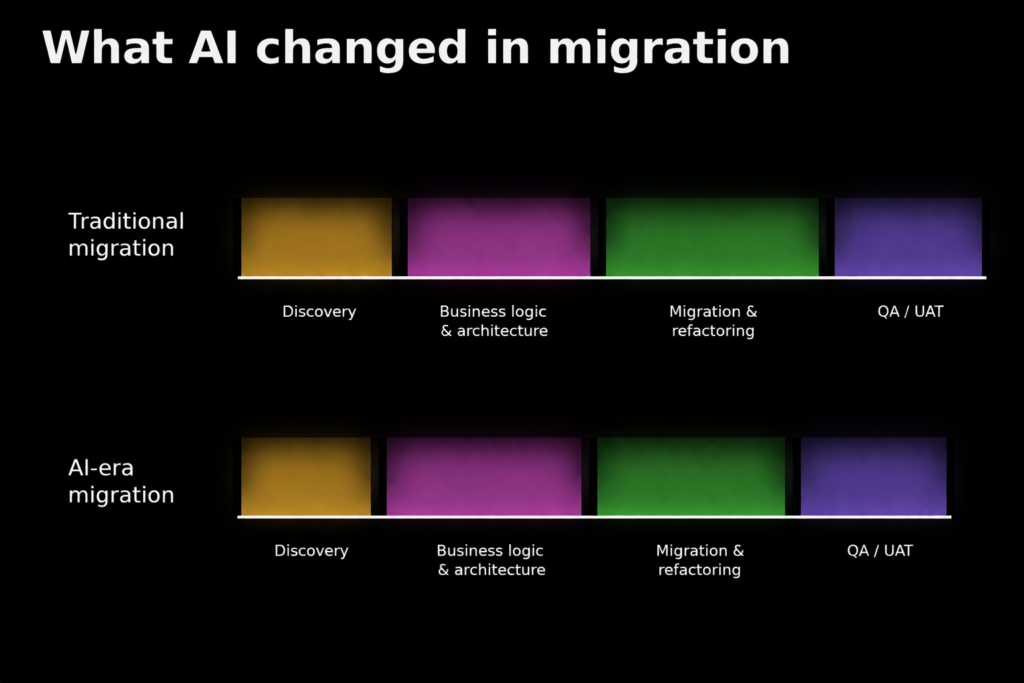


In migration projects, the real risk is not whether a partner can read the system.
It is whether the right people can understand what the business still depends on.
That distinction matters more than many teams expect. In long-running systems, the biggest risks are rarely just technical. They are usually hidden in the logic, workflows, and exceptions that have quietly supported the business for years.
A workflow may look outdated. A rule may look inconsistent. A dependency may look easy to remove.
But in practice, those details often carry business meaning. They may reflect a regulatory requirement, an operational workaround, a customer commitment, or a decision that was made to keep the business moving under real-world constraints.
When that context is missed, migration risk does not always show up immediately. It often appears later, in the form of functional drift, support gaps, and timeline or cost changes that were not visible in the original plan.
Legacy systems hold more than technical debt
It is easy to view an older system mainly through a technical lens. Teams see aging architecture, duplicated logic, manual processes, and integrations that no longer fit the current technology landscape.
All of that may be true. But legacy systems also contain something more difficult to map: accumulated business knowledge.
Over time, systems become shaped by day-to-day operational needs. Small exceptions are introduced for specific customers. Validation rules are added to prevent downstream issues. Reporting logic evolves to support finance, compliance, or service teams. In many cases, the system no longer reflects just the original design. It reflects the history of how the business has actually worked.
That is why migration cannot be treated as a purely technical exercise. Reading the code is only one part of understanding the system.
The real difference is in the people involved
Successful migration depends heavily on the people doing the discovery before major changes begin.
The right team does more than analyze architecture and inventory dependencies. They ask why the system works the way it does today. They test assumptions with business users. They look for the difference between a bug, an exception, and business-critical logic.
That work is essential because many of the most important decisions in migration are not obvious from the system itself. A rule that looks redundant may still protect an important process. A manual step may exist because no one trusted a previous automation. A dependency that seems safe to remove may still support a critical reporting path or operational handoff.
Without people who can connect the system to the business context, migration plans often become too optimistic too early.
AI can accelerate parts of migration, but not all of it
AI is already changing migration work, especially in areas like code analysis, refactoring, documentation support, and technical discovery. It can help teams move faster through large codebases, identify patterns, and reduce the manual effort required to understand legacy implementations.
That is valuable, and it will continue to improve.
But AI does not remove the need for human judgment where business meaning is involved. It may help identify what the system does, but it cannot fully validate why the business still depends on it, whether a rule is still operationally necessary, or how a change will affect teams working around the system every day.
In other words, AI may change the time distribution in migration work. It can reduce effort in technical discovery and accelerate migration and refactoring tasks. But business understanding, stakeholder validation, and operational interpretation still depend heavily on people.
Where migration risk really appears
When business understanding is weak at the start of a migration, the consequences tend to surface later.
They show up when users say the new system is technically correct but operationally harder to use. They appear when support teams lose the context that used to live with one internal expert. They emerge when a process still works in theory but no longer fits the way the business actually runs.
This is where migration projects run into avoidable friction:
- Functional drift between the old and new system
- Hidden support dependencies
- Rework caused by incomplete discovery
- Delays from late-stage validation
- Cost increases tied to missed business rules
These issues are often described as execution problems, but in many cases they begin as understanding problems.
Migration success starts before the first change
Successful migration depends on more than technical execution. It depends on people who can connect the system, the business context, and the operational reality before changes begin.
That means taking time to validate assumptions, involve the right business stakeholders, and preserve knowledge that may not be documented anywhere else. It also means working with teams who can support the system beyond the knowledge of a single internal expert.
The goal is not simply to move from old technology to new technology. The goal is to carry forward what the business still needs, remove what no longer serves it, and do both with enough clarity to reduce risk rather than shift it downstream.
In migration, that is what makes the real difference.
Related case study: Automating vehicle-finance operations on a scalable system