

Twenty-five years is a long time in software.
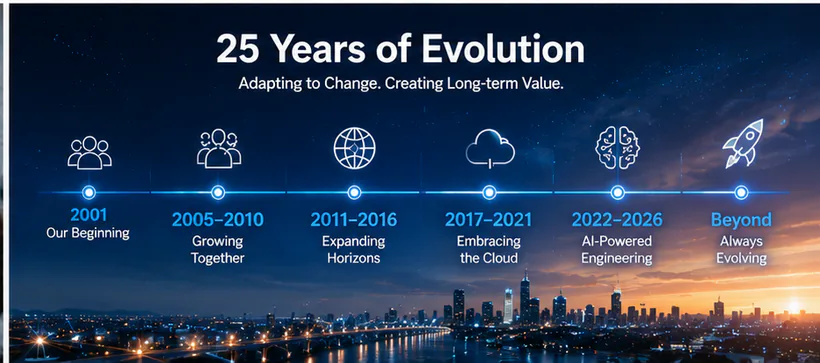
When Shinetech was founded in 2001, the software industry looked very different from the one we know today. Enterprise applications were largely built for desktops and private infrastructure. Cloud computing had not yet become the default model for running software. Smartphones had not reshaped how people interacted with digital products. SaaS was still emerging, and many of the technologies and practices that now define modern software engineering had yet to become mainstream.
Since then, almost everything around software development has changed. Web applications became the norm, mobile created an entirely new generation of products, cloud platforms transformed infrastructure, open-source ecosystems expanded dramatically, Agile and DevOps changed how teams worked, and globally distributed development became increasingly common. Now artificial intelligence is beginning another transition, changing how software is designed, written, tested, understood, and maintained.
Shinetech has changed through those transitions as well. What began in 2001 as a small development team has grown into a global software development organization working across North America, Europe, Asia, and Australia.
But reaching 25 years creates an interesting opportunity to look beyond the milestones.
The more interesting question is not how much software development has changed since 2001. That answer is obvious.
The more interesting question is what has remained important despite all that change.
What Changes, and What Doesn't
Software development has always been unusually susceptible to reinvention. A new language appears, a new architectural pattern gains momentum, a new infrastructure model becomes standard, or a new tool promises to fundamentally change developer productivity. Each wave creates a natural temptation to divide engineering into what came before and what comes next.
There is real progress behind many of these shifts. Building and operating software today can be dramatically faster, more scalable, and more accessible than it was 25 years ago. A small engineering team now has access to infrastructure, development tools, open-source libraries, automation, and AI capabilities that would have been difficult to imagine in 2001.
Yet the experience of building software over a long period also reveals something less obvious: many of the hardest problems have remained surprisingly consistent.
A development team still needs to understand what the business is trying to accomplish. Engineers still make trade-offs between what needs to be delivered now and what will make the system easier to change later. Architecture still has to accommodate requirements nobody fully anticipated at the beginning. Knowledge still gets lost when people leave. Communication still matters when requirements are uncertain. Ownership still matters when something goes wrong.
The tools have become more sophisticated, but good engineering has never been only about tools.
This is why adopting modern technology and developing mature engineering capability are not the same thing. A company can use cloud-native infrastructure, microservices, automated deployment pipelines, and AI-assisted development while still struggling with fragmented knowledge, unclear ownership, poor maintainability, or software that no longer reflects how the business actually operates.
Technology can amplify an engineering organization. It cannot replace the foundations underneath it.
Software That Lasts Is Software That Changes
Twenty-five years also changes the way you think about the word legacy.
In technology, old software is often discussed as though age itself were a defect. Legacy systems become associated with outdated frameworks, technical debt, difficult maintenance, and modernization projects. From that perspective, the natural destination of an aging system appears to be replacement.
Real software is more complicated than that.
A system can be old because nobody has maintained it. But it can also be old because it has spent years doing something valuable.
Some long-lived applications contain years of accumulated business knowledge: pricing rules, customer workflows, integrations, regulatory requirements, operational exceptions, and decisions that may no longer be documented anywhere else. Replacing the technology does not automatically replace that knowledge.
This is why the question around mature software is rarely as simple as whether to keep it or rewrite it.
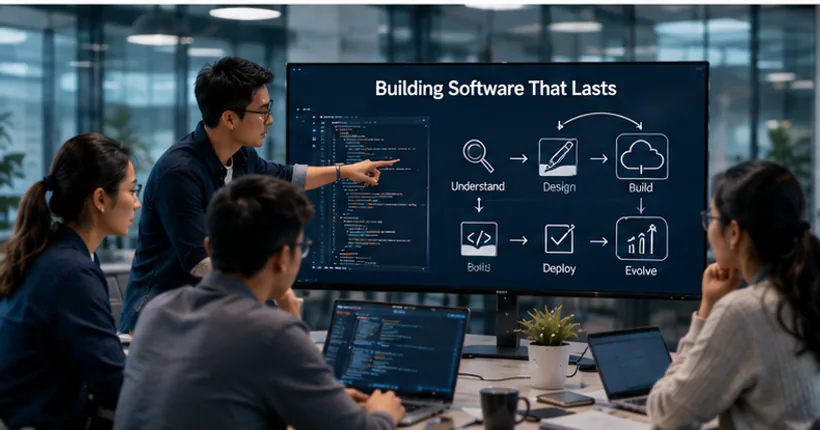
Software that lasts tends to change continuously. Parts of it are refactored. Interfaces are improved. Infrastructure moves. Frameworks are upgraded. Tests are added. Integrations are replaced. Components that create constraints are redesigned while stable parts continue doing their jobs.
Shinetech's work today includes both new software development and the modernization of long-lived systems, with an emphasis on stabilizing and evolving critical systems while business operations continue.
That reflects a broader reality we have seen repeatedly: longevity is not created by resisting change, but neither is it created by starting over every time technology changes.
The software that lasts is usually the software that has learned how to change without losing what already works.
The Value of Continuity Becomes Clear Over Time
There is another form of infrastructure in a long-running software system that rarely appears on an architecture diagram: human memory.
When a system has existed for years, understanding the code is only part of understanding the software. Someone needs to know why a particular workflow behaves differently for one customer, why an integration was designed around an unusual constraint, why a seemingly unnecessary module cannot simply be removed, or why an architectural decision that looks strange today was entirely reasonable when it was made.
Some of that knowledge can and should be documented. Some of it inevitably remains distributed among the people who have worked with the system.
This is where continuity begins to have a compounding effect.
A developer who has worked with a product for several years does not simply know more files in the repository. They understand relationships between technical decisions and business consequences. They remember previous approaches, failed experiments, customer expectations, historical constraints, and the reasons certain compromises exist.
When that context disappears repeatedly, the organization pays for it repeatedly. New engineers have to reconstruct decisions from code, tickets, documentation, and conversations. Work can still continue, but part of the team's capacity is continually spent rediscovering what was previously known.
When continuity is maintained, the opposite can happen. Context accumulates.
This idea has become deeply connected to how Shinetech operates. Its dedicated-team model emphasizes engineers who remain with a client's product so that business logic, system knowledge, and technical decisions remain with the people doing the work.
Those numbers and operating metrics can change over time, but the principle behind them matters more.
For software expected to live for many years, continuity is not simply a staffing consideration. It becomes part of the software's ability to evolve.
Long-Term Relationships Cannot Stand Still
Continuity, however, should not be confused with keeping everything the same.
A software relationship that lasts ten years should probably look different in year ten than it did in year one, because the client should look different too.
A company may begin with a relatively small product and a handful of developers. Over time, the product may become business-critical. Customer numbers increase. New markets introduce regulatory requirements. Internal processes become more sophisticated. Acquisitions create integration challenges. Infrastructure needs change. Security expectations rise. Eventually AI creates opportunities that did not exist when the original system was designed.
If the engineering relationship does not evolve with those changes, longevity by itself has limited value.
This is one of the reasons long-term software development is different from simply extending the duration of a project. As context accumulates, the conversation should become broader. A team that once focused primarily on delivering functionality may increasingly contribute to modernization, architecture, automation, operational resilience, or decisions about where new technology actually creates value.
The relationship develops because understanding develops.
Shinetech's approach emphasizes transparency, ownership, accountability, and teams that can integrate into client workflows and evolve with the business over time.
That evolution is important. Long-term relationships should preserve knowledge without preserving assumptions that are no longer useful.
Continuity creates the foundation. Adaptability keeps it relevant.
Twenty-Five Years Is Really About People
Technology companies naturally tell their histories through technology.
There is always another platform, architecture, methodology, or generation of tools that can be used to define an era. But after enough time, a company's history begins to look less like a timeline of technologies and more like a timeline of people.
Software does not maintain itself for 15 years. People do. Architecture does not decide when it needs to evolve. People do. A difficult client problem does not become easier because a new framework has appeared. It becomes easier when someone understands both the technical system and the business behind it well enough to make a good decision.
This is particularly relevant to Shinetech because the company has increasingly defined itself around a developer-centric approach. That idea can sound simple, but over a long period it has significant consequences.
If developers are treated primarily as interchangeable capacity, then replacing one engineer with another may appear relatively inexpensive. If developers are expected to accumulate domain knowledge, understand client operations, take ownership of outcomes, and contribute to the evolution of a system over many years, continuity has a very different value.
A developer's contribution is no longer measured only by how quickly code is produced. It also exists in judgment, context, relationships, and the ability to recognize consequences that are difficult to capture in a specification.
That does not mean teams should never change. They will. People move into different roles, new capabilities are needed, and organizations evolve.
The objective is not permanence.
It is to create an environment in which knowledge has the opportunity to compound rather than being continuously reset.
Perhaps this is one of the clearest differences between thinking about software as a project and thinking about software as a long-term business capability.
Projects finish.
Business software continues.
From 2001 to the AI Era
Artificial intelligence makes this 25-year point particularly interesting.
Software development is entering another period in which long-established assumptions are being reconsidered. AI can already generate code, assist with debugging, create tests, explain unfamiliar systems, produce documentation, accelerate analysis, and automate parts of the development lifecycle.
The capabilities will continue improving.
It is entirely possible that producing software will become dramatically faster over the next several years. Some work that once consumed days of engineering effort may increasingly be completed in hours or minutes.
Shinetech is incorporating AI-assisted engineering into its development model, using AI tools to accelerate parts of analysis, implementation, testing, and documentation while retaining engineering oversight around architecture, security, and quality.
But AI also makes an old distinction more important.
Producing code and understanding software are not the same thing.
As producing code becomes cheaper, deciding what code should exist may become more valuable. Understanding business rules, architecture, security boundaries, operational consequences, and the historical context of a system does not disappear because implementation becomes faster.
If anything, organizations may soon be able to create complexity faster than ever before.
The engineering challenge will therefore not simply be to use AI to produce more software. It will be to use AI without losing the judgment, context, and ownership that allow software to remain understandable and adaptable over time.
From that perspective, AI does not invalidate many of the principles accumulated over the previous 25 years.
It makes them newly relevant.
Looking Toward the Next 25 Years
Trying to predict software development in 2051 would be an entertaining exercise, but probably not a useful one.
Someone looking forward from 2001 would have struggled to anticipate today's combination of cloud computing, globally distributed engineering teams, smartphones, massive open-source ecosystems, always-connected software, and generative AI. There is little reason to believe our predictions about the next 25 years would be substantially better.
What we can expect is continued change.
Some technologies considered essential today will disappear. Others will become invisible infrastructure. New categories of software will emerge. AI will almost certainly change the composition of engineering teams and the economics of building software. The boundary between people who use software and people who create it may become increasingly blurred.
Shinetech will change too.
It has already changed many times since 2001, growing from a small development team into an organization serving clients across multiple regions and working across custom software, modernization, dedicated engineering teams, and AI-enabled development.
The objective for the next 25 years should not be to preserve the company exactly as it exists today.
That would contradict one of the clearest conclusions of the first 25.
Anything expected to last must be able to evolve.
The challenge is deciding what should change and what is worth carrying forward.
For us, that means continuing to adapt the technologies, tools, and capabilities around software development while preserving the things that have proven valuable across technology cycles: understanding the client's business, giving developers room to accumulate meaningful context, taking ownership of outcomes, protecting continuity where it creates value, and improving software rather than treating delivery as the end of the relationship.
Twenty-five years does not provide a formula for predicting what comes next.
It provides perspective on how much can change.
And perhaps more importantly, how much can remain important through all of it.
25 Years, and Still Evolving
An anniversary naturally invites a company to talk about what it has accomplished.
For Shinetech, reaching 25 years feels more meaningful as an opportunity to think about what made those years possible.
Not one technology stack. Not one architecture. Not one methodology. Not one generation of software.
All of those changed.
What endured was the ability to keep learning, keep adapting, preserve knowledge, and continue working with clients as their businesses and systems became something different from what they were at the beginning.
That may ultimately be the most useful definition of longevity in software.
It is not the ability to avoid becoming old.
It is the ability to remain useful while everything around you changes.
The goal is not to build something that lasts unchanged. It is to build the capability to keep changing.
After 25 years, Shinetech is still changing. And that is exactly the point.