

For decades, one of the fundamental constraints in software development was straightforward: producing software required a significant amount of skilled human effort. Requirements had to be translated into designs, designs into code, and code into software that could be tested, reviewed, integrated, deployed, and maintained. Increasing software development capacity usually meant increasing engineering capacity.
AI is beginning to change that equation.
In August 2026, Google introduced Gemini 3.7 Flash with a particular focus on coding and agentic workflows.[1] The announcement is one example of a much larger transition across software development. AI-assisted engineering is moving beyond autocomplete toward implementation, debugging, testing, code analysis, and increasingly autonomous multi-step development workflows.
The question facing software organizations is therefore changing.
For the past several years, the industry has largely asked: How much faster can AI help developers write code?
A more important question may now be emerging:
What happens when producing code is no longer the slowest part of software development?
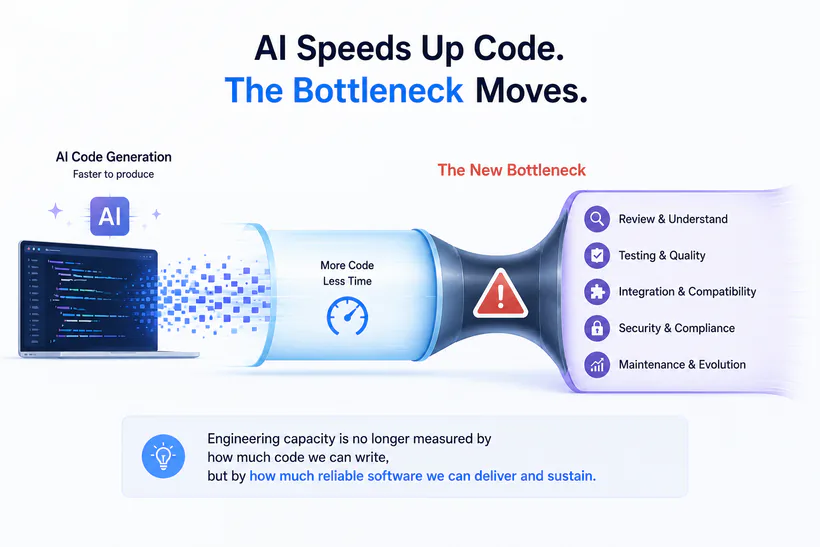
The Bottleneck Is Moving
AI adoption among technology professionals is already widespread. Google's 2025 DORA research found that 90% of technology professionals were using AI at work, while more than 80% believed it had increased their productivity.[2] But DORA's broader conclusion is more important than the adoption number alone: AI primarily acts as an amplifier, magnifying the strengths and weaknesses of the engineering organization around it.[3]
That distinction matters.
Imagine an engineering organization that dramatically increases its ability to produce implementation work. It does not automatically increase its ability to review that work at the same rate. Its testing infrastructure does not instantly become more capable. Security reviews do not automatically become faster. Deployment pipelines do not become more reliable simply because implementation takes less time. Architects and senior engineers do not suddenly gain more attention to evaluate design decisions.
Code generation accelerates one stage of a much larger system.
When one stage becomes dramatically faster while the others remain relatively unchanged, the constraint moves somewhere else.
For many organizations, that constraint may increasingly appear in verification, review, testing, security, integration, deployment, and maintenance.
Code still needs to be understood. Changes still need to be reviewed. Behavior still needs to be tested. Security still needs to be evaluated. New functionality still needs to fit existing systems. Someone still needs to determine whether an implementation actually solves the business problem it was intended to solve.
The faster code enters that system, the more important those capabilities become.
More Code Is Not the Same as More Engineering Capacity
This distinction challenges one of the easiest ways to think about AI productivity.
If an AI coding assistant allows a developer to produce significantly more code, it is tempting to interpret that additional output as additional engineering capacity.
But software engineering has never really been measured by the amount of code produced.
A thousand lines of unnecessary code can create negative value. A small architectural decision can eliminate thousands of lines of future complexity. A developer who prevents an incorrect implementation may contribute more than one who produces a large feature quickly.
Recent research is beginning to capture this shift.
A 2026 longitudinal study of professional software engineers found that 82% of participants reported spending less time writing code when using AI coding assistants. The researchers also observed a broader movement from creation toward verification and proposed the term "supervisory engineering work" for activities involving the direction, evaluation, and correction of AI output.[4]
That may be one of the most important changes AI introduces into software engineering.
The developer does not simply disappear from the implementation loop.
The nature of the developer's work moves.
Verification Becomes Part of the Production System
As implementation becomes increasingly automated, verification cannot remain an informal activity that happens at the end of development.
It needs to become part of the production system itself.
Automated tests need to become more comprehensive. Continuous integration needs to identify problems earlier. Observability needs to make unexpected behavior visible. Security controls need to be systematic. Architecture needs clear boundaries that both people and AI-assisted workflows can operate within.
This is particularly important because benchmark performance and production readiness are not necessarily the same thing.
METR reported in March 2026 that many pull requests which passed SWE-bench-style automated evaluation would still not have been accepted by maintainers. The researchers cautioned against directly extrapolating benchmark performance into real-world usefulness, particularly because real development involves creation, review, iteration, and maintainability rather than a single automated correctness test.[5]
This points to an important distinction:
AI can increase software production faster than an organization increases its capacity to trust that production.
The engineering organization therefore needs to scale verification alongside generation.
The Productivity Question Is More Complicated Than It Looks
There is another reason organizations should be cautious about reducing AI adoption to coding speed.
Different environments produce very different results.
In a randomized controlled trial published in 2025, METR studied experienced open-source developers working on repositories they already knew well. With the AI tools available during the study, developers took 19% longer to complete the assigned tasks when AI use was allowed.[6]
That result should not be generalized into a claim that AI makes developers slower. METR explicitly cautioned against that interpretation.
The tools are also evolving quickly. In a February 2026 update, METR said its newer data provided some evidence that more recent AI tools were producing speedups, but selection effects and measurement problems made the magnitude difficult to estimate reliably.[7]
The useful conclusion is therefore not that AI makes developers faster or slower.
It is that AI productivity is highly dependent on context.
Greenfield development is different from modifying a mature enterprise platform. A developer exploring an unfamiliar library is different from an engineer who has spent years working with a particular business system. Generating a prototype is different from changing software that processes critical transactions or contains years of accumulated business rules.
The value of AI cannot be understood entirely through generation speed.
The surrounding engineering environment matters.
Context May Become More Valuable as Code Becomes Cheaper
This leads to an interesting paradox.
AI makes technical knowledge easier to access. A developer can ask an AI system to explain an unfamiliar framework, generate an API integration, propose a database schema, analyze an error, or suggest a refactoring strategy.
But many of the hardest questions in mature software systems are not programming questions.
Why does this customer have a different workflow? Why does this service behave differently in one market? Why was this integration designed this way years ago? What happens operationally if this process changes? Which apparently obsolete behavior is still relied upon by a major client? Why was a technically cleaner approach rejected during an earlier architecture review?
The answers may not exist in the code.
They exist in business history, engineering decisions, customer relationships, previous incidents, operational constraints, and accumulated organizational knowledge.
AI can reason over context that it receives.
It cannot automatically recover context that an organization has failed to preserve.
As implementation becomes cheaper, this kind of knowledge may therefore become proportionally more valuable.
A developer who understands both the software and the business behind it is not simply a code producer. That developer provides context that helps determine whether code should be produced at all, what constraints it must respect, and how a change is likely to affect the system over time.
The Risk Is Not AI-Generated Code. It Is Unmanaged AI-Generated Complexity.
There is a familiar pattern here.
Engineering organizations have long discussed technical debt as though the objective should be to eliminate it. In practice, the bigger problem is technical debt that becomes invisible, unmanaged, and increasingly expensive to change.
AI-generated software may follow a similar pattern.
Generating more code is not inherently dangerous. If the additional implementation is well designed, tested, understood, and maintainable, faster production can create substantial business value.
The risk appears when organizations increase generation capacity without increasing their ability to manage what is generated.
More code creates more surface area. More dependencies create more upgrade paths. More services create more operational relationships. More generated implementations create more decisions that someone may eventually need to understand.
The important metric is therefore not:
How much code can we generate?
It is:
How much reliable software can we sustainably understand, operate, and evolve?
The Developer's Role Moves Up the Engineering Stack
If AI continues improving, developers will almost certainly spend less time on some forms of manual implementation.
That does not necessarily make engineering less important.
It changes where engineering value is created.
More attention moves toward defining problems correctly, decomposing work, designing architecture, supplying context, evaluating AI output, establishing technical constraints, validating behavior, protecting security boundaries, and understanding the long-term consequences of implementation decisions.
The 2026 longitudinal study described this movement toward supervisory engineering work, where developers increasingly direct, evaluate, and correct AI output rather than focusing exclusively on producing implementation themselves.[4]
This suggests that developers may increasingly operate at a higher level of abstraction.
Instead of writing every implementation directly, engineers may orchestrate combinations of tools and agents. Instead of manually inspecting every routine, they may design verification systems that continuously evaluate generated software. Instead of spending most of their time translating specifications into syntax, they may spend more time determining whether the specification, architecture, implementation, and business objective remain aligned.
Coding remains part of engineering.
But coding and engineering become increasingly difficult to treat as synonyms.
What This Means for Long-Term Software Development
For companies building software that may operate for ten or twenty years, this shift matters even more.
AI can accelerate a migration. It can help refactor a module. It can generate tests. It can analyze unfamiliar legacy code. It can help engineers understand dependencies that previously required substantial manual investigation.
These capabilities could make long-term software modernization significantly more efficient.
But the central challenge of long-lived software remains unchanged: the system has accumulated context.
Business logic, architecture, integrations, operational knowledge, customer requirements, technical compromises, and historical decisions all influence what can safely change.
This is why Shinetech approaches AI-assisted engineering as an extension of engineering capability rather than a replacement for engineering ownership.
For long-term development teams, the opportunity is not simply to generate more code. It is to combine AI's increasing implementation capacity with developers who understand the client's systems, business objectives, architecture, and history.
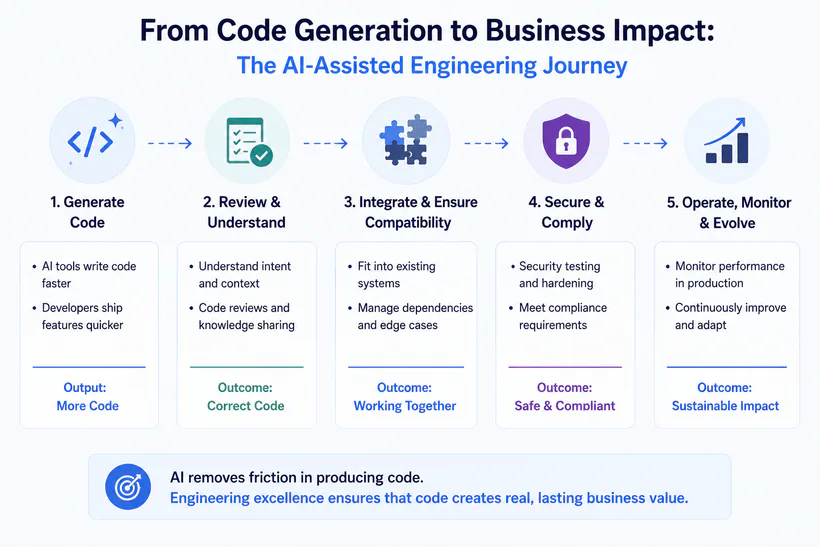
AI provides acceleration.
Engineering continuity provides context.
Automation provides verification.
Human judgment provides accountability.
Together, those capabilities can produce something much more valuable than faster coding: software that can evolve faster without becoming harder to understand.
The Next Bottleneck
Software development has always been a system of constraints.
At different moments, the bottleneck has been infrastructure, computing power, deployment, access to specialized technical knowledge, engineering capacity, or organizational coordination.
AI is removing some of those constraints remarkably quickly.
That should be welcomed.
But removing one constraint does not remove the system around it.
As code becomes faster and cheaper to produce, the competitive advantage in software development may increasingly shift toward everything required to turn that code into reliable software: architecture, verification, security, business understanding, operational discipline, engineering continuity, and ownership.
The companies that benefit most from AI may therefore not be the ones that generate the most code.
They may be the ones that build the strongest engineering systems around it.
The next software bottleneck is unlikely to be our ability to produce code. It will be our ability to understand, verify, and responsibly evolve everything we can now produce.
And solving that problem will require more engineering, not less.
Sources
[1] Reuters. "Google unveils Gemini 3.7 Flash AI model for coding, agent workflows." August 13, 2026.
https://www.reuters.com/business/google-unveils-gemini-37-flash-ai-model-coding-agent-workflows-2026-08-13/
[2] Google DORA. "Balancing AI tensions: Moving from AI adoption to effective SDLC use." March 10, 2026.
https://dora.dev/insights/balancing-ai-tensions/
[3] Google DORA. "State of AI-assisted Software Development 2025."
https://dora.dev/research/2025/dora-report/
[4] Vella, Annie and Kelly Blincoe. "The Impact of AI Coding Assistants on Software Engineering: A Longitudinal Study." 2026.
https://arxiv.org/abs/2605.23135
[5] METR. "Many SWE-bench-Passing PRs Would Not Be Merged into Main." March 10, 2026.
https://metr.org/notes/2026-03-10-many-swe-bench-passing-prs-would-not-be-merged-into-main/
[6] METR. "Measuring the Impact of Early-2025 AI on Experienced Open-Source Developer Productivity." July 10, 2025.
https://metr.org/blog/2025-07-10-early-2025-ai-experienced-os-dev-study/
[7] METR. "We are Changing our Developer Productivity Experiment Design." February 24, 2026.
https://metr.org/blog/2026-02-24-uplift-update/