


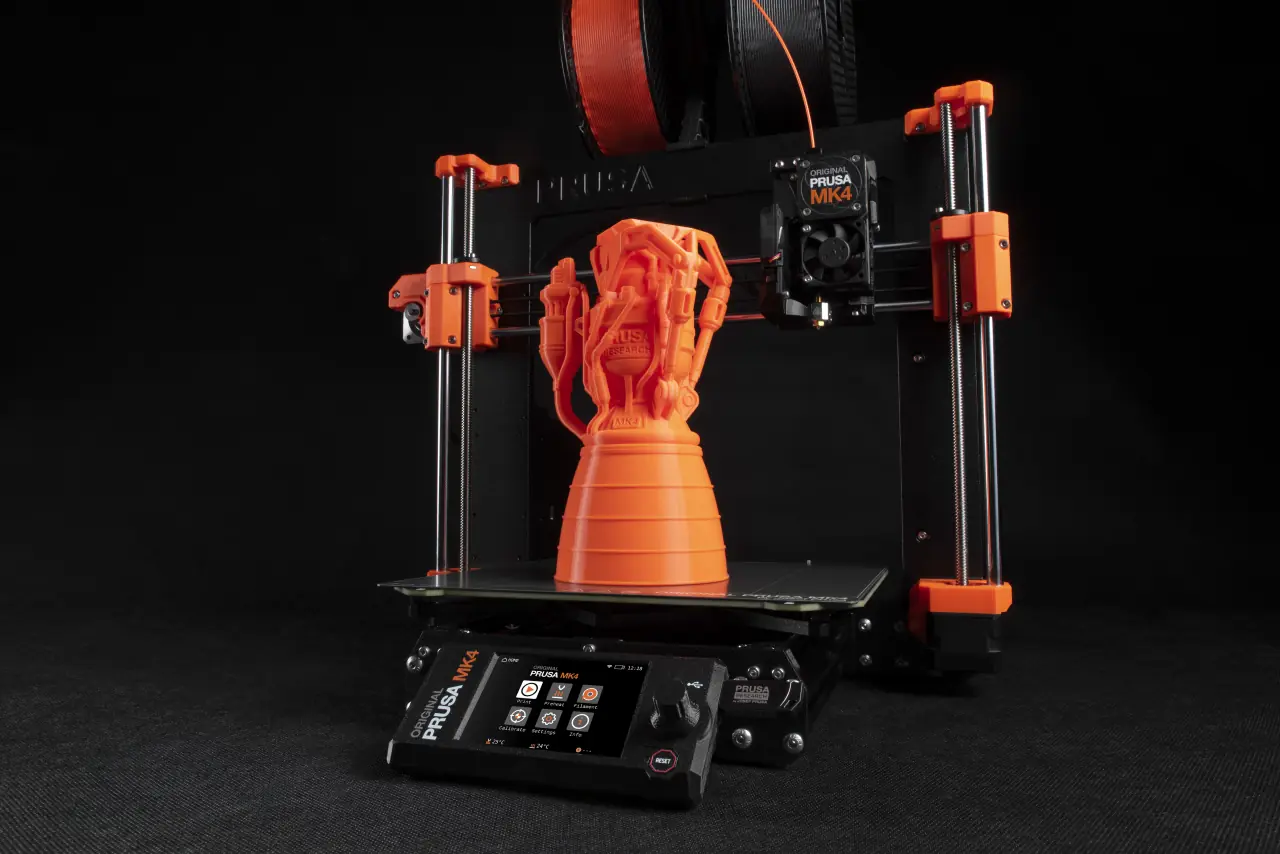

Consider a modest robotics job: moving a camera a few centimeters so that a gripper no longer blocks its view. Someone has to measure the existing mount, change the bracket, check clearance, print a replacement and test the new arrangement. It is a small task, but it connects software, geometry and a physical machine. That is the kind of work worth watching after GPT-6 Astra’s release.
What the CAD result measures
OpenAI’s September 3 launch included a substantial improvement on BenchCAD. Its published score for Astra was 95.9%, compared with 83.3% for GPT-5.6 Sol. The release also showed work in Blender and Unreal Engine. These results suggest greater scope for AI assistance in spatial and design workflows; they do not establish how reliably Astra can engineer a complete robot. OpenAI’s release
The benchmark’s task is quite specific. In its image-to-code evaluation, BenchCAD gives a model multiple views of a part and asks it to reconstruct the object as a CadQuery program. The program generates CAD geometry. BenchCAD explains that vendor results with tools use a geometric-overlap measure on a 1,000-file subset. A high score therefore measures reconstruction quality, not load capacity, service life or successful robot assembly. BenchCAD’s methodology
The distinction leaves plenty of useful work for a stronger model. Parametric CAD gives a developer dimensions and relationships that can be inspected and edited. In the camera-bracket example, that could mean revising a hole spacing or a mounting angle while keeping the rest of the design consistent. A successful assistant would also expose missing information: the actual camera dimensions, screw specification and clearance around moving parts.
The commercial opportunity is in making these revisions easier to attempt. A small team may have time to test several mounting positions where it previously settled for the first workable arrangement. A researcher may be able to adapt a published fixture to the equipment already on the bench. These are plausible uses to evaluate, not measured productivity gains from the Astra launch.
Printing makes revisions testable
3D printing supplies a practical way to test such changes. The SO-101 arm offers an existing example of this approach. The Robot Studio’s public repository includes printable parts, CAD files and a bill of materials. It also includes optional designs such as camera mounts and a raised leader base. A developer has a documented starting point rather than an empty modeling workspace. The Robot Studio’s SO-100 and SO-101 repository
The accompanying LeRobot instructions then cover motor configuration, assembly and calibration. That last step is important: the documentation explains that matching joint position readings across physical arms helps a policy trained on one robot work on another. Access to a printable design does not remove the work needed to make two builds behave consistently. Hugging Face’s SO-101 guide
For printing businesses, the near-term opportunity could be more frequent orders for brackets, grippers, sensor mounts, fixtures and replacement parts. Many of these jobs involve small quantities and repeated changes, making them natural candidates for additive manufacturing. This is our assessment of where demand could appear; there is no basis yet for translating Astra’s benchmark improvement into a forecast for printer sales.
Physical production retains its own variables. A CAD file does not specify every consequence of the material and process used to make it. Prusa’s guidance on warping, for example, describes how temperature and print speed affect layer bonding and part strength. Developers still need to test the actual printed component in its intended use. Prusa’s printing guidance
Printing will also have different roles at different volumes. Pollen Robotics’ earlier Reachy Mini began as a 3D-printed prototype before its manufacturing collaboration with Seeed Studio moved into production. Seeed’s account describes substantial work across mechanical design, electronics and acoustics. Faster model creation can help teams reach that stage; production engineering determines how they proceed from there. Seeed’s Reachy Mini account
Open projects provide a starting point
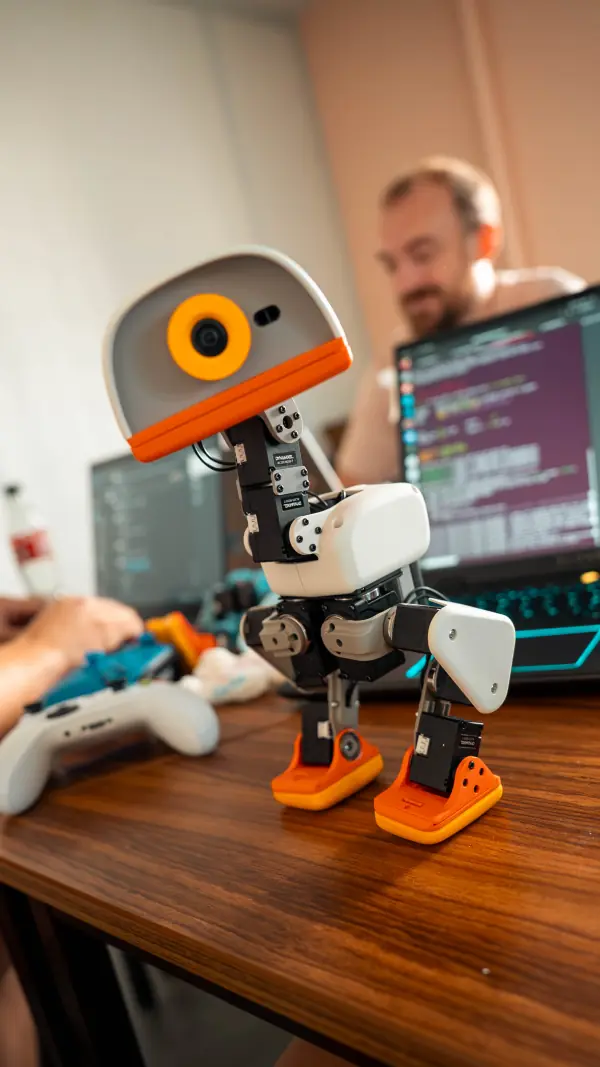
Open-source robotics gives improved AI tools somewhere useful to work. Microduck’s public software covers robot operation, while its separate reinforcement-learning repository provides training environments and tools for taking learned policies onto the robot. The launch materials describe a workflow of training, testing and sharing behavior. That offers a more concrete starting point than asking a model to invent both a robot and its entire software stack. Microduck RL repository, Pollen Robotics’ launch account
Here, an Astra-class assistant could help a developer understand unfamiliar code, prepare a controlled modification, update documentation or create a candidate test environment. For an open-source maintainer, a useful contribution would be a small change another person can review and reproduce. That is a sensible starting point for evaluating the new model on a real project.
Openness also needs a precise description. Published robot-control code, training code, model weights and hardware designs are different things. The presence of simulation meshes is not sufficient evidence that a project has released the manufacturing files and permissions needed to reproduce the whole robot. In Microduck’s case, the verified starting point for this article is its published software and training stack.
Simulation still needs physical measurements
Simulation is another likely beneficiary of better 3D tools. Developers need objects, obstacles and environments in which to test a robot. Faster creation of those assets could expand the range of scenarios a team can examine. But a scene that looks convincing may behave incorrectly. NVIDIA’s Isaac Sim documentation requires masses, centers of mass and inertias to match the real world as closely as possible; it also identifies friction and controller settings as factors in grasping behavior. Isaac Sim’s simulation guidance
That makes measured feedback essential. A team can propose a design, simulate it, build it and use the differences between predicted and observed behavior to revise the next version. The promise of stronger AI assistance is that more of the preparation and revision becomes manageable. The physical measurements still have to come from somewhere.
More experiments, measured by working hardware
Over time, this could encourage a broader range of robot bodies. Structure and control can be explored together: changing limb proportions or joint arrangements while searching for a suitable controller. MIT’s RoboGrammar demonstrated this research direction in 2020 by optimizing robot structures and controllers for different terrains. Astra’s arrival does not invent that idea, but more capable general tools could make related workflows accessible to more teams. MIT’s RoboGrammar project
We expect the earliest visible effect to be more experiments: modified open-source arms, specialized end effectors, compact mobile machines and attachments built for one job. Some will become useful products. Others will remain instructive prototypes. Keeping and sharing the failed results would make the next developer’s work more valuable too.
The camera bracket is a useful test of this progress. Did the AI-assisted design fit, clear the gripper and hold the camera steady? Could another person reproduce it from the files and instructions? Did the entire job take less time, including the failed prints and corrections? Those answers will tell robotics teams more than a polished rendering alone.
Sources
Reporting and analysis as of September 4, 2026.