


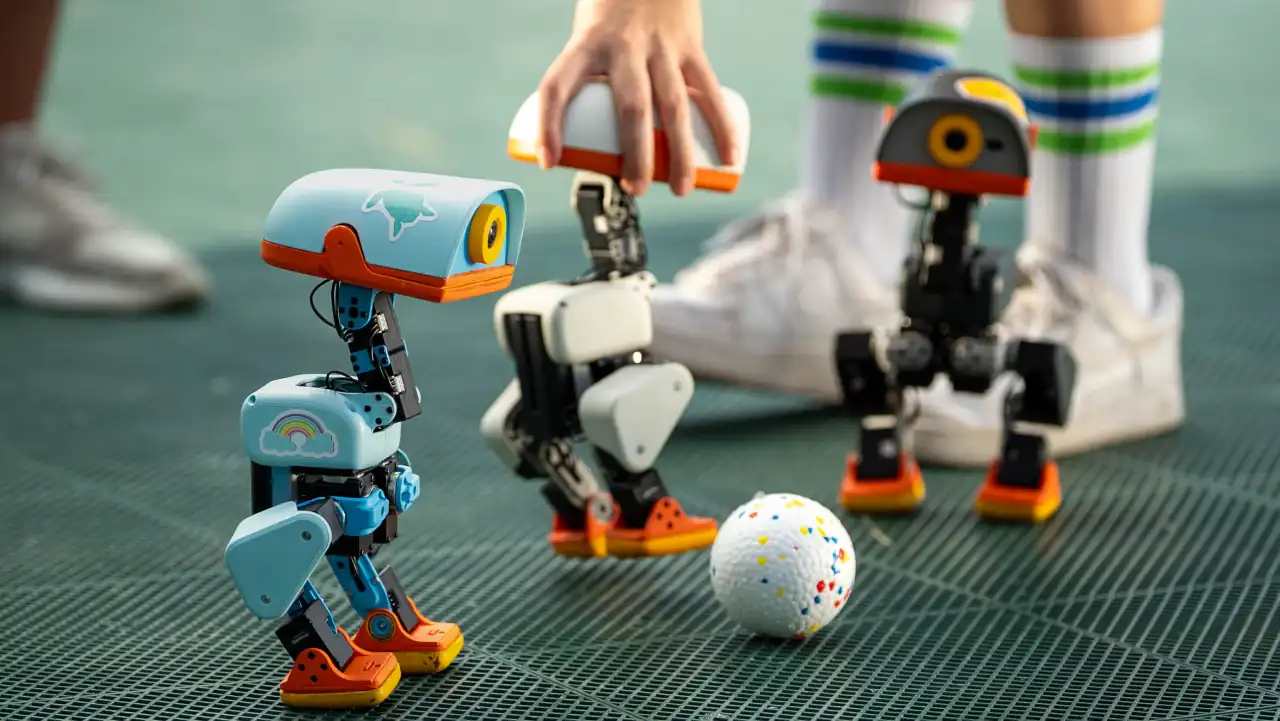
The first important number in Microduck’s launch was $399. The next was $2.6 million. On August 28, Hugging Face cofounder Thomas Wolf said customers had ordered more than that amount in the robot’s first 24 hours, according to Business Insider. By September 1, Yahoo Tech was reporting more than 10,000 orders, also attributing the figure to Wolf. These are company-reported preorders, not robots already delivered to customers. Business Insider, syndicated by Yahoo, Yahoo Tech
The wait is part of the story. On September 4, China Daily reported delivery estimates of four to six months for new orders. A successful launch has become a production problem: enough parts, consistent assembly, calibrated motors and a queue of customers expecting the machine they saw in the video. China Daily
Developed by Pollen Robotics, Hugging Face’s robotics team in Bordeaux, Microduck is a small biped with a grasping beak. It stands 25 centimeters tall and has 15 motors. Preorders opened on August 27 at an introductory price of $399 before tax and shipping. Its appeal includes the ability to retrain movements, alongside the ready-made behaviors demonstrated at launch. Pollen Robotics’ announcement
That combination gives the launch wider significance. Buyers can start with an assembled machine and then experiment with its behavior. The preorder response suggests an audience for approachable robotics outside a specialist laboratory. How many buyers become regular users, developers or repeat customers remains an open question.
The NVIDIA agreement and the wider platform
A week after the launch, NVIDIA added a much larger number to the news cycle. On September 3, Jensen Huang announced an agreement to acquire Hugging Face for $12,930,300,000. He said the platform would continue to support different models, clouds and computing platforms, without requiring NVIDIA hardware. This was an acquisition agreement; the announcement did not establish that the transaction had closed. NVIDIA’s announcement
The deal concerns the broader AI platform. It would be a mistake to read its price as a valuation of Microduck or as proof that consumer robotics has already become a large business. For robot developers, the relevant possibility is better support for sharing models, data and software. Whether that translates into easier, more portable robotics development will depend on the tools delivered after the announcement.
From prototype to production
The physical machine still needs a manufacturing network. China Daily reports that Microduck is manufactured in China and identifies Shenzhen-based Seeed Studio’s involvement, citing technology reporting. That places the robot within an international production relationship: a French development team, a global software community and manufacturing expertise in southern China. It does not mean every component originates in Shenzhen. China Daily


Seeed’s work on Pollen’s earlier Reachy Mini provides a documented example of what this relationship involves. In a January 2026 account, Seeed said the collaboration had moved from a 3D-printed prototype to shipping 3,000 robots within five months. Motor noise interfering with microphones was one of the problems the teams worked through together, making changes across mechanical design, acoustics and software. Seeed Studio’s project account
That is valuable work for a startup. A prototype can receive individual attention from the people who designed it. Thousands of customer units need repeatable assembly and testing. A supplier who can help change the design, diagnose a noisy mechanism and organize production contributes well before a finished robot reaches a shipping box.
Shenzhen’s role in a global supply chain
Shenzhen brings substantial industrial depth to that work. According to the city’s report on its 2025 robotics white paper, it produced 194,900 industrial robots that year, representing 25.2% of China’s output. Those are industrial-robot production figures, not a global market share or a measure of humanoid sales. They nevertheless show the manufacturing base on which newer robot businesses can draw. Shenzhen government report
The supply chain extends from motion and sensing to electronics and integration. An August report described collaborations facilitated by Shenzhen’s AIR Design House: Fourier and Tongchuan on integrated joints, Galbot and Zhaowei on dexterous hands, and Longtech and LimX on printed circuit board assembly. These are concrete examples of suppliers participating in product development. Economic Information Daily, via Digital China
Component companies also have businesses beyond any one robot brand. RoboSense reported 282,600 LiDAR units sold for “robotics and other applications” in the first half of 2026, up 510.4% year over year. The category is broader than humanoids, which matters when interpreting the growth. It indicates demand across multiple applications rather than dependence on a single fashionable body shape. RoboSense’s interim results
Shenzhen’s role also reaches beyond its municipal boundary. The city’s 2026–2028 robotics plan, published on September 2, calls for closer links with neighboring manufacturing cities, including Dongguan and Huizhou. It seeks denser local component supply, stronger open-source infrastructure and more real-world deployment. These are policy objectives, not evidence that every intended capability is already available. Shenzhen’s 2026–2028 work plan
What to watch through September 2028
For the period from September 2026 to September 2028, our expectation is that this combination of accessible software and manufacturing support will produce more kinds of useful robots. The strongest early candidates are small development platforms, task-specific manipulators and machines designed around a constrained environment. This is an outlook, not a shipment forecast.
Their shapes will follow different requirements. A mobile arm working on a flat floor has different needs from a crawler inspecting a narrow passage. A small biped built for learning can prioritize easy handling and recovery after a fall. A robot operating around people may justify a more humanlike arrangement. The useful question is how much complexity each task requires, and whether customers will pay for it.
Shared components could make that variety affordable. Different machines can reuse motor families, cameras, computing boards and software while changing their structure and end effectors. Manufacturers benefit when they can support these variations without treating every order as a completely new engineering project.
There are limits to how quickly this can happen. Changing a robot’s body changes its motion and may require new training, calibration and testing. A preorder rush also creates obligations for spare parts, support and delivery. Small teams can reach a global audience quickly; supporting that audience takes sustained work.
By September 2028, the most revealing numbers will be fulfilled orders, repeat purchases, useful operating hours and repair rates. Microduck has already attracted buyers. Its next contribution to robotics will depend on what those buyers can reliably do with the machines once they arrive.
Sources
Reporting and analysis as of September 4, 2026.