

When companies evaluate software developers, experience is often translated into speed. A senior developer is expected to understand technology faster, solve problems faster, write code faster, and require less supervision. From this perspective, seniority can appear to be a productivity multiplier: the same engineering work, completed more efficiently by someone with more experience.
But this interpretation misses much of what senior developers actually contribute. If their primary advantage were simply producing code faster, the economics would be relatively straightforward. Companies could compare the output of one senior developer with two or three less-experienced developers and determine which option delivers more implementation capacity for the cost. Software engineering, however, does not work that way.
The most consequential engineering decisions are often made before code is written. They involve understanding what should be built, identifying what could go wrong, deciding which trade-offs are acceptable, recognizing when an apparently simple change affects a much larger system, and sometimes concluding that the best decision is not to build something at all. This is where seniority begins to matter. The value of an experienced developer is not primarily that they produce the same software faster, but that experience can improve the quality of the decisions surrounding the software.
Writing Code Is Only One Part of Engineering
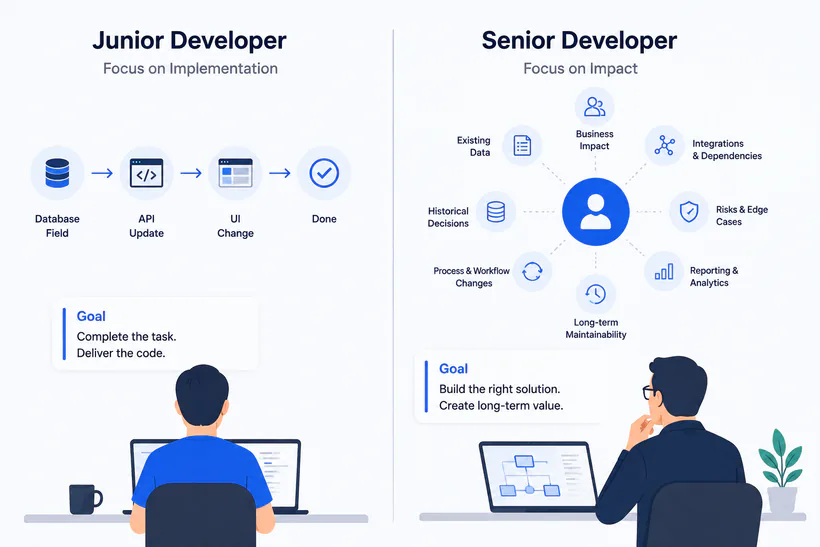
Consider a seemingly simple requirement: add a new status field to a customer record. At the implementation level, the change might appear straightforward. A developer could add a database field, update an API, modify the user interface, write the necessary tests, and release the feature.
An experienced developer may approach the same request by first examining the assumptions behind it. Is the new status actually a new piece of data, or does it represent a new business process? Is similar information already stored elsewhere? Which integrations consume customer data? Will historical records require migration? Does the change affect reporting, permissions, or automation? What happens when a customer moves from one status to another, and are external systems expecting the existing data model?
The eventual implementation might still be simple, but the difference is that the developer has explored the consequences before committing the organization to a particular solution. This matters because software engineering is full of decisions whose costs are asymmetric. Asking another question during design may take minutes, while discovering six months later that the underlying data model was wrong can require weeks of remediation.
A developer who produces less code but prevents the wrong architecture can therefore create substantially more value than one who implements the original requirement quickly. Some of the most valuable engineering work is not visible in the amount of software produced; it appears in the unnecessary work, complexity, and risk that never have to be created in the first place.
Seniority Is Increasingly About Decision Quality
Programming knowledge still matters. Senior developers are generally expected to have deeper technical expertise, stronger debugging skills, and broader familiarity with engineering tools and patterns. But technical knowledge alone does not explain seniority, because modern software development rarely presents engineers with problems that have one objectively correct solution.
Instead, teams continuously make trade-offs. A piece of functionality could become a separate service or remain within an existing application. An abstraction could be introduced immediately or postponed until additional use cases justify it. Technical debt could be addressed now or intentionally accepted in exchange for faster delivery. A legacy component could be replaced, incrementally modernized, or left alone. Each option may be technically defensible, but the appropriate decision depends on the architecture, team, product maturity, operational environment, budget, expected growth, and business priorities.
This is one of the important ways engineering judgment develops with experience. Less-experienced engineers may naturally focus on finding a technically good solution, while experienced engineers increasingly learn to ask whether that solution is appropriate for this particular system, team, and business. The most technically sophisticated architecture is not necessarily the best architecture, just as the newest technology is not necessarily the right technology.
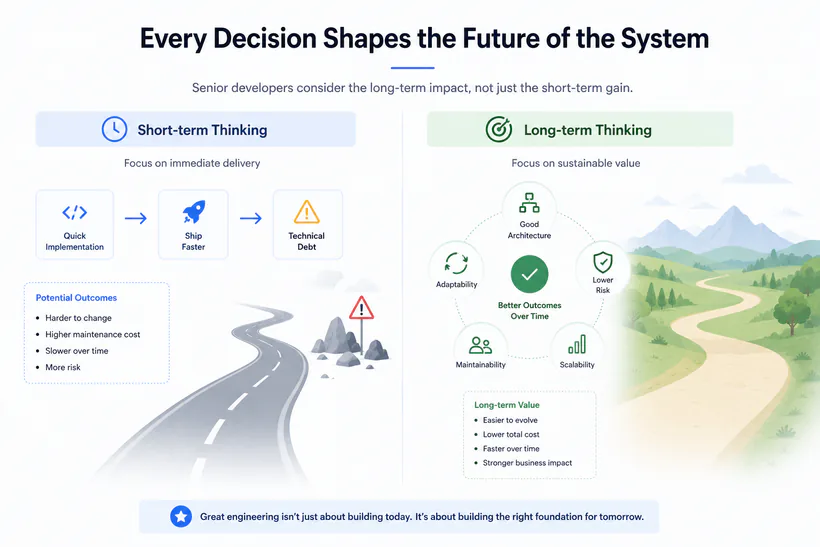
Decision quality becomes especially important because engineering decisions accumulate. One unnecessary abstraction may have little impact. Hundreds of unnecessary abstractions can make a system difficult to understand. One tightly coupled integration may be manageable. A decade of integrations designed without clear boundaries can make every future change expensive. Senior engineering judgment is valuable partly because it considers not only whether something works today, but what today's decision is likely to make easier or harder tomorrow.
Experience Changes How Engineers See Risk
Many software problems are inexpensive when they first appear. An API designed for one integration may work perfectly until twenty external systems depend on it. A shortcut in a database model may create little friction with ten thousand records but become extremely difficult to migrate with hundreds of millions. A tightly coupled component may accelerate an early release while making every subsequent change more complicated.
None of these decisions necessarily look unreasonable when they are made. The difficulty is recognizing which compromises are genuinely temporary and which ones are quietly creating long-term constraints. Experienced developers have usually seen more of those consequences. They have participated in migrations triggered by earlier architectural assumptions, investigated production incidents caused by edge cases nobody originally considered, and worked with technical debt that began as a reasonable shortcut but was allowed to accumulate for too long.
Over time, those experiences create pattern recognition. The technologies may change, but many of the underlying engineering problems do not. An experienced developer may recognize the early signs of excessive coupling even in an unfamiliar technology stack, notice when requirements contain contradictory assumptions, or identify when a temporary workaround is likely to become permanent architecture.
This does not mean senior developers can predict the future or that their decisions are always correct. Experience can create its own biases, and assumptions based on previous systems do not always transfer cleanly to new ones. The more useful advantage is often knowing where uncertainty exists and which questions need to be answered before a responsible decision can be made.
That ability has significant economic value because it allows teams to recognize expensive problems while those problems are still relatively cheap to address. Preventing a poor architectural decision rarely appears in a productivity dashboard: there is no incident to count because the incident never happened, and no six-month migration because the problematic design was avoided. The absence of a problem is difficult to measure, but it can still represent some of the highest-value work performed by an engineering team.
Context Becomes Part of Engineering Expertise
There is another dimension of seniority that becomes particularly important in long-term software development: accumulated context.
Imagine two highly capable developers. The first has fifteen years of Java experience but has just joined a mature enterprise application. The second has ten years of Java experience and has spent the last six years working on that particular system. For purely language-specific questions, the first developer may have deeper expertise. For many decisions affecting the actual software, however, the second may possess knowledge that is considerably more difficult to replace.
That developer may understand why a particular module was designed in an unusual way, remember the customer requirement that led to an architectural compromise four years earlier, know which apparently obsolete interfaces are still used by external systems, and understand the operational consequences of changing a critical workflow. They may also remember approaches the team has already tried, why those approaches failed, and which constraints are likely to appear again.
None of this knowledge appears on a technology skills matrix, yet it directly affects the team's ability to change software safely. Documentation, architecture diagrams, clear code, and systematic knowledge sharing can reduce dependency on individuals and should always be encouraged, but complex software inevitably contains knowledge distributed across code, documents, conversations, historical decisions, operational experience, and people's understanding of the business.
This is why replacing an experienced developer is rarely equivalent to exchanging one unit of engineering capacity for another. Technical skills can often be replaced relatively quickly; accumulated context has to be rebuilt. In long-term software development, seniority is therefore not only accumulated technical experience. It can also become accumulated knowledge of a particular system and the business it exists to support.
Senior Developers Create Leverage Beyond Their Own Work
Individual output creates another misleading way of evaluating experienced engineers. Suppose two developers are measured by the number of features they personally deliver during a quarter. One completes substantially more implementation work, while the other spends significant time reviewing architecture, helping teammates debug difficult problems, improving development standards, mentoring less-experienced engineers, documenting critical systems, and identifying risks before implementation begins.
If productivity is measured exclusively through individual output, the first developer appears more productive. If the performance of the engineering team is considered, the picture may be very different.
Strong senior developers create leverage. A thoughtful code review can prevent a defect while teaching another developer a better approach. A clear architectural pattern can improve dozens of future implementations. Better documentation can reduce onboarding time for every engineer who joins later. A senior developer who helps several engineers make better technical decisions may have greater organizational impact than one who simply completes more tickets.
This is why lines of code, commits, pull requests, story points, or completed tasks can describe engineering activity without fully describing engineering value. Senior developers often contribute to the system through which other developers work. Their individual visible output may even decrease as more of their time is spent enabling the team, yet the overall engineering organization becomes more capable because they are there.
The strongest senior developers therefore do more than increase their own productivity. They increase the productivity and decision-making capacity of the engineering system around them.
Engineering Maturity Also Means Knowing What Not to Build
Technology naturally rewards creation. New architectures are interesting, new frameworks are exciting, and rebuilding an old system can feel more satisfying than understanding the accumulated constraints that made it complicated in the first place. Experienced engineers have usually learned that every new technical capability also creates something that must be operated, understood, tested, secured, upgraded, and eventually changed.
As a result, restraint becomes an important part of engineering maturity. The existing architecture may be sufficient. An additional microservice may introduce more operational complexity than business value. A proposed abstraction may solve a problem the organization does not actually have. A legacy component may be unattractive but stable, well understood, and inexpensive to operate. In other cases, the feature itself may be simplified enough that much of the proposed engineering work is no longer necessary.
A senior engineer could spend several days investigating a modernization proposal and ultimately recommend leaving the existing system unchanged. Measured by code output, almost nothing happened. Measured by business impact, the organization may have avoided months of unnecessary development and years of additional maintenance.
This is an important distinction because engineering maturity should not be demonstrated by how much complexity a developer is capable of building. It should also be visible in how much unnecessary complexity they can prevent. The ability to say "we don't need this yet" can sometimes require more confidence and experience than proposing another technical solution.
What Senior Engineering Talent Actually Looks Like
If seniority is primarily about more than coding speed, companies also need to think differently about how they evaluate engineering talent. Years of experience remain useful information, technical depth matters, and familiarity with the relevant technology stack can reduce onboarding time. None of these characteristics, however, demonstrates engineering maturity on its own.
A stronger indicator is how an engineer reasons when the answer is uncertain. Experienced developers should be able to explain trade-offs rather than simply identify preferred technologies. They should understand how a local implementation can affect a larger system, connect technical decisions with operational and business consequences, recognize risk without automatically overengineering against every possibility, and communicate complex technical issues clearly enough that other people can make informed decisions.
Ownership matters as well. Completing an assigned ticket and taking responsibility for the outcome are not the same thing. A mature engineer considers whether the requirement makes sense, whether the implementation introduces unexpected consequences, whether the solution can be maintained, and whether the result actually improves the system. This does not mean challenging every requirement or turning every implementation into an architectural discussion. Good judgment also includes understanding when a straightforward task should remain straightforward.
Perhaps most importantly, strong senior developers try to understand the environment surrounding a problem before proposing a solution. Technical expertise tells an engineer what is possible. Context and judgment help determine what is appropriate.
Why This Matters for Long-Term Software Teams
These characteristics have particular importance for software expected to operate and evolve over many years. When organizations need more engineering capacity, the immediate question is often how quickly additional developers can be added. Headcount is visible and easy to measure, so increasing the number of people assigned to a system appears to be a direct way to increase delivery capacity.
For mature systems, however, another question is equally important: how much engineering knowledge can the team accumulate and retain?
A developer who remains with a system for several years does not simply repeat the same contribution each year. In an environment that encourages ownership and learning, their understanding deepens. They know more of the architecture, recognize more business rules, understand how customers actually use the software, remember previous technical decisions, become familiar with recurring operational risks, and develop stronger working relationships with the people responsible for the product.
This creates a form of compounding engineering value. The developer becomes valuable not only because of what they knew when they joined, but because of everything they have learned since. A stable team can therefore develop capabilities that cannot be recreated simply by assembling another group of developers with equivalent technology skills.
This principle is closely connected to Shinetech's developer-centric approach to long-term software development. The value of stable engineering teams is not simply that continuity reduces replacement and onboarding effort. More importantly, continuity gives developers the opportunity to accumulate technical and business context around the software they support. When experienced developers remain close to a system, knowledge can deepen rather than repeatedly being reconstructed, and engineering decisions can benefit from a longer understanding of how the software and the business have evolved together.
For software expected to remain important for five, ten, or fifteen years, that accumulated context can become an engineering asset in its own right.
Seniority Is About Leverage, Not Speed
Senior developers may indeed write code faster. They may diagnose problems more quickly, navigate unfamiliar systems more efficiently, and require less time to understand certain technical challenges. Experience naturally creates these efficiencies, but speed is one of the least interesting ways to describe the value of senior engineering talent.
The deeper contribution appears in decision quality and leverage. Experienced engineers can recognize risks before they become expensive, distinguish useful complexity from unnecessary complexity, connect technical decisions to business consequences, preserve context, and improve the effectiveness of the developers around them. Some of their most valuable contributions may appear as things that never happen: a flawed architecture that was never introduced, a migration that never became necessary, a production problem that was prevented, or months of development that were avoided because the team recognized a simpler solution.
These outcomes are difficult to capture through conventional productivity metrics precisely because good engineering often removes work rather than creates more of it. Measuring senior developers primarily by implementation speed therefore overlooks much of what experience contributes to a software organization.
The best senior developers do not merely help organizations build software faster. They help organizations make better engineering decisions over the lifetime of the software.