4 data types
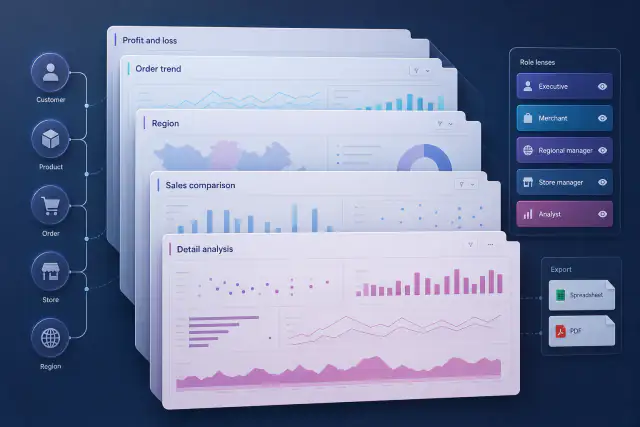
Orders, listed products, inventory, and refunds were connected in the first phase.


E-commerce & Retail · Marketplace data integration
A consumer-brand group built and integration-tested a marketplace data pipeline, connecting order and product mappings with incremental synchronization, retries, and traceable logs for business reporting.
The business context
A consumer-brand group sold through several digital channels and needed a consistent view of its marketplace business. Its central reporting team depended on orders, sales amounts, inventory, and related activity from systems that used different identifiers and field definitions.
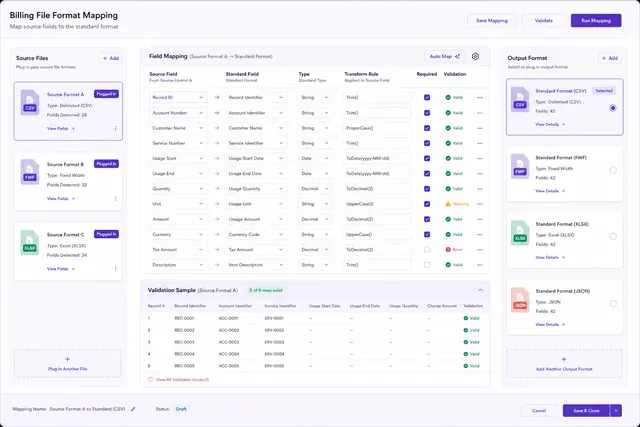
The useful unit of work was more than a downloaded order. A bundle could contain several products; a gift item could appear alongside a paid item; a refund could change the meaning of an earlier sale. Those distinctions needed to survive the journey from the marketplace API to the data environment intended for Tableau reporting.
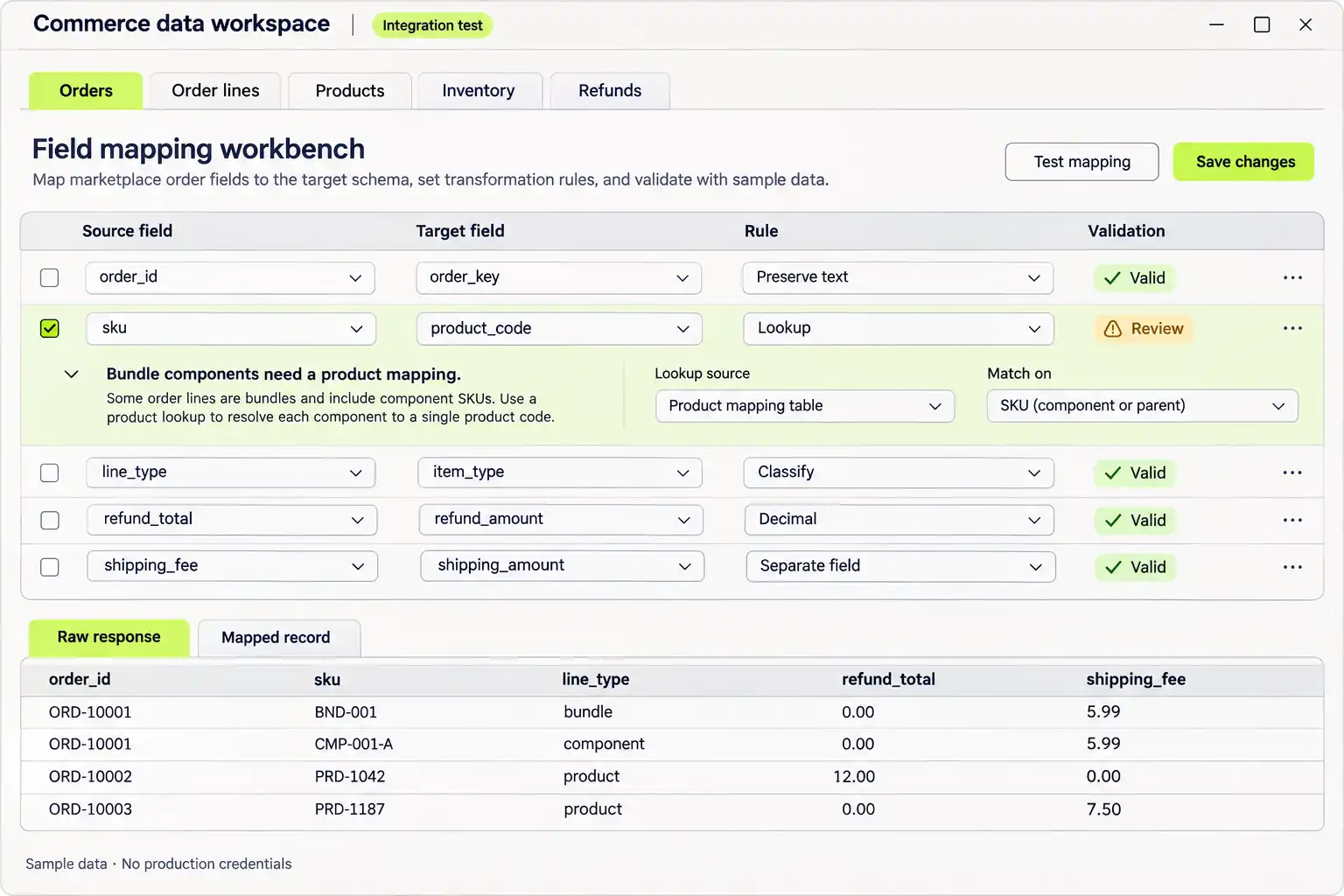
Illustrative field-mapping view using fictional records. It explains the source-to-target decisions in the project; the exact interface and sample values are reconstructed. View full-size interface (new tab)
The operating challenge
The first constraint was access. The team checked application authorization, permission packages, and the fields each API actually returned. In the interface reviewed for this project, ordinary order queries covered only the preceding three months. Older history could not simply be requested through the same path.
The second constraint was interpretation: marketplace product and SKU identifiers had to connect to the group's product codes, while bundles, gifts, refunds, coupons, and shipping charges retained their business meaning. The third was continuity. Rate limits and failed requests had to be handled without silently duplicating records or leaving gaps.
The delivery decisions
The initial plan covered several channels. The team narrowed the first phase to the marketplace with the most mature account and API access. That gave the team a real source against which to validate fields, relationships, and incremental processing before expanding coverage.
Parent orders, order lines, refunds, synchronization cursors, and logs were modeled separately. The team designed keys, relationships, indexes, and duplicate checks, then connected orders, listed products, inventory, and refund endpoints to the synchronization service.
Retry, error compensation, and missing-order checks were exercised in the integration environment. Order and inventory views, acquisition monitoring, task lists, and logs gave the team a way to inspect the data path as well as demonstrate the screens.
The working detail
The team classified requested fields as directly available, requiring a relationship, or still awaiting confirmation. This kept an apparently simple reporting requirement from becoming an assumption about what the source API could provide.
The resulting ETL work connected source access, field mapping, database storage, and operational inspection. Incremental cursors addressed the ongoing collection window; they did not create access to unavailable historical records. Customer-supplied sample data and business rules guided the mapping discussions.
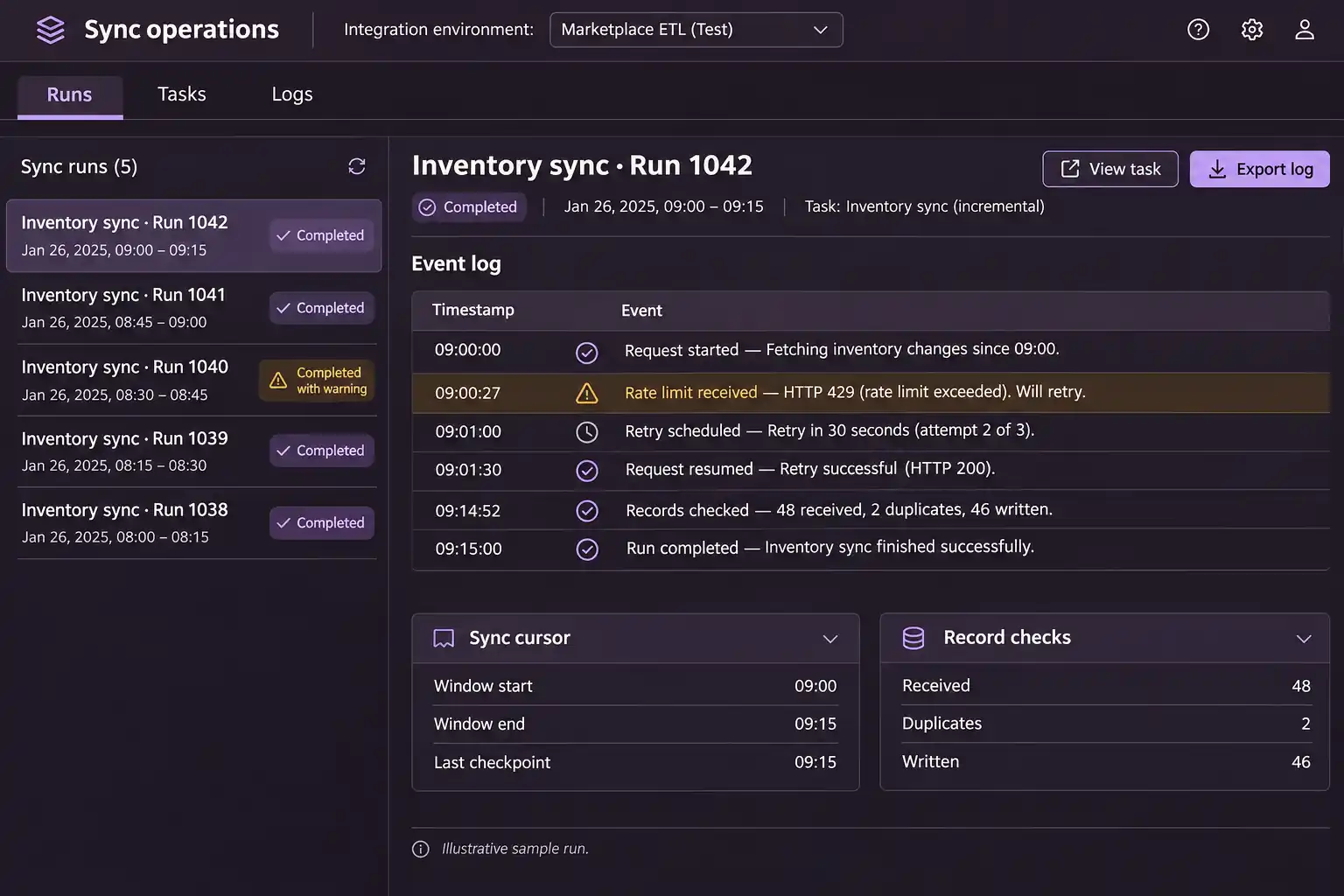
Conceptual synchronization log with fictional timestamps, counts, and retry events. The project tested rate-limit handling and compensation; these sample values are not production measurements. View full-size interface (new tab)
The delivered result
Orders, listed products, inventory, and refunds were connected in the first phase.
Order and inventory views, acquisition monitoring, tasks, and logs completed frontend/backend integration.
The team validated retries, compensation, and missing-order handling in an integration environment.
Delivery status: frontend pages were deployed to a test server and synchronization scripts were validated in integration. Production rollout, additional channels, and measured business improvements are not established by the project record.
Case taxonomy
Discuss your project
Tell us how your business works and where your software needs to change.
Get in touch
Tell us what you need to build, modernize, automate, or augment with AI. We can start with a focused discussion or a no-risk 1-week trial.

“A fantastic company to work with.” After the initial rapid development project, American Shipping Co. kept two Shinetech developers embedded for nearly four years, supporting internal and external tools and new AI initiatives.
 CEO, American Shipping Co. - 5-star Google Review