Tested placement
Site trials informed the sensor positions and installation guidance.


E-commerce & Retail · In-store connected devices
A connected-device project improved motion-triggered store announcements by testing sensor placement, wireless event delivery, and playback together in real entrance conditions.
The business context
The product used motion sensing to trigger spoken messages or advertising audio in stores. For a shop, the useful result was simple: a person passing the entrance should trigger the intended announcement. Behind that interaction were a sensor, a wireless connection, a main device, and the installation itself.
Glass and metal doors, curtains, air curtains, and the available wireless coverage varied between sites. An arrangement that worked in one position could miss a trigger or fail to deliver it reliably in another.
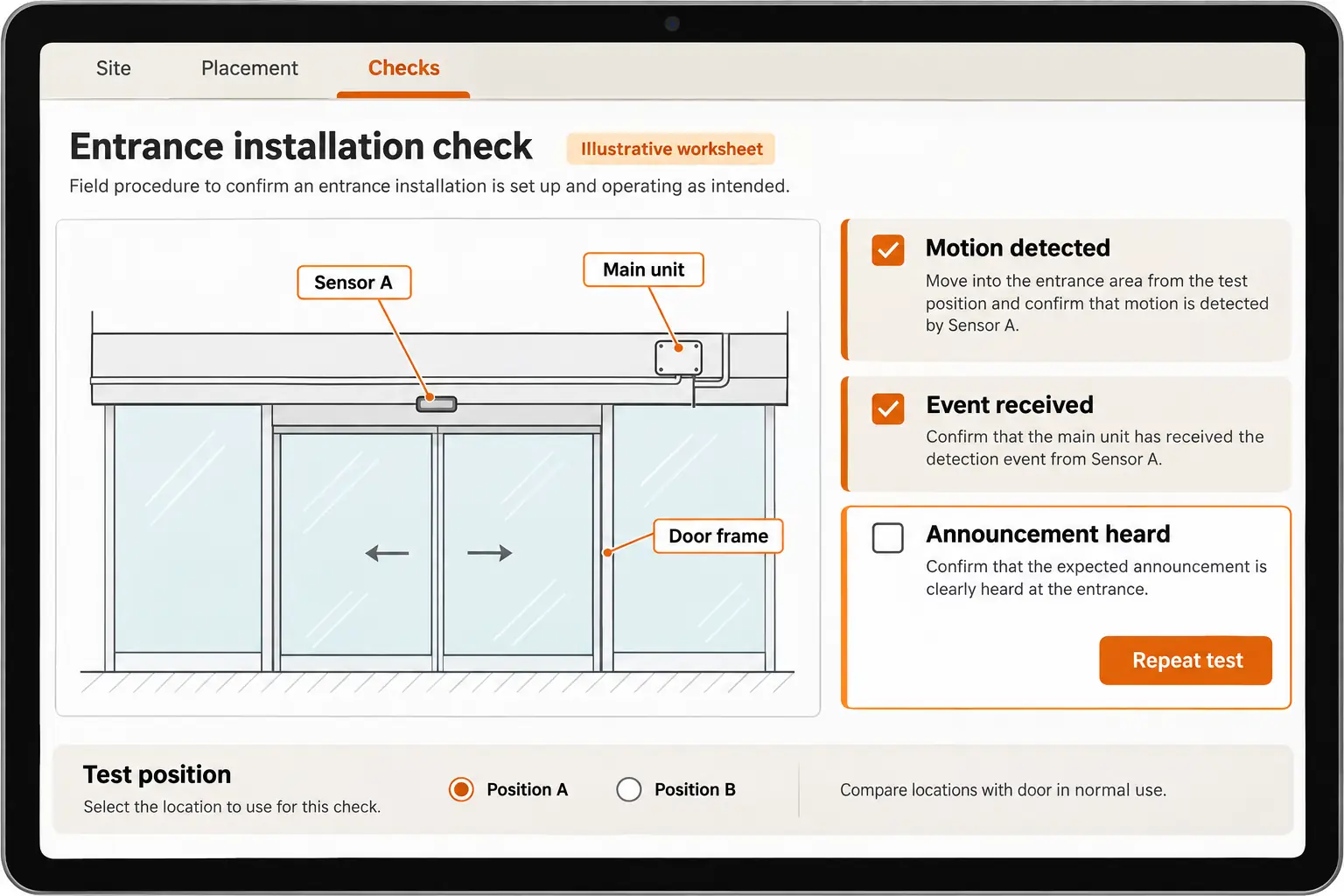
An explanatory installation worksheet with a fictional entrance. It visualizes the field-validation method and is not presented as a separately delivered diagnostic application. View full-size interface (new tab)
The operating challenge
The team needed to distinguish sensing behavior from the connection between the sensor and the main unit. Obstructions could affect Bluetooth event delivery, while weak store Wi-Fi also complicated connectivity and remote management.
That made a repeatable installation method part of the product work. A generic instruction to place the device near the door would not account for the different entrance structures encountered in the field.
The delivery decisions
The team tried different placements at typical stores and refined installation guidance around the observed behavior. The entrance configuration became a condition to validate rather than a fixed assumption.
Sensor selection was revisited for the more difficult store conditions. Field testing considered whether motion was detected, whether the event reached the main unit, and whether the announcement followed.
The main device retained an option for later cellular connectivity. The documented work focused on placement, sensor suitability, and observed operation; the reserved capability was not treated as an already deployed cellular service.
The working detail
Testing only the sensor would leave the rest of the path unverified. The project evaluated the sequence from a person passing the entrance to an event being transmitted and audio being played, using repeated site trials to refine the setup.
This approach also made the findings useful to installers and store staff. The outcome included a repeatable installation method, rather than requiring each new location to rediscover the same placement and connection issues.
The delivered result
Site trials informed the sensor positions and installation guidance.
The team verified sensing, transmission, and playback together in representative conditions.
The project report describes more stable triggering and easier installation and adjustment for deployment partners and store staff.
The work continued with a second phase under consideration. The source does not establish a rollout count or measured detection rate; cellular connectivity remained a future option.
Case taxonomy
Discuss your project
Tell us how your business works and where your software needs to change.
Get in touch
Tell us what you need to build, modernize, automate, or augment with AI. We can start with a focused discussion or a no-risk 1-week trial.

“A fantastic company to work with.” After the initial rapid development project, American Shipping Co. kept two Shinetech developers embedded for nearly four years, supporting internal and external tools and new AI initiatives.
 CEO, American Shipping Co. - 5-star Google Review