Native applications
Both iOS and Android supported connection, equipment controls, alignment, and device status.


Construction & Field Services · Equipment control
Native iOS and Android applications connected equipment readings with on-site controls, while targeted BLE maintenance addressed the gap between a connected device and a responsive one.
The business context
At the worksite, a phone can be part of the equipment’s operating interface. The client’s application showed angle, direction, battery, and signal information while letting an operator adjust sensitivity, brightness, operating mode, zero position, and direction.
The useful experience was the full loop: connect to the equipment, read its state, make an adjustment, and see the resulting feedback. Shinetech developed native iOS and Android applications around that loop and continued to support them after the main delivery.
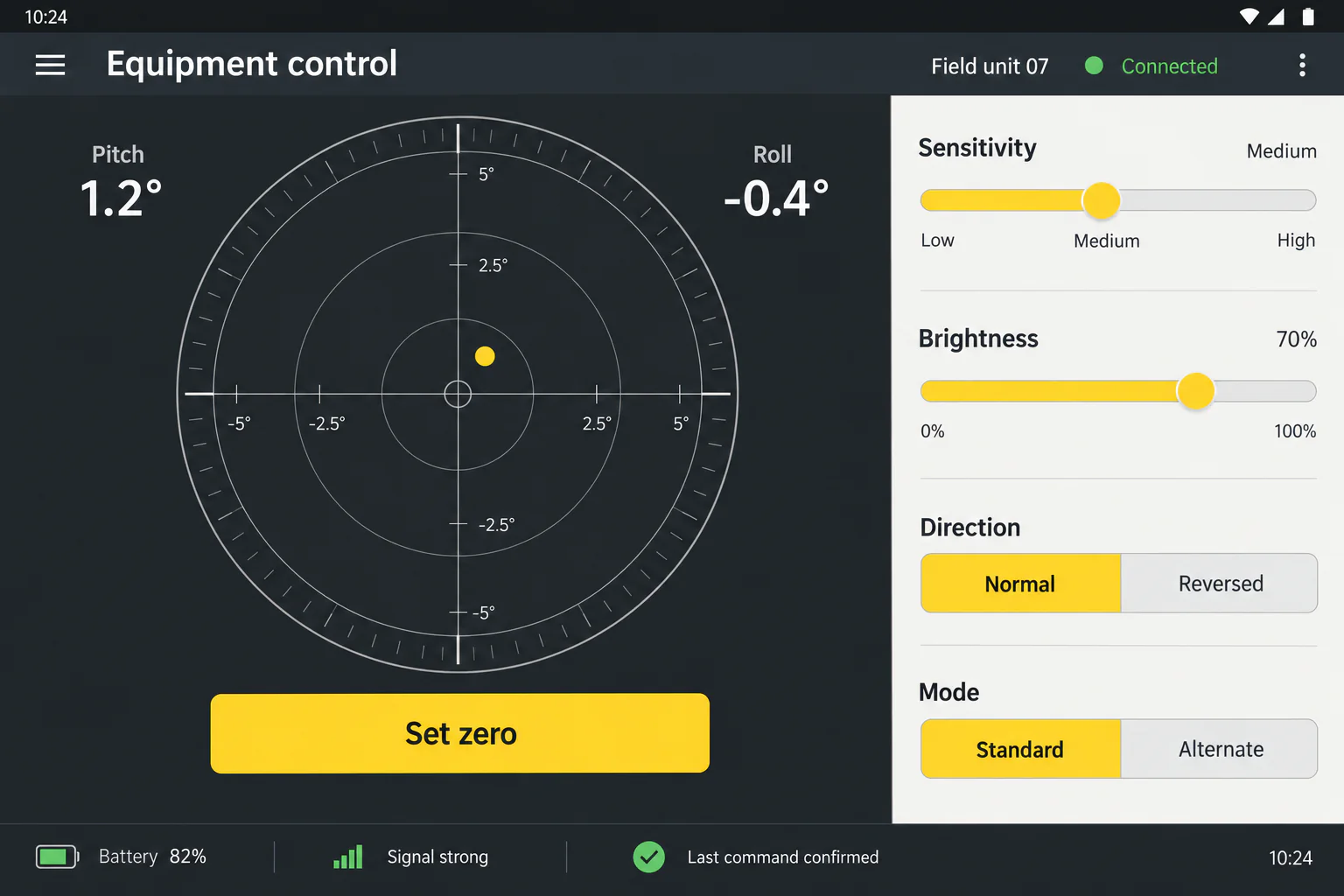
An illustrative equipment-control screen combines readings and operator actions. Device names, measurements, and interface details are fictional and do not reproduce the client’s hardware protocol. View full-size interface (new tab)
The operating challenge
An established Bluetooth connection could still leave a command without a useful result. Notification setup, the order of writes, connection state, firmware behavior, and weak signals all affected the exchange. From the operator’s perspective, those different failures could look like the same unresponsive control.
The two mobile platforms also had to interpret the same equipment consistently. A sensitivity setting, zero command, or direction flip needed the same meaning on either phone. Even when data arrived correctly, coordinate conversion and display state could change how the operator understood alignment.
The delivery decisions
Swift and CoreBluetooth on iOS, and Kotlin with Bluetooth GATT on Android, supported device scanning, connection, characteristic subscriptions, and command exchange. The application logic followed the actual equipment controls rather than a generic remote-control screen.
Android maintenance separated connection state, notification configuration, queued writes, timeouts, retries, and device responses. Debug states and exception monitoring helped the team locate intermittent failures within the exchange instead of treating every problem as a dropped connection.
The applications translated angle and direction data into alignment feedback alongside battery and signal status. Zeroing, direction changes, and sensitivity settings were handled in the same operating context so that controls and the displayed state could be checked together.
How the workflow holds together
The maintenance work focused on the stages between a tap and the equipment’s response: whether notifications were configured, a command had reached the write queue, a response arrived, or a timeout required recovery. Reconnection prompts made interrupted operation visible to the user.
Keeping this information at distinct stages helped investigate a difficult symptom: a phone that still appeared connected while commands stopped responding. The applications also provided instructions, troubleshooting, and support entry points, recognizing that equipment operation continues outside a developer’s controlled test environment.
The delivered result
Both iOS and Android supported connection, equipment controls, alignment, and device status.
The maintenance approach exposed separate BLE states for investigating intermittent command failures.
The delivered applications remained in use, with further work on stability as field issues emerged.
The main mobile applications were delivered and remain in use, with periodic maintenance focused on equipment interaction, feedback, and BLE stability.
Case taxonomy
Discuss your project
Tell us how your business works and where your software needs to change.
Get in touch
Tell us what you need to build, modernize, automate, or augment with AI. We can start with a focused discussion or a no-risk 1-week trial.

“A fantastic company to work with.” After the initial rapid development project, American Shipping Co. kept two Shinetech developers embedded for nearly four years, supporting internal and external tools and new AI initiatives.
 CEO, American Shipping Co. - 5-star Google Review