Capture live machine data
Receive large volumes of GPS activity and translate them into reliable location and progress information.


NuPoint customer story · Agriculture IoT
NuPoint partnered with Shinetech to turn an IoT hardware prototype into a field-ready platform for machinery tracking, cultivated-area mapping, weather monitoring, and operational reporting.
About NuPoint
NuPoint brought the IoT hardware concept and agricultural context. Shinetech extended the software capacity needed to connect the devices, cloud services, maps, and customer-facing web experience.
The situation
Farm work spans large areas, moving machines, changing weather, and intermittent connectivity. NuPoint wanted one intelligent system that could bring those touchpoints together.
The product needed to monitor weather, capture real-time equipment data, distinguish cultivated from uncultivated land, and present useful reports and benchmarks to the provider and its farm customers.
The challenge
The software had to connect NuPoint’s hardware prototype with cloud processing and practical web tools that worked for both NuPoint and farm operators.
Receive large volumes of GPS activity and translate them into reliable location and progress information.
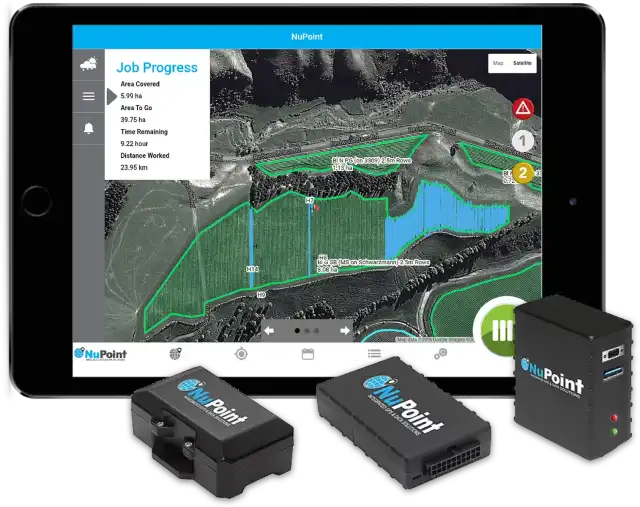
Use mapping tools to show boundaries, machinery routes, completed work, and the remaining cultivated area.
Validate the integrated hardware and software in machine cabs and across fields where network conditions could be poor.
The solution
Shinetech’s four-person team handled software development and hardware integration, turning data collection, processing, mapping, and reporting into one working flow.
Connect NuPoint devices and cultivation machinery so field activity could be captured and tracked.
Use AWS-based services with PHP and Node.js to receive, process, and organize incoming operational data.
Give NuPoint and its customers a detailed interface for maps, weather, equipment, reporting, and benchmarking.
How we worked
Two-week iterations gave NuPoint regular working software to evaluate, keeping product decisions close to customer feedback.
Shinetech engineers accompanied machine operators, observed the hardware in use, and tested the integrated experience under poor network connectivity. Follow-up visits helped the team retest components in the field.
Daily updates, direct messaging, project tools, and weekly video calls made progress visible and helped both sides coordinate feedback and resources.
Deliver a working increment.
Collect direct NuPoint feedback.
Test with field operators.
Resolve issues in the next increment.
The result
The team delivered a usable product in three months. The resulting platform supported distributed farms, connected machines, and substantial data processing.
Equipment tracking, field mapping, weather information, reporting, and benchmarking came together in one web experience.
The team integrated NuPoint’s custom-built devices into the wider cloud and web platform.
Short iterations and field testing turned client and operator observations into product improvements.
Case taxonomy
Bring the moving parts together
Get in touch
Tell us what you need to build, modernize, automate, or augment with AI. We can start with a focused discussion or a no-risk 1-week trial.

“A fantastic company to work with.” After the initial rapid development project, American Shipping Co. kept two Shinetech developers embedded for nearly four years, supporting internal and external tools and new AI initiatives.
 CEO, American Shipping Co. - 5-star Google Review