Domain learning
The engineering team needed to understand aquaculture operations and the devices used in the field.


Aquaculture IoT case study
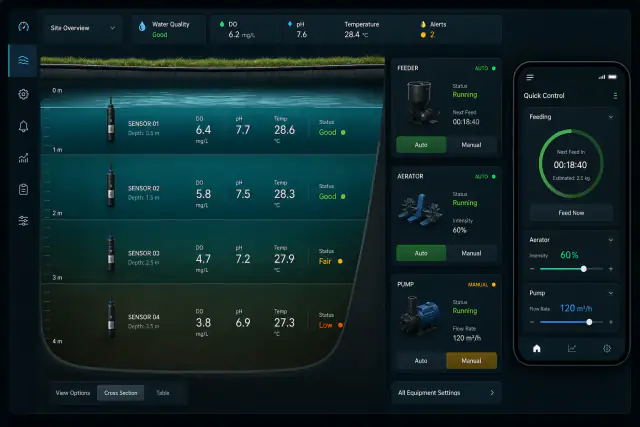
A system integrator and hardware partner needed software that could turn pond sensor data into mobile monitoring and direct control of feeding, aeration, and pumping equipment.
The situation
The product had to receive water-quality information from connected sensors and present it in a form that operators could review remotely.
It also needed to connect that information with feeders, aerators, and pumps so users could adjust or automate equipment behavior from a mobile interface.
The challenge
Software, sensors, and control hardware had to be understood together while the team separated essential functions from longer-term ideas.
The engineering team needed to understand aquaculture operations and the devices used in the field.
Sensor readings and equipment commands crossed software and physical interfaces.
The first release had to focus on monitoring and control without absorbing every future product idea.
The solution
Domain immersion and joint work with hardware specialists informed prototypes, priorities, and the integrated product design.
Work with domain and hardware specialists to map sensors, devices, and operator actions.
Validate how readings, status, manual commands, and automatic modes should appear.
Connect mobile monitoring with feeder, aerator, and pump control on the server and device stack.
How the work was structured
The team combined software and hardware knowledge rather than treating device integration as a final connector.
Prototypes gave stakeholders a concrete way to review controls and refine priorities before the full MVP was implemented.
The documented release focused on water-quality monitoring and equipment operation; broader inventory, warning, patrol, market, and financial ideas remained outside the delivered claim.
Learn the operating and hardware environment.
Validate readings and control interactions.
Integrate sensors, server, mobile, and equipment.
Monitor conditions and adjust device behavior.
The result
The documented system linked sensor information with mobile access and operating controls for feeders, aerators, and pumps, including automatic behavior.
Water-quality information and equipment controls appeared within the same product context.
Users could review conditions and adjust relevant equipment remotely.
Planned inventory, warning, patrol, market, and financial functions were not presented as delivered outcomes.
Case taxonomy
Connect field data with real action
Get in touch
Tell us what you need to build, modernize, automate, or augment with AI. We can start with a focused discussion or a no-risk 1-week trial.

“A fantastic company to work with.” After the initial rapid development project, American Shipping Co. kept two Shinetech developers embedded for nearly four years, supporting internal and external tools and new AI initiatives.
 CEO, American Shipping Co. - 5-star Google Review