Field-to-cloud path
Water-system observations were uploaded through an app and SMS-supported route.


Energy & Utilities · Remote water monitoring
A water-technology provider connected remote equipment readings to a cloud platform through Android relay applications and SMS, addressing sites without dependable mobile data access.
The business context
A water-technology provider supplied equipment and monitoring systems for remote communities. The people responsible for operating those installations needed access to site readings, but dependable high-speed data connectivity could not be assumed. The previous monitoring platform also suffered from inaccurate updates.
Shinetech helped rebuild the connection between field equipment, mobile relay applications, and a web platform. The objective was practical: make water-system observations available remotely using the communication options that the site could support, including SMS where a mobile data connection was unavailable.
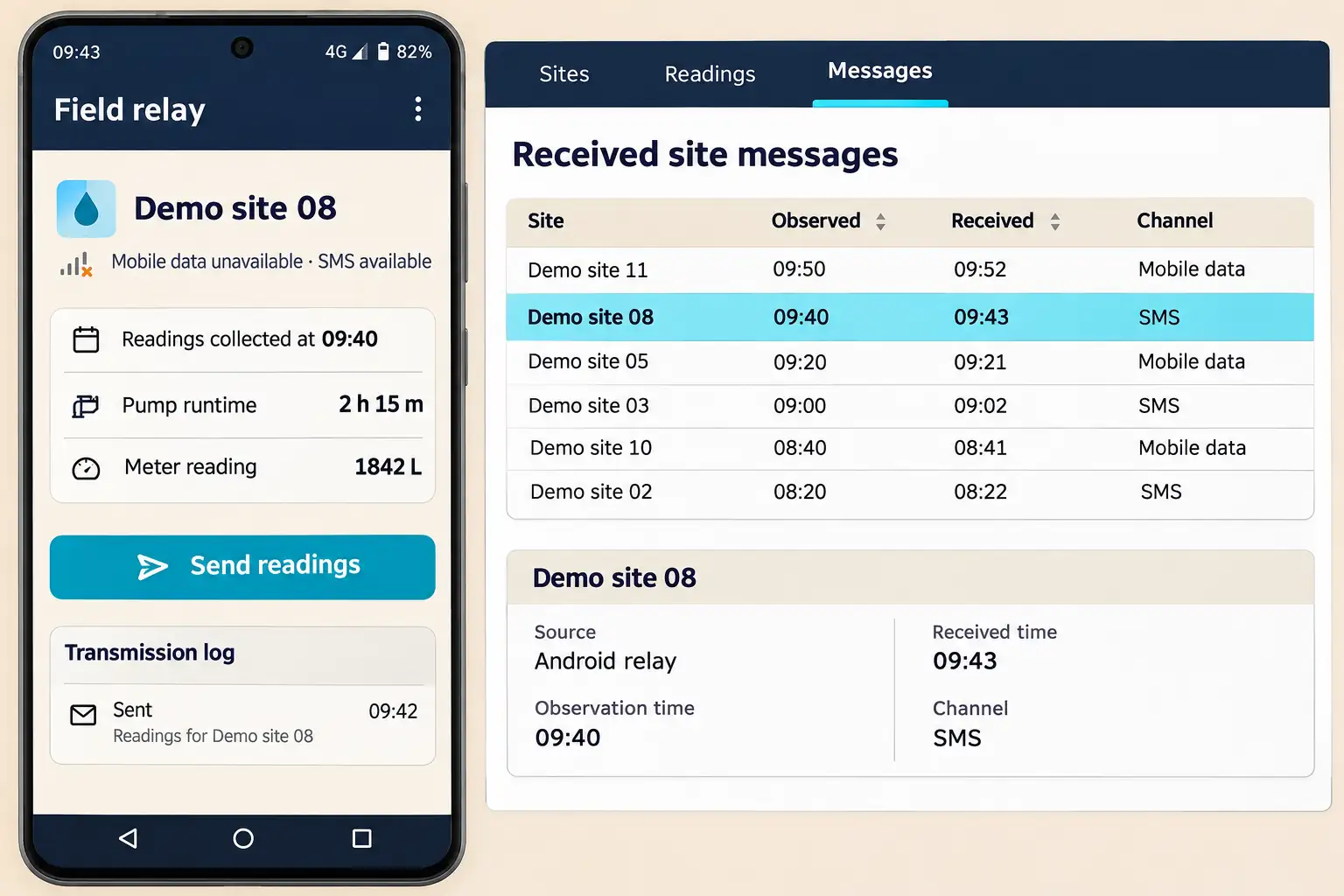
Synthetic site codes, readings, and receipt times illustrate the relay workflow. These are concept screens, not actual infrastructure locations or water-safety results. View full-size interface (new tab)
The operating challenge
SMS introduced a much tighter capacity limit than a conventional data connection. The project encountered lost data when larger amounts of business information passed through the constrained channel. Improving the transmission approach was therefore central to making the monitoring service useful.
The work also spanned several operating roles and devices. Platform administrators, service users, and field relay equipment each needed an appropriate part of the system. Team changes added another challenge: incoming developers had to understand how those components related to the actual water-service workflow.
The delivery decisions
Relay devices and an Android application collected information from field equipment and passed it toward the platform. The web side handled receipt, storage, analysis, and alerts, connecting the field observation with a place where it could be reviewed.
The team iteratively changed the transmission approach to address data loss associated with SMS capacity. The delivery account confirms that app-assisted SMS uploads reached the web platform; it does not establish a universal delivery guarantee or a particular messaging protocol.
The system was divided into platform administration, user-facing web and app access, and device-side relay work. Core workflows came first, followed by extensions. Customer and internal discussions helped new team members connect their tasks to the business process.
The working detail
The solution combined a field application with SMS. It addressed locations where high-speed or conventional data connectivity was unsuitable, while SMS still depended on a usable cellular connection.
For an operator, a remote reading is valuable only when it can be related to a site and interpreted in the context of when it was received. The concept view makes those relationships visible with fictional timestamps and receipt states. It does not imply that a displayed water reading certifies drinking-water safety.
The delivered result
Water-system observations were uploaded through an app and SMS-supported route.
Device, user, and administration responsibilities were supported across the product.
The engagement continued through additional phases and support work.
The documented result is successful data upload under limited-connectivity conditions. No zero-loss guarantee, coverage claim, or public-health outcome is asserted.
Case taxonomy
Discuss your project
Tell us how your business works and where your software needs to change.
Get in touch
Tell us what you need to build, modernize, automate, or augment with AI. We can start with a focused discussion or a no-risk 1-week trial.

“A fantastic company to work with.” After the initial rapid development project, American Shipping Co. kept two Shinetech developers embedded for nearly four years, supporting internal and external tools and new AI initiatives.
 CEO, American Shipping Co. - 5-star Google Review