Continued ordering
The application supported order capture when the venue connection was interrupted.


Hospitality · Dining and entertainment operations
A dining and entertainment business digitized ordering, game operations, and inventory work, including the ability to keep taking orders during a connection outage.
The business context
A business combining dining with on-site entertainment handled ordering and game equipment without a connected cloud workflow. Staff mediated the process, while the equipment itself came in different models with different integration constraints.
The digital service had to fit a working venue. Customers still needed to place orders during a connection outage, and game operations and inventory work belonged to the same operating business. Shinetech began with on-site investigation of how orders and games were handled, then developed the applications around those routines.
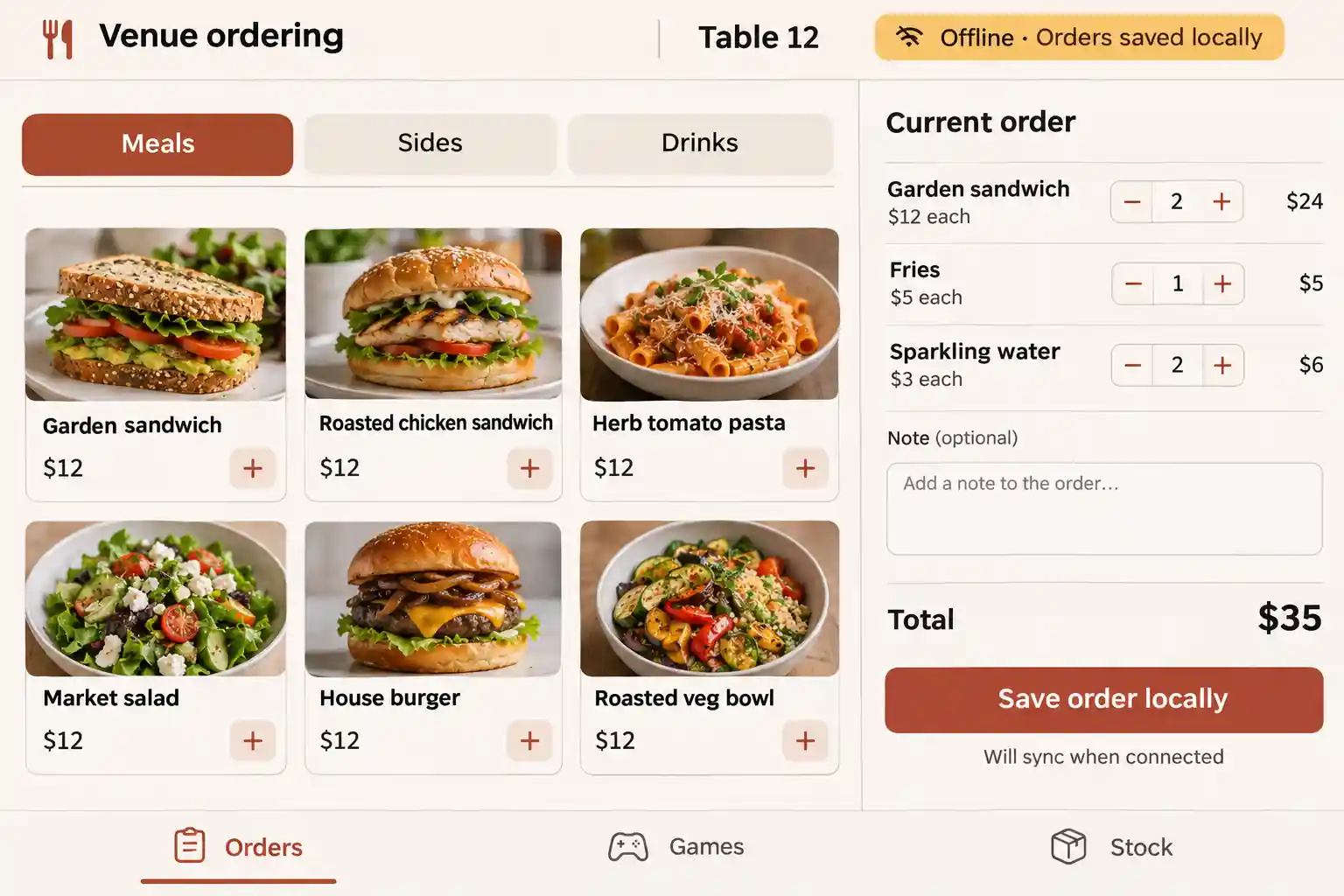
Menu items, order totals, and connection states are invented. The concept demonstrates local order capture, not an actual customer transaction or offline payment approval. View full-size interface (new tab)
The operating challenge
An order-taking system is part of active service. If a lost connection prevents the next order, the technical failure immediately changes what staff can do for the customer. The project therefore required ordering to remain available locally during outages, with synchronization connecting that work back to the wider system.
The entertainment equipment introduced a separate challenge. Different models did not share a uniform route to the cloud, and some could not connect directly. The team had to coordinate integration for the equipment in use instead of assuming one device interface would cover the whole venue.
The delivery decisions
The team investigated the ordering and game workflows on site, developed requirements, and designed the screens before implementing them. This grounded the application in the service routine and the equipment the business actually used.
Offline ordering and data synchronization were part of the delivered workflow. The local ability to take an order was considered alongside the need to bring venue activity back into the connected system.
The project digitized ordering, game operations, and purchasing, sales, and inventory processes. Web and mobile applications supported the work, while equipment integration was coordinated around the different device models.
The working detail
The venue needed an immediate way to continue taking orders. Synchronization then connected that local activity with the broader application. The documented requirement covers order capture; it does not establish offline payment authorization.
The delivery moved into a smaller maintenance arrangement after the main development phase. The project account reports less dependence on staff-mediated ordering, but does not supply a controlled staffing or productivity comparison. This case therefore describes the changed workflow without presenting a headcount reduction as a measured software outcome.
The delivered result
The application supported order capture when the venue connection was interrupted.
Games and inventory processes were included alongside ordering.
The delivered system moved from development into maintenance.
The case describes documented functional delivery. It does not claim zero lost orders, universal device compatibility, or a measured financial return.
Case taxonomy
Discuss your project
Tell us how your business works and where your software needs to change.
Get in touch
Tell us what you need to build, modernize, automate, or augment with AI. We can start with a focused discussion or a no-risk 1-week trial.

“A fantastic company to work with.” After the initial rapid development project, American Shipping Co. kept two Shinetech developers embedded for nearly four years, supporting internal and external tools and new AI initiatives.
 CEO, American Shipping Co. - 5-star Google Review