Diner discovery and booking
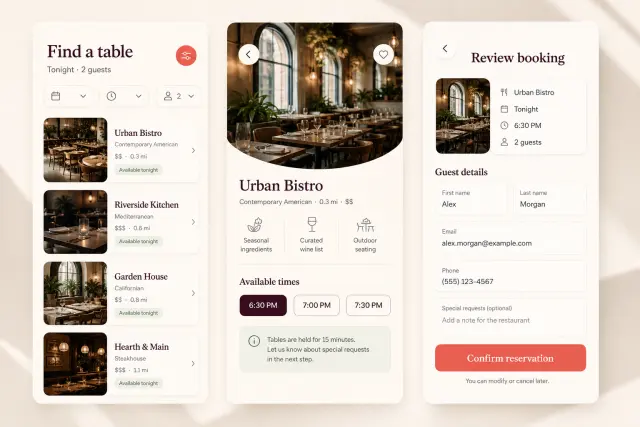
Help diners search by restaurant name, location, and available offers, then move from discovery to an available reservation.


Hospitality case study
An established restaurant reservations provider needed a delivery model that could extend its SaaS portfolio without adding management overhead. A focused initial scope grew into delivery across core product modules.
The situation
The client connected diners with restaurants and helped restaurant operators improve booking activity and marketing. Its internal team remained focused on the core platform while outside delivery began with a smaller, clearly bounded product scope.
The new SaaS products needed to support different goals without becoming disconnected: diners wanted fast discovery and reservations, booking partners needed search and analysis, and restaurant operators needed practical tools for listings, offers, campaigns, and reports.
The product challenge
The team had to translate a shared reservation domain into focused products, align with the client’s business, quality, and technical leaders, and release useful increments without losing sight of the wider platform.
Help diners search by restaurant name, location, and available offers, then move from discovery to an available reservation.
Give booking partners and agencies a focused way to search restaurants, place reservations, and analyze booking activity.
Let restaurant operators manage core information, promotions, campaigns, and reports in the same product family.
The solution
The client’s business analyst, quality leader, and technical expert worked directly with a cross-functional Shinetech team. Together, they prioritized the highest-value requirements, created shared product foundations, and built modules around clear user stories.
Review requirements as a shared backlog and begin with the stories that delivered the strongest value to each user group.
Use continuous integration, unit and smoke testing, pair programming, and rapid defect correction throughout each iteration.
Keep objectives and delivery status visible through daily coordination, knowledge sharing, and collective ownership of testing work.

How we worked
The engagement began with non-core product work so the client could evaluate technical capability, communication, and delivery quality with limited risk.
Short iterations, daily coordination, and working software gave stakeholders frequent points to review priorities and correct issues before they accumulated.
As the team established trust, its responsibility expanded into core platform modules while preserving close collaboration with the client’s internal specialists.
Begin with a bounded product scope.
Select the highest-value stories.
Build and test continuously.
Take on core modules as trust grows.
The result
The product family became available to users across Europe and gave diners, booking partners, and restaurant operators purpose-built experiences on a shared delivery foundation.
Each experience concentrated on the work its audience needed while remaining connected to the broader restaurant reservation domain.
The client extended its development capacity and reduced development costs while maintaining quality and on-schedule releases.
Consistent collaboration and delivery enabled the external team to move beyond the initial scope and contribute to core product modules.
Case taxonomy
Connect a multi-sided product
Get in touch
Tell us what you need to build, modernize, automate, or augment with AI. We can start with a focused discussion or a no-risk 1-week trial.

“A fantastic company to work with.” After the initial rapid development project, American Shipping Co. kept two Shinetech developers embedded for nearly four years, supporting internal and external tools and new AI initiatives.
 CEO, American Shipping Co. - 5-star Google Review