Calendar-based forecast
Recurring services, exceptions, and one-time costs contribute to the projected funding use.


Healthcare · Support funding
A disability-support planning product connects recurring services, changing rates, and one-time costs to a full-plan forecast, with separate scenarios for exploring alternatives.
The business context
A family planning disability support has to think beyond the next appointment. Regular services may run throughout the plan, school holidays can change the schedule, and an assessment or report may be needed before a review. Money still in the budget may already be needed for those future commitments.
The client wanted to turn that planning problem into a subscription product for participants, families, and plan managers. Their existing spreadsheet approach required people to work through recurring dates and exceptions themselves. Shinetech developed a platform that brings the participant’s funding, service calendar, and forecast into the same planning workflow.
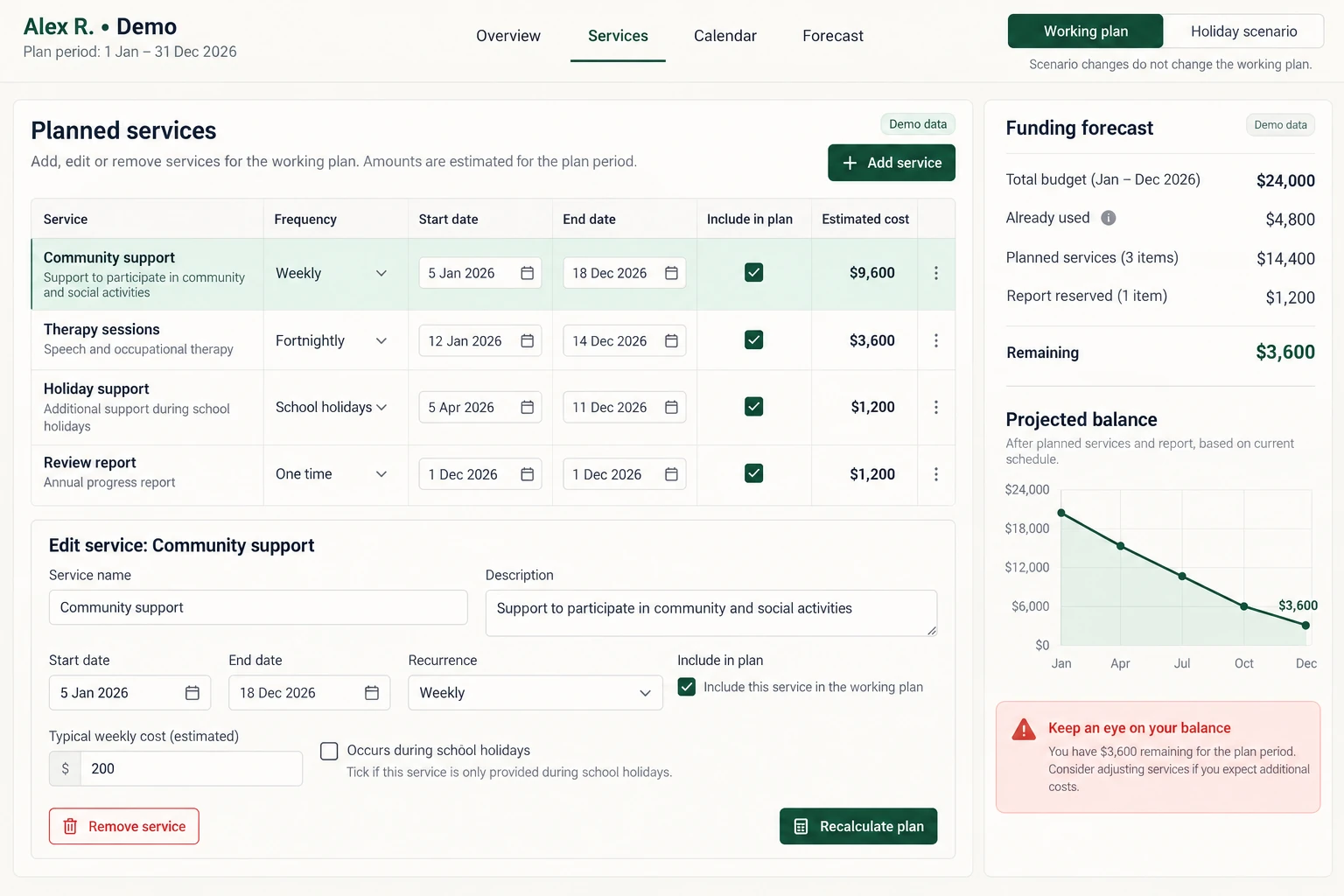
The forecast includes future services and a reserved report cost. All amounts and participant details are fictional; the image demonstrates the planning logic rather than an official funding calculation. View full-size interface (new tab)
The operating challenge
Consider a recurring service that follows the school term. Holiday sessions may follow a different pattern, a canceled appointment changes the expected cost, and a public holiday may have a different applicable rate. A one-time report also needs room in the plan. Each change alters the forecast even if the headline annual budget stays the same.
The underlying rules were held largely by the client and needed clarification during development. Rates depend on region and timing; school calendars and plan periods add another set of dependencies. Implementing a plausible assumption too early could produce a neat-looking forecast based on the wrong service rules. The team had to make those rules explicit before connecting the calculations.
The delivery decisions
The platform maintains support items, regional prices, time-based rates, public holidays, and school terms as shared information. Participant plans carry their funding categories, budget lines, and plan dates. Keeping this information separate from individual screens lets the calendar and budget use the same assumptions instead of calculating two different versions of the plan.
Service recurrence generates the appointments that drive the budget forecast. Cancellations and holiday arrangements affect that schedule, while one-time assessments and reports can be included alongside regular support. The distinction between a support item and each scheduled service makes the forecast depend on what is planned to happen, rather than a flat monthly spending assumption.
Changes to rates, residence, holiday calendars, school terms, or plan dates recalculate existing services and budget entries. A separate scenario copies the working plan so a user can explore an alternative service mix without overwriting it. That separation lets a family compare an option before deciding whether to change their actual plan.
How the workflow holds together
In the illustrative screen, a fictional $24,000 budget includes $4,800 already used, $14,400 in planned services, and $1,200 reserved for a report. The remaining $3,600 is a projection after those commitments, not simply the current bank balance. Changing the service schedule should change that answer. These sample amounts explain the workflow; they are not official rates or client results.
The product also includes participant-based subscriptions, card and invoice payment options, and administrative maintenance of rates and calendars. Those operations support the planning service, but the central decision remains with the family or plan manager: which combination of future services fits the funding and assumptions in their plan.
The delivered result
Recurring services, exceptions, and one-time costs contribute to the projected funding use.
Updated rates and calendar assumptions recalculate entries already in the plan.
Users can explore a scenario without writing its changes into the working budget.
The initial product has launched and is in early promotion. There is not yet a stable user or revenue baseline, and the forecast does not guarantee that a participant will avoid a funding shortfall.
Case taxonomy
Discuss your project
Tell us how your business works and where your software needs to change.
Get in touch
Tell us what you need to build, modernize, automate, or augment with AI. We can start with a focused discussion or a no-risk 1-week trial.

“A fantastic company to work with.” After the initial rapid development project, American Shipping Co. kept two Shinetech developers embedded for nearly four years, supporting internal and external tools and new AI initiatives.
 CEO, American Shipping Co. - 5-star Google Review