Complex allocation
Skills, availability, assignment windows, and project priorities created interdependent planning decisions.


Energy resource planning case study
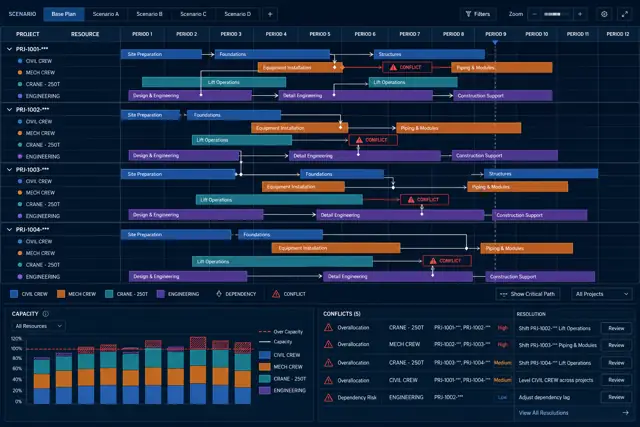
An energy organization needed one enterprise platform to plan specialist capacity, allocate people across complex projects, and replace fragmented resource data.
The situation
Complex energy work depended on coordinating thousands of specialists with different skills, availability, locations, and project commitments. Fragmented planning made conflicts and future capacity difficult to see.
The client needed an enterprise system that could support large data volumes and concurrent planning activity while migrating historical resource information safely.
The challenge
The product had to combine data scale, concurrent updates, scheduling rules, and practical planner workflows.
Skills, availability, assignment windows, and project priorities created interdependent planning decisions.
Large operational datasets and many users required efficient access and dependable updates.
Historical and active planning data had to move without breaking current staffing work.
The solution
The team modeled planning rules with domain specialists, built scalable services and SQL Server data structures, and migrated information in controlled stages.
Define specialists, skills, availability, projects, demand, allocation, and conflict behavior.
Optimize services and data access for high-volume planning and concurrent use.
Profile, map, move, and reconcile resource data before each transition step.
How we worked
Agile workshops turned planning decisions into clear product rules and testable scenarios.
The team delivered usable planning slices so stakeholders could validate allocation behavior early.
Migration rehearsals measured completeness, reconciliation, and operating readiness rather than file transfer alone.
Define capacity, demand, allocation, and conflicts.
Deliver scalable services and planner workflows.
Profile, map, move, and reconcile data.
Validate planning scenarios and operational readiness.
The result
The platform centralized resource data, made project demand and conflicts more visible, and supported large-scale planning on a maintainable .NET and SQL Server foundation.
Planners could compare demand, capacity, skills, and timing in one context.
Migration and reconciliation created a clearer operational source of truth.
Service and database work supported future growth without preserving the old fragmentation.
Case taxonomy
Make resource constraints visible
Get in touch
Tell us what you need to build, modernize, automate, or augment with AI. We can start with a focused discussion or a no-risk 1-week trial.

“A fantastic company to work with.” After the initial rapid development project, American Shipping Co. kept two Shinetech developers embedded for nearly four years, supporting internal and external tools and new AI initiatives.
 CEO, American Shipping Co. - 5-star Google Review