Manual duplication
Patient, claim, and invoice details were re-entered across spreadsheets and messages.


Healthcare operations case study
A healthcare organization needed to replace spreadsheet-based patient, claim, and invoice coordination with a secure CRM that connected staff, partners, and field work.
The situation
Teams managed patient information, claims, invoices, and partner exchanges through manual files and disconnected communication. Repeated data entry slowed work and made current status difficult to see.
The client needed a CRM that brought operational records and communication into one workflow while remaining practical for office staff, partner organizations, and mobile users.
The challenge
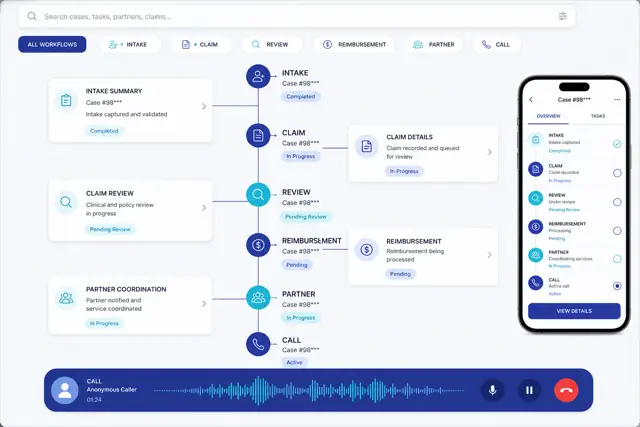
The product needed dependable data boundaries, clear status, and usable journeys across office, partner, voice, and mobile channels.
Patient, claim, and invoice details were re-entered across spreadsheets and messages.
External organizations needed reliable exchanges without losing ownership or status.
Calls and field activity had to connect back to the same operational record.
The solution
The team designed around end-to-end care journeys, then implemented services and interfaces that kept each operational step visible.
Create a shared model for patients, claims, invoices, tasks, and partner interactions.
Link partner integrations and Amazon Connect activity to the relevant CRM context.
Provide mobile workflows that let staff review and update work away from a desk.
How we worked
Product discovery followed how information moved from intake through partner work, claims, invoicing, and follow-up.
Microservices were introduced around clear business responsibilities instead of arbitrary system layers.
Regular demonstrations helped staff validate terminology, status transitions, and mobile behavior.
Trace intake, claims, invoices, calls, and handoffs.
Create shared records and service boundaries.
Integrate partners, voice activity, and mobile work.
Validate workflows with operational users.
The result
The CRM brought patient, claim, invoice, partner, call, and mobile activity into a more consistent operational journey.
Teams could see where work stood without reconciling several files.
Structured exchanges reduced ambiguity around handoffs and follow-up.
Modular cloud services provided room for additional workflows and integrations.
Case taxonomy
Connect complex care operations
Get in touch
Tell us what you need to build, modernize, automate, or augment with AI. We can start with a focused discussion or a no-risk 1-week trial.

“A fantastic company to work with.” After the initial rapid development project, American Shipping Co. kept two Shinetech developers embedded for nearly four years, supporting internal and external tools and new AI initiatives.
 CEO, American Shipping Co. - 5-star Google Review