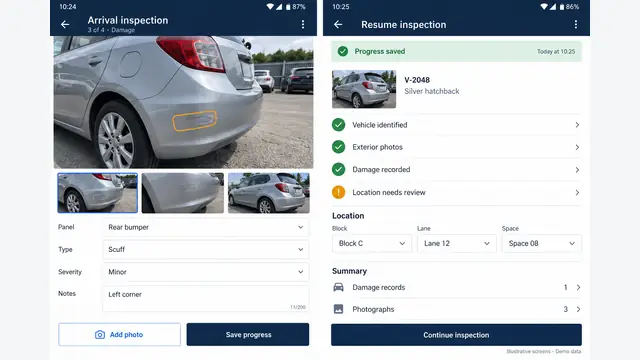
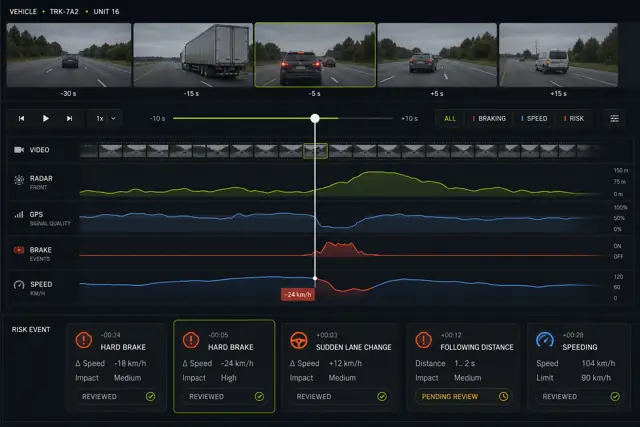
Mobile availability
The product was released on both iOS and Android.


Business Software · Vehicle lifecycle management
A vehicle technology business connected owner and driver permissions with mileage, service reminders, expenses, insurance, and supporting records across mobile and administration tools.
The business context
A vehicle technology business was developing a platform around the complete vehicle record. Owners, drivers, and enterprise administrators needed to work with the same vehicle while carrying different responsibilities. Mileage, maintenance, expenses, insurance, tire checks, and incident documents all contributed to that record.
For the business, the value depended on those pieces staying connected. A stored policy or a new mileage reading was only useful if the surrounding reminders and permitted actions reflected the change. Shinetech worked across the mobile applications, administration interface, and backend to develop that continuity.
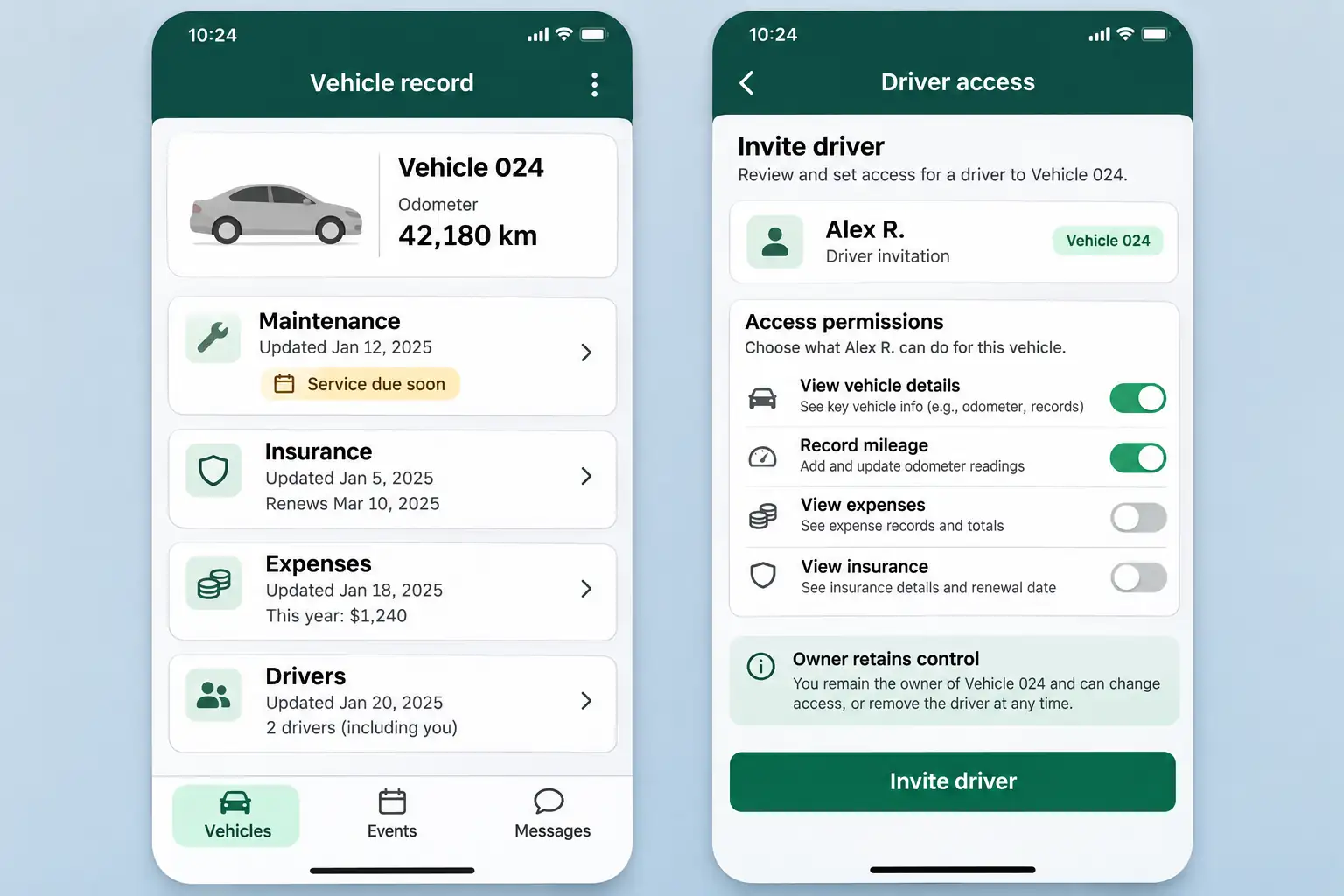
Fictional vehicle details and permissions illustrate two related tasks. The screens are a concept reconstruction, not a copy of the customer’s application. View full-size interface (new tab)
The operating challenge
The modules were closely related. Recording mileage could affect a maintenance reminder; saving insurance information could alter an event and its messages. If each screen treated these changes independently, users would have to check multiple places to establish what was current.
Ownership also differed from permission to drive. One person could manage several vehicles, and one vehicle could involve several people. Invitations, declined invitations, reassignment, and ownership transfer needed consistent behavior. Hiding a screen alone could not enforce who was entitled to access the underlying information.
The delivery decisions
The team first reviewed the existing mobile, administration, and backend applications, aligning requirements, data relationships, and release scope. Vehicle, mileage, maintenance, insurance, expense, and event workflows were then completed in phases around that common record.
Owner, driver, and enterprise roles were connected to invitations, assignments, and vehicle transfers. Access rules were addressed in backend operations as well as in the interface and associated records, so the same relationship governed what the user could see and do.
Image and voice processing supported entry of vehicle and supporting information. File limits, recording limits, error handling, and human confirmation were part of that work. A recognition result could help the user complete a record without being treated as automatically authoritative.
The working detail
Consider a driver adding mileage: the business event is the new vehicle reading, while the user may also expect a service reminder and the vehicle overview to change. Consistency across those surfaces was an explicit delivery concern.
The mobile and web experiences served different jobs, but they depended on common backend behavior. Following launch, the team continued to use operational feedback to improve permission handling, workflow reliability, and administration. That work made the platform more coherent as a product rather than simply increasing the number of screens.
The delivered result
The product was released on both iOS and Android.
Vehicle, maintenance, insurance, expense, and incident information were brought into the same system.
Owner and driver participation was supported through explicit permission workflows.
The product is released and continues to receive updates. Functional coverage assessments are not presented as adoption or production reliability metrics.
Case taxonomy
Discuss your project
Tell us how your business works and where your software needs to change.
Get in touch
Tell us what you need to build, modernize, automate, or augment with AI. We can start with a focused discussion or a no-risk 1-week trial.

“A fantastic company to work with.” After the initial rapid development project, American Shipping Co. kept two Shinetech developers embedded for nearly four years, supporting internal and external tools and new AI initiatives.
 CEO, American Shipping Co. - 5-star Google Review