Resumable fieldwork
Inspectors can save progress and continue a task with its photographs and damage records.


Logistics · Vehicle inspection
A finished-vehicle logistics operator improved mobile inspections, damage evidence, location selection, and controlled app delivery while its connected operating systems stayed in use.
The business context
A finished vehicle can pass through arrival, storage, inspection, and onward movement before reaching its destination. At each step, the people doing the work need to know which vehicle they are handling, where it is, and what has already been recorded. A photograph of a scuff is useful only when it belongs to the right vehicle and inspection.
The client already operated a connected logistics environment: a management platform, a field mobile application, shared data, and interfaces with customer systems. Shinetech joined the ongoing modernization effort. The work had to improve practical tasks at the vehicle while preserving the information used by the wider operation.
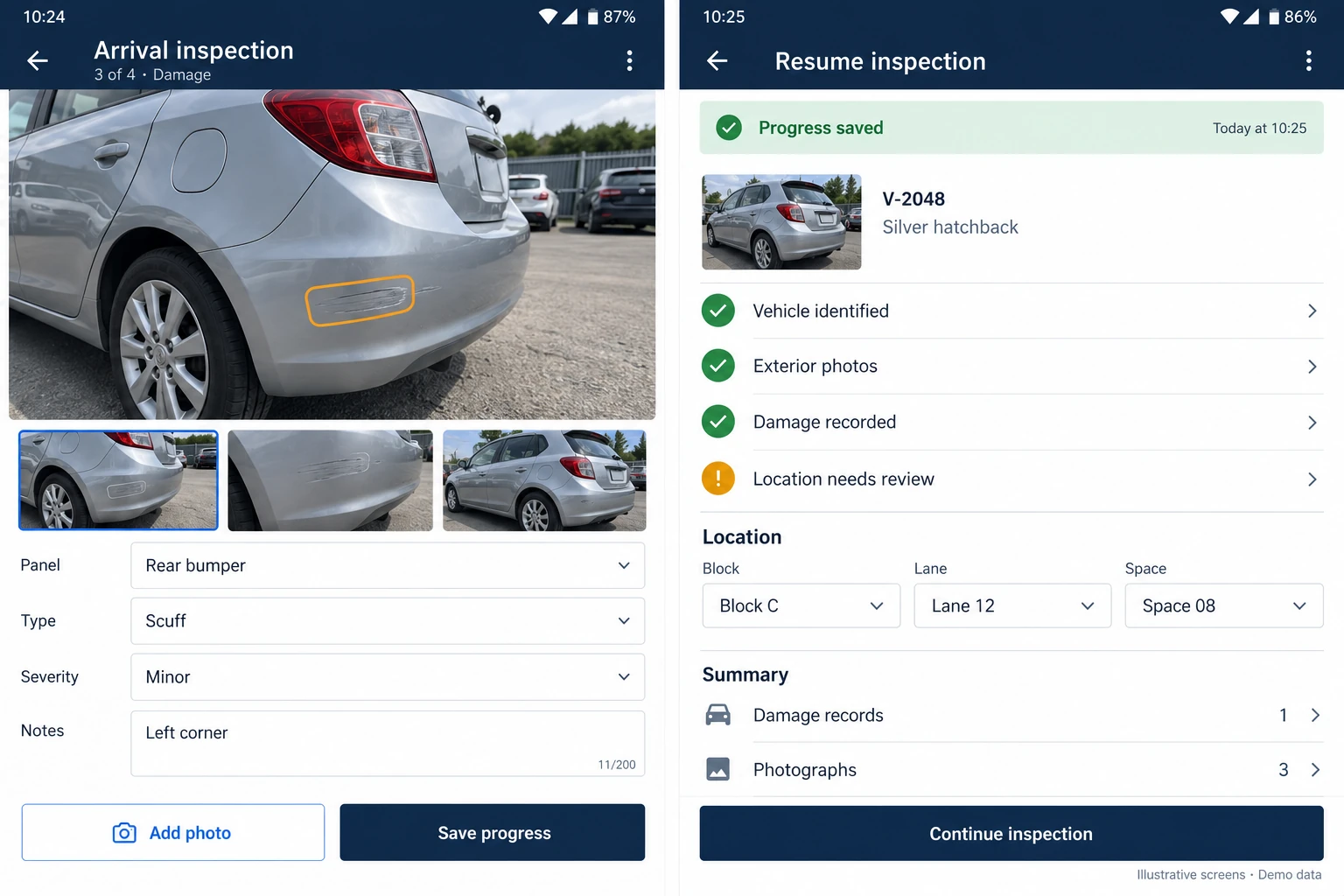
An unfinished inspection remains actionable: a damage record and photographs are saved, while the location step still needs review. Reconstructed screens, synthetic vehicle photography, and fictional records. View full-size interface (new tab)
The operating challenge
Field staff identify a vehicle, follow inspection steps, take photographs, record damage, and select a location. These steps have different inputs and can be interrupted. If the application treats the inspection as one long, fragile form, staff may have to repeat work or reconstruct which evidence belongs to an unfinished task.
The location itself is also more specific than a site name. A large compound contains blocks, lanes, and individual spaces. A picker that looks adequate in a small demonstration can become awkward when staff must navigate the real site’s hierarchy. Both inspection progress and location selection had to be designed around the size and pace of the operation.
The delivery decisions
Shinetech improved guided data entry, photo capture, damage records, and saved progress with resumption. The workflow keeps the unfinished inspection as a usable business record. Staff can return to the vehicle’s task and continue the remaining steps, with the photographs and recorded findings kept in the same context.
During a vehicle-arrival redesign, the client challenged whether a proposed location picker would work across large compounds and long lanes. The team worked through those operating conditions and explained the design choices. The client accepted the approach. The discussion made the real site structure a design input, rather than relying on a compact demonstration to stand in for field use.
Backend interfaces and shared business services connect vehicle, job, and customer-system information. Work on the web and mobile applications was coordinated with that shared data. Improvements were introduced progressively because the existing applications and integrations continued to support daily operations.
How the workflow holds together
The delivery process was part of the operating problem. Installing a new application package on each device by hand made updates dependent on individual installations. Shinetech helped establish automated builds and validation, enterprise Android distribution, and device-group rollout. Human review remained in place for production releases.
Two core applications also completed a cloud-environment migration, providing a foundation for subsequent maintenance and development. The field workflow and the release process support each other: one makes an inspection easier to carry through, while the other gives the team a controlled way to put those improvements into use.
The delivered result
Inspectors can save progress and continue a task with its photographs and damage records.
Vehicle and job information link mobile work to management and customer-system interfaces.
Central distribution and device groups replace reliance on manual app installation.
The engagement continues across the platform, mobile workflows, and delivery process. The evidence does not establish a quantified reduction in inspection time, vehicle damage, or claims.
Case taxonomy
Discuss your project
Tell us how your business works and where your software needs to change.
Get in touch
Tell us what you need to build, modernize, automate, or augment with AI. We can start with a focused discussion or a no-risk 1-week trial.
“A fantastic company to work with.” After the initial rapid development project, American Shipping Co. kept two Shinetech developers embedded for nearly four years, supporting internal and external tools and new AI initiatives.
 CEO, American Shipping Co. - 5-star Google Review