End-to-end visibility
Teams needed to follow cargo from arrival through customs, storage, transfer, and dispatch.


Logistics operations case study
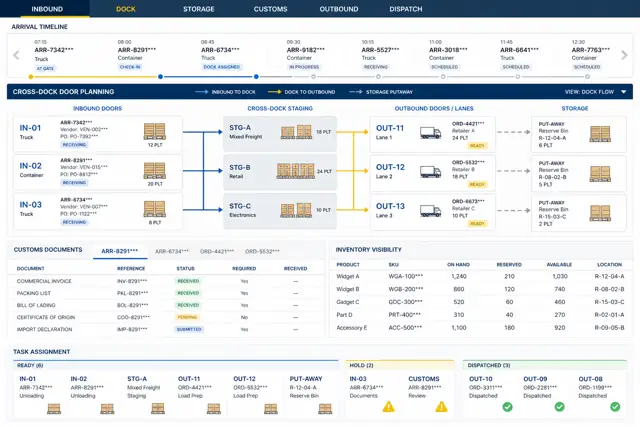
A global logistics provider needed one operational platform for freight forwarding, customs coordination, warehousing, inventory, and cross-dock work.
The situation
Inbound, outbound, storage, customs, inventory, and cross-dock activity crossed several roles and systems. Delayed updates and manual coordination made it harder to know where cargo stood and what needed attention next.
The client wanted a shared platform that could represent the full operating flow while remaining usable for warehouse, forwarding, and management teams.
The challenge
The product had to connect cargo status, documents, locations, tasks, and exceptions across a fast-moving logistics environment.
Teams needed to follow cargo from arrival through customs, storage, transfer, and dispatch.
Holds, document issues, capacity changes, and missed handoffs required visible ownership.
Warehouse operators, forwarding staff, and managers needed different views of the same operation.
The solution
The team modeled the operating chain around shared shipment and inventory records, then delivered role-specific workflows over that common state.
Define shipments, units, locations, tasks, documents, statuses, and exception rules.
Link inbound, outbound, storage, cross-dock, customs, and inventory workflows.
Provide role-based work queues and dashboards using the same operational events.
How we worked
Discovery followed physical workflows and the decisions users made at each handoff.
Modules were delivered around complete operational scenarios rather than isolated screens.
Demonstrations used exceptions as well as normal flow so the team could confirm holds, corrections, and recovery behavior.
Trace cargo, documents, tasks, and locations.
Create shared shipment and inventory records.
Build forwarding and warehouse modules incrementally.
Validate priorities, exceptions, and live visibility.
The result
The platform connected forwarding, customs, inventory, storage, and cross-dock work, giving teams more current operational information and clearer task ownership.
Teams could see status and responsibility across functional boundaries.
Holds and document issues became visible work rather than hidden messages.
A common logistics model created clearer connection points for customers and partners.
Case taxonomy
Connect physical and digital logistics
Get in touch
Tell us what you need to build, modernize, automate, or augment with AI. We can start with a focused discussion or a no-risk 1-week trial.

“A fantastic company to work with.” After the initial rapid development project, American Shipping Co. kept two Shinetech developers embedded for nearly four years, supporting internal and external tools and new AI initiatives.
 CEO, American Shipping Co. - 5-star Google Review