Parent application
Families could navigate from meals and ingredients to the relevant video views.


Logistics · Food-supply visibility
A food supplier built a parent-facing app and administration tools that connected school meals, ingredient records, and video from supply activities, turning a broad visibility idea into a working product.
The business context
The supplier sourced ingredients through both its own growing operation and external purchasing. It wanted families to see more of the journey behind a school meal, from procurement and preparation through storage and transport.
The business had little existing digital infrastructure. Its starting point was an idea for video visibility, rather than a defined software workflow. Making that useful required a connection between the meal a parent recognized, the ingredients it contained, and the relevant video.
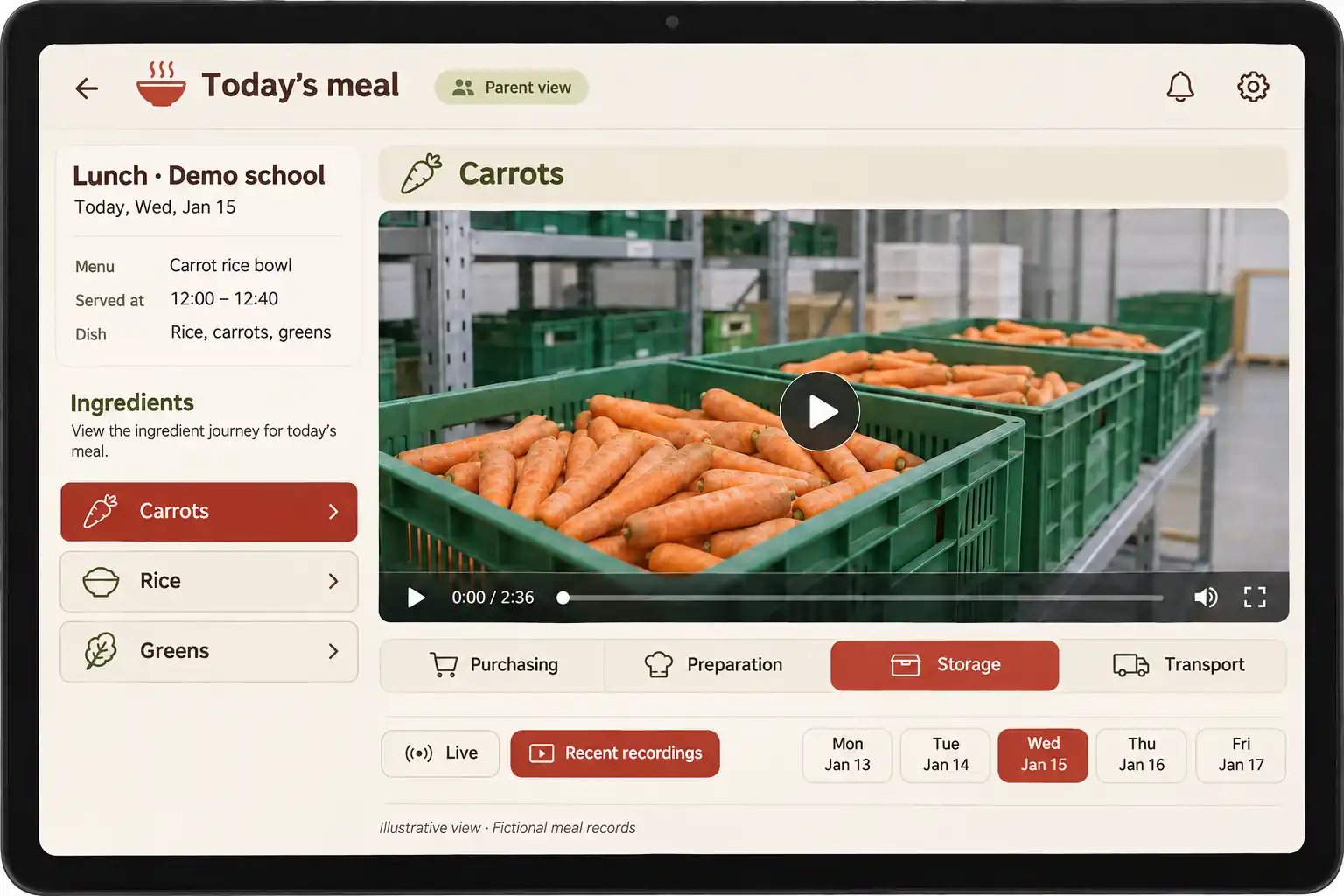
Reconstructed parent view with fictional meal records and generated warehouse footage. No real school, family, child, or supplier location is shown. View full-size interface (new tab)
The operating challenge
A collection of camera feeds would not explain which footage belonged to a particular meal. The team needed to clarify how meals, ingredients, supply stages, schools, and video access related to one another.
The customer also needed help deciding what belonged in the first release. Live viewing, recorded playback, administrative entry, and parent access had to form a usable core within a short delivery period.
The delivery decisions
A business analyst worked with the team to break the initial idea into prioritized functions. Running prototypes gave the customer concrete screens and flows to react to as the scope became clearer.
The backend managed the relationships between meals and ingredients alongside video scheduling and access controls. This gave the parent app a business context for the footage instead of presenting unrelated streams.
The administration application covered supplier, school, meal, and ingredient information as well as video devices. Those functions supported the records on which the family-facing experience depended.
Flutter supported the parent application, while Django supported services and administration. Short iterations, demonstrations, embedded testing, and a container-based delivery environment helped the team validate the connected workflow.
The working detail
The app connected each meal's ingredient list with relevant supply-stage viewing. It included live video and access to recordings from a seven-day window, giving the customer a defined first scope for video visibility.
This product made supply information inspectable through the application. The footage and records supported visibility; they did not by themselves establish a food-safety certification or prove that a supplier had won additional business.
The delivered result
Families could navigate from meals and ingredients to the relevant video views.
The supplier gained backend and administration capabilities for the associated information and devices.
The project team reports completing the app, services, and administration with a five-person team in three months.
The confirmed endpoint is a delivered, runnable system. Commercial growth and food-safety outcomes were not independently measured in the project record.
Case taxonomy
Discuss your project
Tell us how your business works and where your software needs to change.
Get in touch
Tell us what you need to build, modernize, automate, or augment with AI. We can start with a focused discussion or a no-risk 1-week trial.
“A fantastic company to work with.” After the initial rapid development project, American Shipping Co. kept two Shinetech developers embedded for nearly four years, supporting internal and external tools and new AI initiatives.
 CEO, American Shipping Co. - 5-star Google Review