Independent databases
Departmental schemas had little connection and could not be redesigned as part of the project.


Textile manufacturing case study
A growing textile provider needed to coordinate material, product, data, and messages across supply, manufacturing, warehousing, sales, and distribution without changing the schemas of its existing departmental databases.
The situation
Technical, sales, warehouse, compounding, and distribution teams each depended on information and materials passed from other groups. Their databases had developed independently, with limited connection between them.
The client wanted real-time tracking and coordinated instructions across the operation, but the existing database structures could not be changed and the platform also needed to accommodate a different database technology.
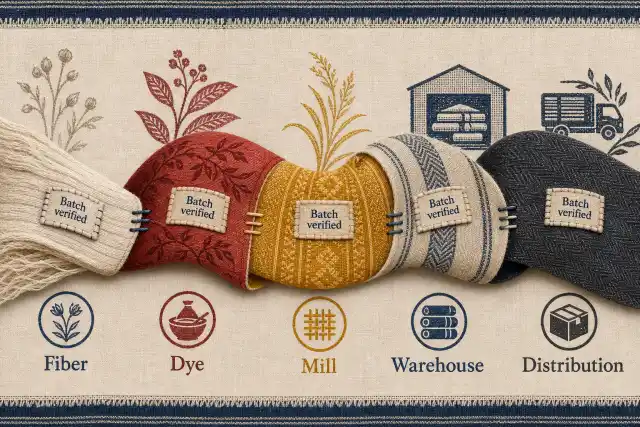
The product challenge
Integration had to respect existing database constraints while supporting complex, changing workflows across internal and external participants.
Departmental schemas had little connection and could not be redesigned as part of the project.
Instructions, feedback, material, and product status moved in multiple directions across many participants.
The application needed flexibility to work with SQL Server and support a move to Oracle without rewriting the business layer.
The solution
The team joined the work from analysis through design, implementation, and remote support, documenting architecture, classes, sequences, data flow, and components before building against the client’s database design.
Use Struts to route requests, validate data and business rules, and keep presentation concerns maintainable.
Use Hibernate as the object-relational layer for separated databases without forcing schema changes.
Add connection pooling, logging, PDF support, shared libraries, and reusable table presentation around the core workflow.

How we worked
Analysis translated the client’s functional specification into a full system design with architecture, class, sequence, data-flow, and component views.
The application was built around the database structures supplied by the client instead of changing schemas to make integration easier.
Open frameworks and isolated layers kept routing, validation, presentation, business behavior, object mapping, and database technology from becoming tightly coupled.
Map departments, handoffs, and data sources.
Document architecture and component behavior.
Connect independent schemas through Hibernate.
Add validation, logging, pooling, and operational outputs.
The result
The delivered architecture connected material and information flow across technical, sales, warehouse, compounding, and distribution work while preserving the existing database structures and supporting more than one database platform.
The system was designed to follow raw materials and products as work moved among supply-chain participants.
Departments could receive instructions, provide feedback, and make current information available to the next step.
Three application layers and object-relational mapping isolated business workflow from database-specific details.
Case taxonomy
Connect the flow without breaking the core
Get in touch
Tell us what you need to build, modernize, automate, or augment with AI. We can start with a focused discussion or a no-risk 1-week trial.

“A fantastic company to work with.” After the initial rapid development project, American Shipping Co. kept two Shinetech developers embedded for nearly four years, supporting internal and external tools and new AI initiatives.
 CEO, American Shipping Co. - 5-star Google Review