Published products
The delivered scope included channel publication within distributor operations.


E-commerce & Retail · Distributor operations
An automotive-parts supplier brought distributor product publishing, order flow, and stock synchronization into a shared platform, with asynchronous channel tasks and a phased rollout.
The business context
For a parts supplier, a distributor's sale depends on more than a product appearing in a catalog. The listing has to reach the relevant sales channel, the order has to enter an operating process, and stock information has to stay useful across the places where the item is sold.
The client already sold through regional storefronts and external marketplaces. Those channels had grown without a unified distributor-management capability. Shinetech helped build a platform around the work between the product, the distributor, and the channel, rather than treating each storefront as a separate project.
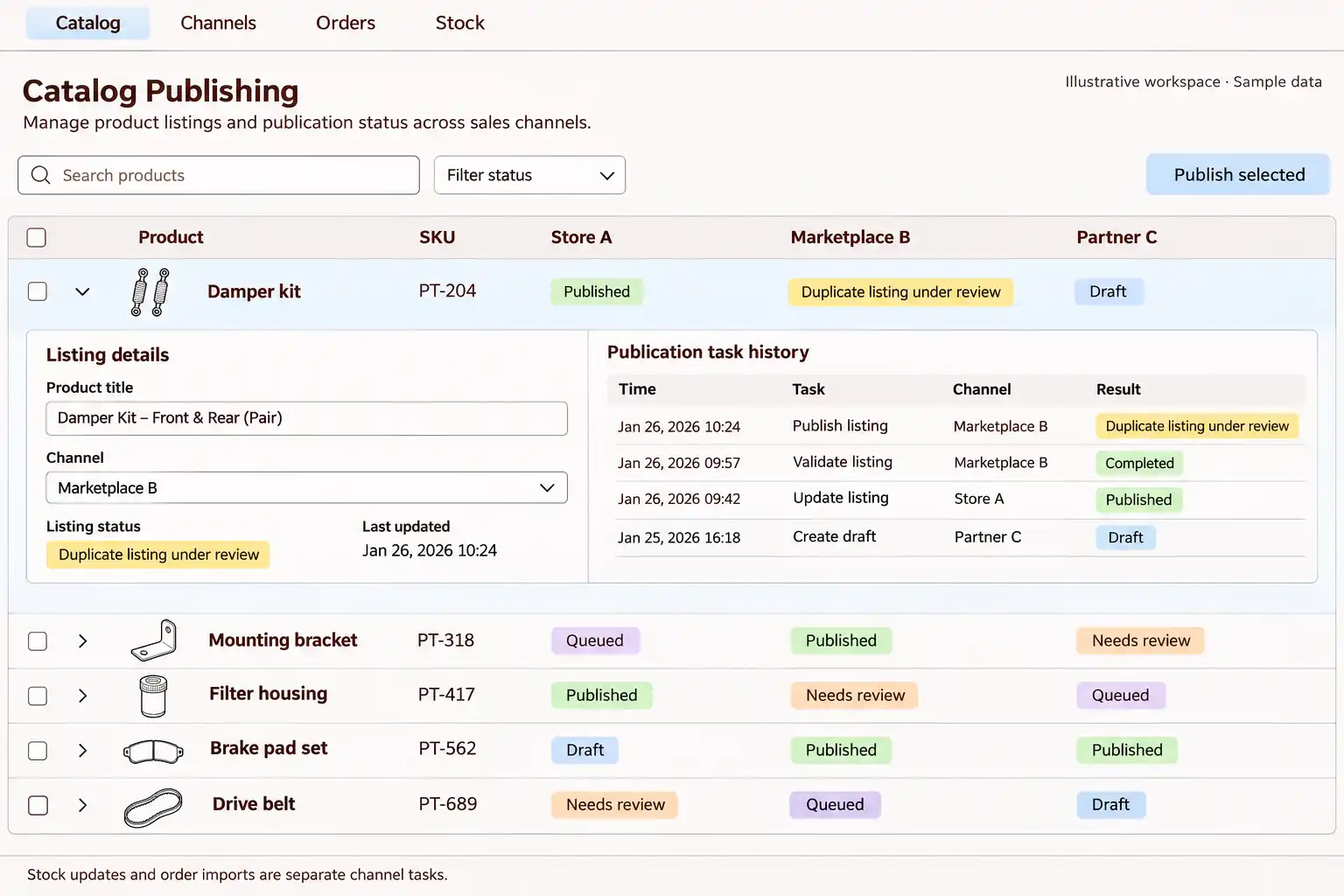
Reconstructed publishing workspace with invented products, channel names, statuses, and timestamps. It illustrates the operating problem; the exact interface and sample history are not client records. View full-size interface (new tab)
The operating challenge
Publishing a product, receiving an order, and updating stock are different operations. Each external platform has its own rules, and a successful action in one channel does not establish the state of the others. The integration work had to support those differences while giving the distributor platform a common role in the workflow.
Duplicate-publication defects and the performance of asynchronous tasks were practical delivery issues. The team needed to improve the work moving through the platform while continuing to extend channel coverage. Adding every integration at once would have made those operating problems harder to isolate.
The delivery decisions
The platform connected product publication with distributor management, order flow, and inventory synchronization. This brought the actions needed to sell through a channel into the same delivery scope, instead of stopping at a catalog or storefront.
RabbitMQ supported background channel tasks, including product publication. The team worked on queue performance and duplicate-publication issues as part of the integration effort, alongside the platform's continuing channel development.
The engagement progressed through a core release and successive additions, followed by further channel work and maintenance. Business analysis, development, QA, and operations coordinated the rollout rather than treating external integrations as a final attachment.
The working detail
A product being published answers whether it is offered in a channel. An incoming order represents demand from that channel. A stock update affects what can be offered next. Keeping those responsibilities in view helps explain why the project needed channel operations as well as commerce screens.
For the business, those connections made distributor operations part of the platform itself. Publishing and synchronization work could evolve through subsequent releases alongside the order workflow, while ongoing maintenance supported the channels already brought into operation.
The delivered result
The delivered scope included channel publication within distributor operations.
Order flow and stock synchronization were part of the platform's integration work.
The platform was delivered in stages and remained under maintenance, with later channel expansion.
The platform reached operation through phased releases, followed by maintenance and further channel development. The documented outcome is this delivered operating capability; business improvements were not quantified.
Case taxonomy
Discuss your project
Tell us how your business works and where your software needs to change.
Get in touch
Tell us what you need to build, modernize, automate, or augment with AI. We can start with a focused discussion or a no-risk 1-week trial.

“A fantastic company to work with.” After the initial rapid development project, American Shipping Co. kept two Shinetech developers embedded for nearly four years, supporting internal and external tools and new AI initiatives.
 CEO, American Shipping Co. - 5-star Google Review