Connected channels
The delivered platform brought the online commerce experience and physical-store network into one operating program.


E-commerce & Retail · Omnichannel retail
A consumer-electronics brand connected its online store with a network of retail partners, bringing orders, inventory, and customer records into a shared commerce model while preserving the different roles of stores and shoppers.
The business context
For a brand that sells through both its own online channel and partner stores, the storefront is only one part of the sale. Products, customer accounts, and orders also have to make sense to the people operating physical outlets. Separate channel systems make that coordination harder, even when each channel works on its own.
The customer wanted to support a business-to-business-to-consumer model: the brand, its retail partners, and shoppers would participate in one commerce environment with different responsibilities. Shinetech helped turn that operating model into a launched regional platform.
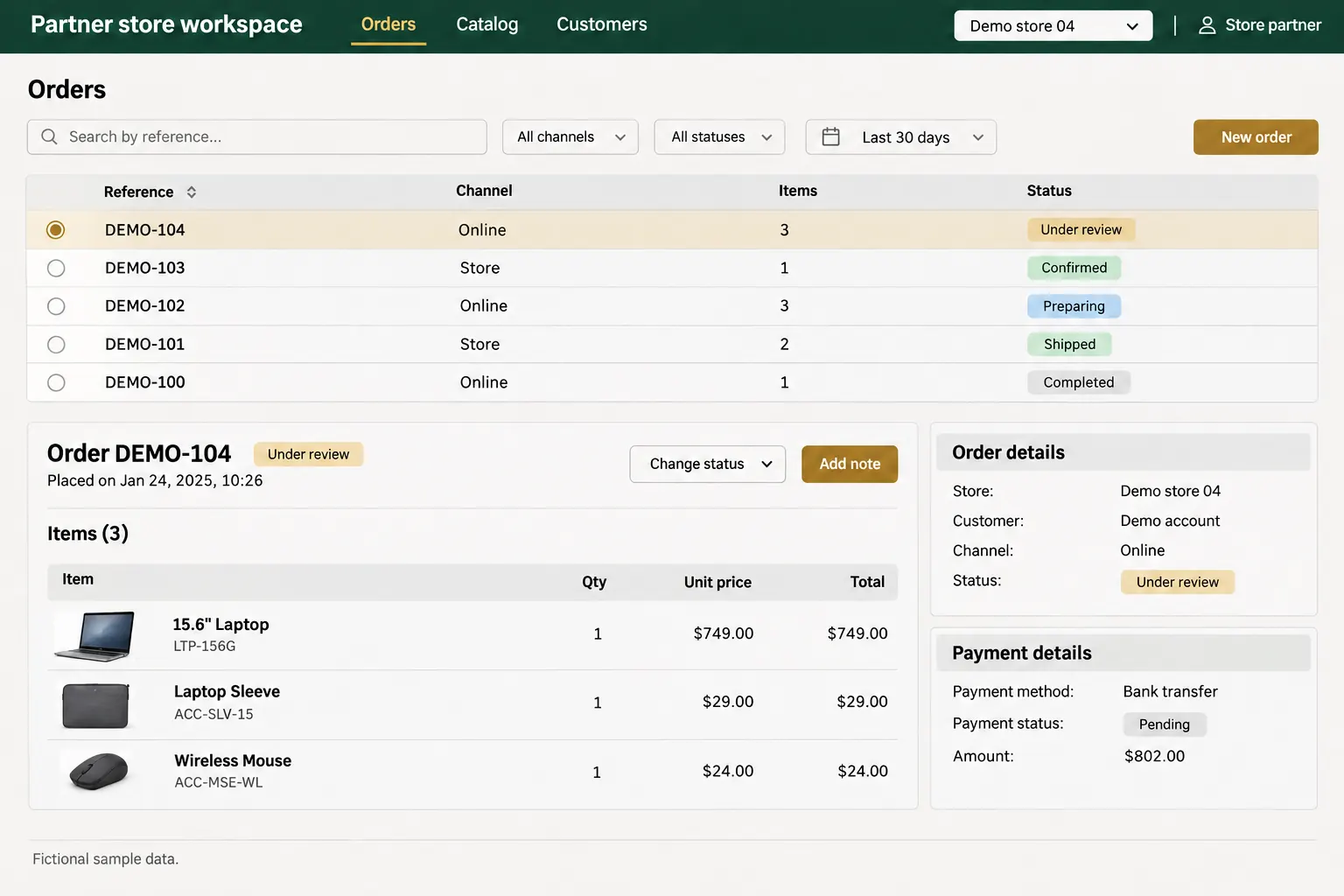
Reconstructed partner workspace with fictional products, records, and amounts. It illustrates the business context of an order without exposing the customer's internal integration design. View full-size interface (new tab)
The operating challenge
Stores carried different product categories, and a partner user did not need the same permissions or experience as a consumer. Treating every participant as the same kind of account would miss an essential part of how the channel worked.
The integration scope also extended beyond a website. Orders, inventory, and customer information had to connect with store operations and supporting business services. That made release planning and cross-team coordination as important as individual storefront features.
The delivery decisions
The team built the platform around the brand's multi-party retail model. Partner and consumer roles shaped access and experience, allowing store participation to be represented explicitly rather than treated as an afterthought to direct online sales.
The online store was integrated with physical-store operations and supporting payment, finance, content, and reporting capabilities. The focus was business continuity across channels: an online interaction needed to remain meaningful to the retail operation handling it.
Development and QA worked with the customer's business and IT teams across successive releases. Breaking the work into stages created a practical way to bring a broad channel program into operation and support it after launch.
The working detail
The project joined commercial roles and operational records in the same delivery scope. A store-facing experience, a consumer storefront, and supporting integrations each served part of the sale; completing one in isolation would not fulfill the broader retail objective.
Joint business and technical collaboration helped keep those parts aligned. The engagement included a tiered support arrangement after launch, followed by the customer taking responsibility for maintenance. Wider geographic expansion remained outside the completed rollout.
The delivered result
The delivered platform brought the online commerce experience and physical-store network into one operating program.
The B2B2C model accommodated retail partners alongside consumer users.
After launch and support, maintenance moved to the customer's team.
The confirmed outcome is the regional launch. Further market expansion was not completed, and the source does not establish a measured revenue or conversion increase.
Case taxonomy
Discuss your project
Tell us how your business works and where your software needs to change.
Get in touch
Tell us what you need to build, modernize, automate, or augment with AI. We can start with a focused discussion or a no-risk 1-week trial.

“A fantastic company to work with.” After the initial rapid development project, American Shipping Co. kept two Shinetech developers embedded for nearly four years, supporting internal and external tools and new AI initiatives.
 CEO, American Shipping Co. - 5-star Google Review