Independent product publishing
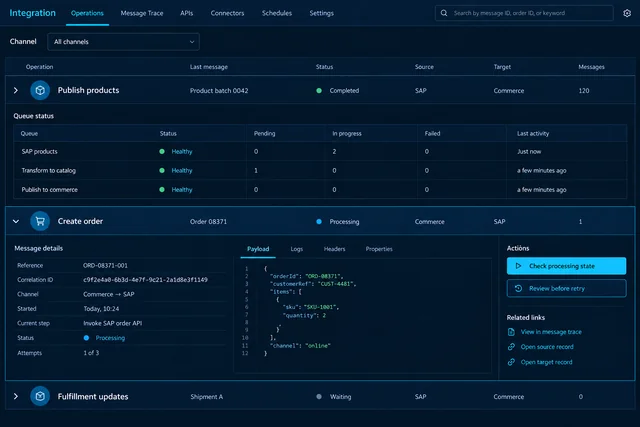
Queued product updates decoupled the channels from each other. An unavailable channel could recover its outstanding updates without holding up the others.


E-commerce · Channel Integration case study
Adding Salesforce Commerce and store orders to Magento and NuORDER can multiply separate SAP integrations. Shinetech’s integration approach uses MuleSoft to share product, order and fulfillment processes while keeping channel-specific adapters.
The situation
Magento and NuORDER already reached SAP S/4HANA through custom services. When Salesforce Commerce and Manhattan Active Omni entered the channel roadmap, each new connection threatened to repeat the same product, order and fulfillment work.
Product feeds, order creation and fulfillment updates each carried their own SAP access, mappings, error handling and deployment. Every new channel increased the support burden.
The challenge
Each channel has its own formats and release needs. A delayed product feed should not hold up other channels, while an uncertain SAP order response must not lead to a duplicate order. The common design needs to preserve those differences.
The solution
The integration design brings the Magento and NuORDER connections, together with Salesforce Commerce and MAO, into MuleSoft. SAP and each channel keep their own connection, so a change on one side does not disturb the other.
Three shared processes carry the product, order and fulfillment work, translating each channel’s format into one common model for products, orders, shipments and invoices.
Workflow detail
| Process | Direction | Business purpose |
|---|---|---|
| Sellable product distribution | SAP → sales channels | Publish product, price and availability through the channel adapters. |
| SAP sales order creation | Sales channel → SAP | Convert the channel order and create the SAP sales order. |
| Fulfillment result distribution | SAP → original order channel | Return shipment, invoice and cancellation information to the correct channel. |
Workflow detail
Product distribution used queues to separate channel updates. Order creation used a direct request to SAP, with a processing-state check when the response was uncertain.
Queued product updates decoupled the channels from each other. An unavailable channel could recover its outstanding updates without holding up the others.
If SAP order creation timed out, the integration checked whether SAP had created the order before deciding on another submission.
Workflow detail
Version controls stopped old product updates overwriting newer data. Transaction identifiers protected order creation and fulfillment updates from duplicate processing.
Technical failures followed retry rules; business errors retained the response for correction. Shared reference fields let support trace a channel request to the exact step that failed.
Monitoring brought volume, response time and errors into one operating view. Support could trace an order number or product reference without entering separate custom services.
Salesforce Commerce and MAO added their own adapters and mappings while reusing SAP access and the shared processes. Channel-specific changes remained in the relevant adapter.
How we work
Work begins with one representative product, order and fulfillment exchange from each channel. The team agrees the common contracts before developing the SAP connection and channel adapters.
Verification covers an offline channel, an older product event, a repeated order and an uncertain SAP response. The handover includes mappings, reference fields and recovery instructions for these cases.
The result
A new channel reuses the established SAP access, process logic and data models.
Support monitors channel traffic, traces failures and follows the agreed recovery path from one operating view.
SAP remains responsible for product, pricing, availability, sales orders and fulfillment. MuleSoft connects those responsibilities to the channels that need them.
Case taxonomy
Discuss your business systems
Get in touch
Tell us what you need to build, modernize, automate, or augment with AI. We can start with a focused discussion or a no-risk 1-week trial.

“A fantastic company to work with.” After the initial rapid development project, American Shipping Co. kept two Shinetech developers embedded for nearly four years, supporting internal and external tools and new AI initiatives.
 CEO, American Shipping Co. - 5-star Google Review