12 axes
The project team reports control of twelve stepper-motor axes with the delivered system.


Manufacturing · Instrument motion control
An instrument maker brought embedded motion control, a host application, communications, and stored parameters together in a usable controller for twelve stepper-motor axes.
The business context
A precision-instrument company needed more than a motor-control board. Its software had to send parameters, read them back, retain settings, and observe controller status while the embedded hardware handled motion.
The customer's own developers had limited capacity, and it lacked the embedded engineering resources to deliver the full system internally. Shinetech worked across the host software, firmware, and circuit-board scope to turn the requirement into a usable controller.
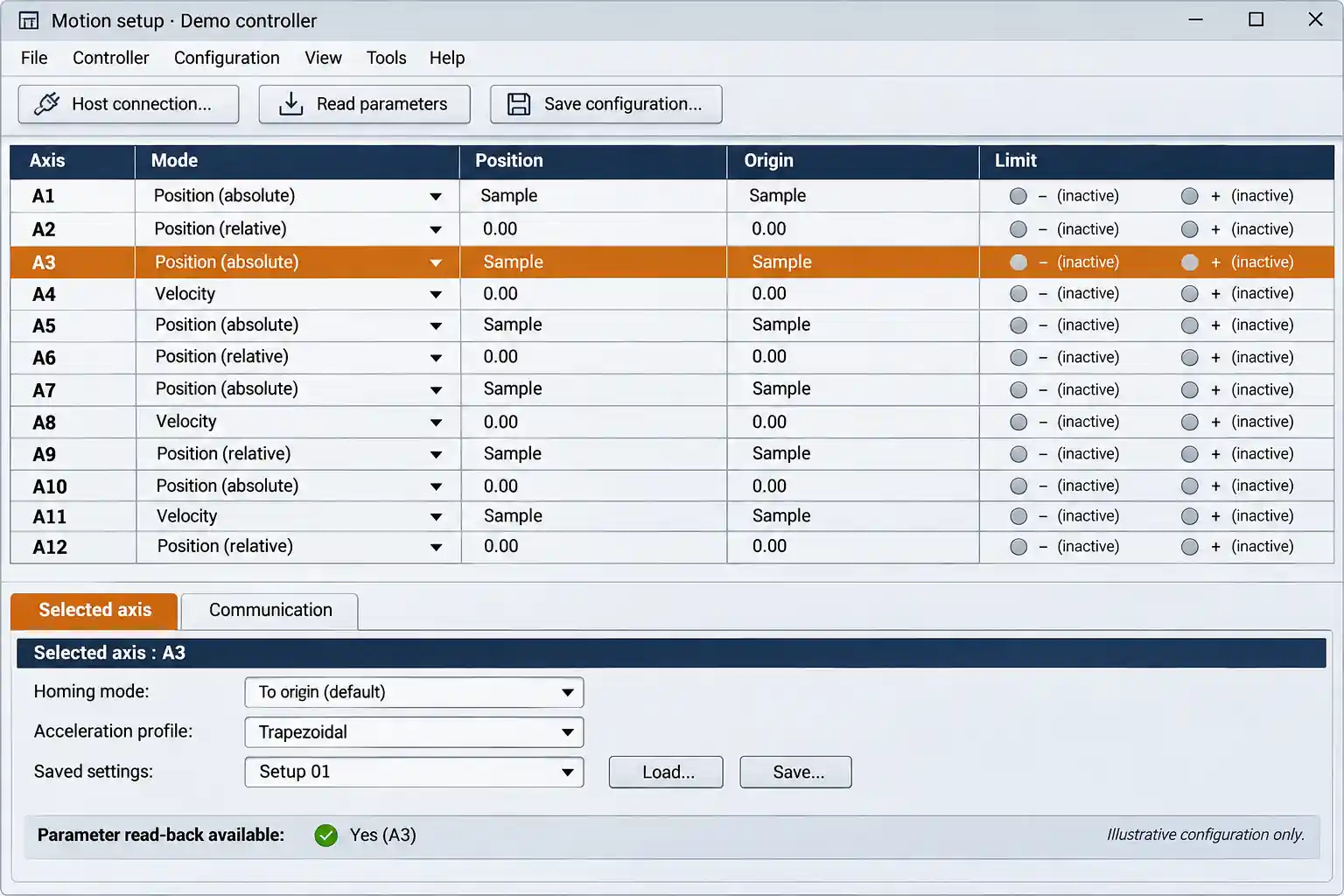
Reconstructed host utility with fictional settings. It explains the configuration workflow without exposing chip-specific commands or customer instrument designs. View full-size interface (new tab)
The operating challenge
The selected motion-control components had little publicly available implementation guidance beyond their documentation. The team had to work through initialization and control behavior rather than adapt a proven project example.
The first implementation attempt also exposed a shortage of available embedded expertise. Progress required a wider engineering effort and the customer's assistance, along with explicit decisions about supported motion and communication functions.
The delivery decisions
The team identified which controller functions to implement, including homing and the boundaries of linear interpolation. Those decisions established a workable scope before the hardware and firmware effort expanded.
Hardware work and FPGA logic proceeded together. The implementation covered twelve-axis pulse and direction output, encoder and origin inputs, limit signals, and the agreed motion routines.
The host application communicated with the controller, sent parameters, and read them back. Settings were stored on the board, with additional communication and status-display capabilities included in the system.
The work included communication checks and retransmission, watchdog behavior, fault checks, and stability and boundary testing. These measures addressed the controller as an integrated device rather than testing the host interface alone.
The working detail
A host screen can show an intended setting before the embedded device has accepted or stored it. The documented communication scope included parameter read-back and persistence, connecting the operator-facing application to the controller's actual configuration.
That same end-to-end view helped organize the work after the initial setback. Hardware, embedded logic, host communications, and testing had to converge on one usable version, with the customer participating in the engineering effort.
The delivered result
The project team reports control of twelve stepper-motor axes with the delivered system.
The host application and controller exchanged configuration data through the implemented communications.
On-board parameter storage formed part of the completed control path.
The source confirms a usable controller. It does not provide a measured positioning-accuracy benchmark, production-volume record, or safety-certification claim.
Case taxonomy
Discuss your project
Tell us how your business works and where your software needs to change.
Get in touch
Tell us what you need to build, modernize, automate, or augment with AI. We can start with a focused discussion or a no-risk 1-week trial.

“A fantastic company to work with.” After the initial rapid development project, American Shipping Co. kept two Shinetech developers embedded for nearly four years, supporting internal and external tools and new AI initiatives.
 CEO, American Shipping Co. - 5-star Google Review