Shared access
Registered platform use grew from an initial small group to more than 300 users, as reported by the project team.


Energy & Utilities · Solar project financing
A solar financing business replaced macro-heavy pricing spreadsheets with a shared calculation workflow, connecting project modeling, partner submissions, and CRM data.
The business context
A commercial solar financing business worked with developers and engineering, procurement, and construction partners. Before a project could progress, the parties needed to evaluate its economics and develop indicative power purchase agreement pricing. The commercial discussion depended on calculations that had previously lived in complex spreadsheets.
Project information, documents, and reporting were also handled outside a shared online workflow. Shinetech helped develop a platform that made modeling, pricing, and project submission available to partners while connecting the resulting project data to the financing business’s CRM.
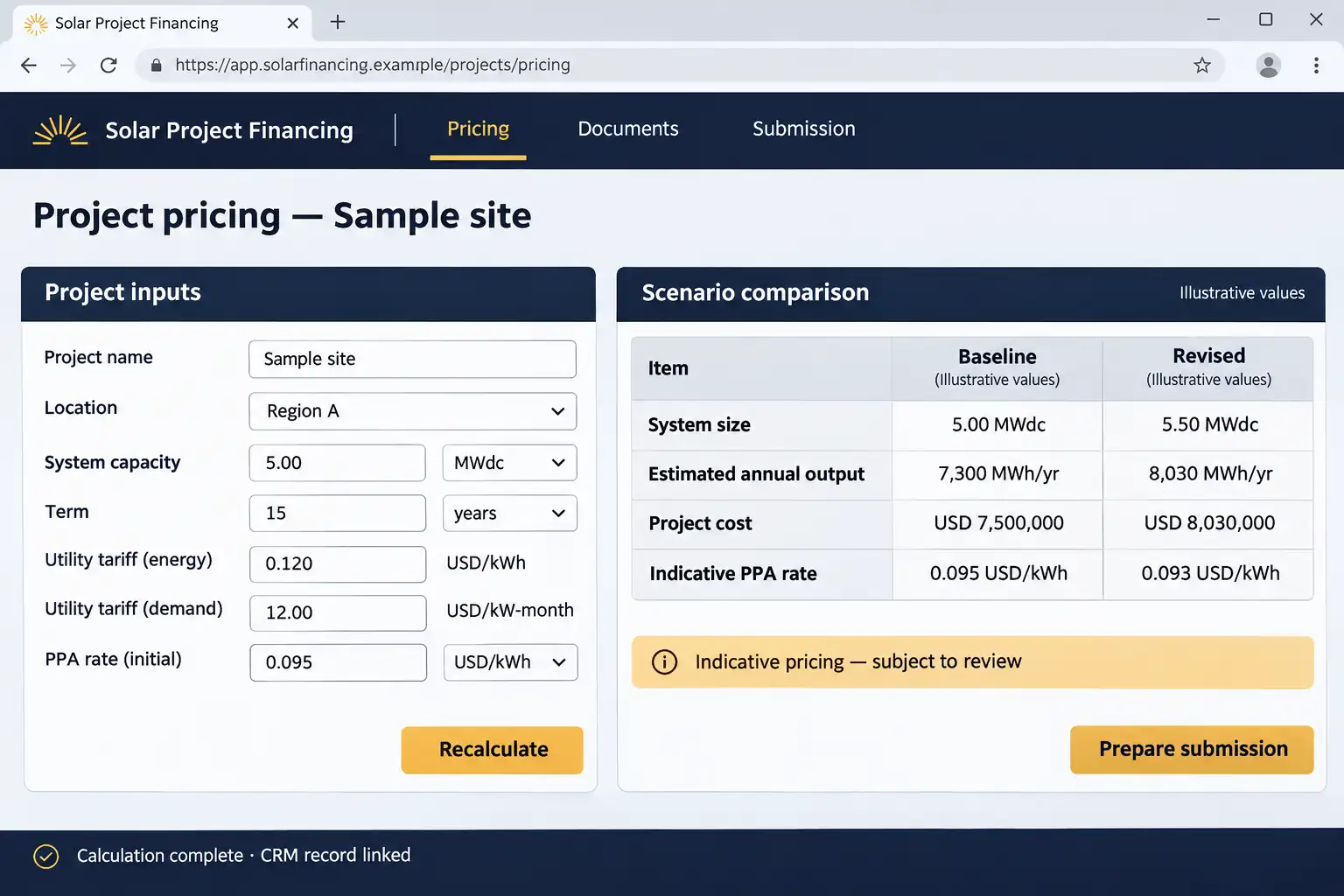
All project variables, scenario values, and prices are fictional examples. This reconstruction illustrates a software workflow and does not reproduce a proprietary financial model or offer financing terms. View full-size interface (new tab)
The operating challenge
The source model contained extensive macro logic. Translating it into application code required the team to carry forward the financial calculation behavior while meeting a demanding response-time requirement: thousands of iterative calculations needed to return a result in roughly three seconds.
The model also operated in a changing business environment. Financing assumptions and project inputs evolved, and project information needed to stay aligned with CRM records. A faster standalone calculator would not solve the whole problem if the commercial team still had to reconstruct the project elsewhere.
The delivery decisions
The team translated the macro-heavy spreadsheet model into .NET code. This placed the calculation behind a shared application workflow and made its execution speed a deliberate engineering concern as model complexity increased.
The platform supported modeling, pricing, and submission in the same environment. Developers and construction partners could provide project information and obtain relevant results without relying entirely on separate offline exchanges.
Project data was connected to Dynamics 365 CRM, linking the partner-facing workflow to the business’s internal records. Continuing development also covered releases, hosting, monitoring, and maintenance of the operating platform.
The working detail
When an input changes, a developer needs to understand what that means for the proposed project. The team reported that the calculation continued to return results in about three seconds even as the model became more complex.
That figure describes reported calculation behavior, not a guarantee that a project receives financing or a promise that every request meets a contractual response time. The business value was access to a shared modeling process whose results could continue into project review. Proprietary formulas, credit rules, and actual customer financing terms remain outside this case.
The delivered result
Registered platform use grew from an initial small group to more than 300 users, as reported by the project team.
The team reported typical calculation times of about three seconds.
The platform supported project submissions and supplied data to connected business systems.
The platform remains in use with continuing development. User and timing figures are project-reported; financing outcomes and investment returns are not attributed to the software.
Case taxonomy
Discuss your project
Tell us how your business works and where your software needs to change.
Get in touch
Tell us what you need to build, modernize, automate, or augment with AI. We can start with a focused discussion or a no-risk 1-week trial.

“A fantastic company to work with.” After the initial rapid development project, American Shipping Co. kept two Shinetech developers embedded for nearly four years, supporting internal and external tools and new AI initiatives.
 CEO, American Shipping Co. - 5-star Google Review