Live replacement
The application moved into use as the replacement for the previous system.


Media & Entertainment · Digital-signage playback
An outdoor-media operator replaced an aging rented playback system with a custom application that separated media downloading, decryption, and playback into cooperating modules.
The business context
For an outdoor advertising business, the screen is the public-facing endpoint of a content-delivery process. Media has to reach the player, be prepared for use, and appear in the intended sequence. Large file transfers and content changes put pressure on different parts of that process.
The customer was using a rented playback system that it considered old and expensive. It engaged Shinetech to build a replacement suited to the requirements of its outdoor displays.
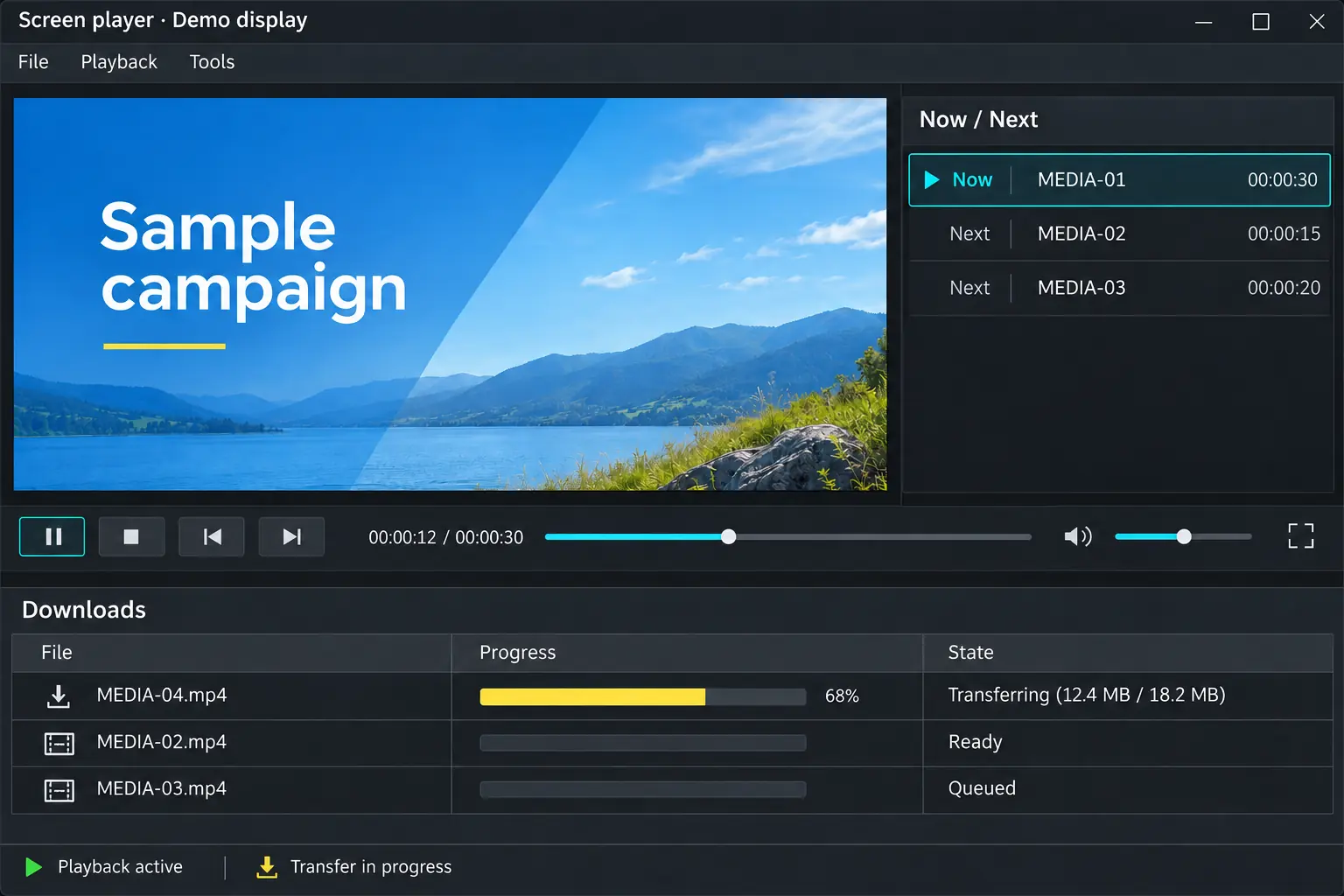
Original playback-console reconstruction with fictional media and transfer states. The view explains task separation without reproducing customer content or security internals. View full-size interface (new tab)
The operating challenge
The project had demanding requirements for advertising transitions, large-file downloads, and security. A design that treated those as one undifferentiated task would make it harder to reason about the behavior of the player.
The engineering question was how to organize the work inside the desktop application so that the steps could cooperate without becoming one tightly coupled sequence.
The delivery decisions
The desktop application separated downloading, decryption, and playback. That made each part of the media lifecycle an explicit responsibility rather than burying transfer and preparation work inside the playback logic.
The implementation used communication between processes to organize the flow between those modules. This was the central design choice described by the team for improving the way the application handled the required work.
The project combined an Electron desktop application with PHP-based work. The result was brought into use by the customer, providing a concrete replacement for the previous rented system.
The working detail
Separating these responsibilities gave the team a practical structure for managing large media and screen transitions. The distinction matters because each step has its own completion state and constraints, even though the viewer only sees the final display.
The source confirms modular implementation and a successful launch. It does not specify a blackout threshold, download benchmark, encryption standard, or offline service guarantee, so the story stays focused on the delivered design and observed improvement.
The delivered result
The application moved into use as the replacement for the previous system.
Download, decryption, and playback responsibilities were implemented as cooperating modules.
The project team reported better performance and user interface behavior than the old system.
The improvement is qualitative in the available source. No measured licensing savings, uptime target, or transition-time benchmark is claimed.
Case taxonomy
Discuss your project
Tell us how your business works and where your software needs to change.
Get in touch
Tell us what you need to build, modernize, automate, or augment with AI. We can start with a focused discussion or a no-risk 1-week trial.

“A fantastic company to work with.” After the initial rapid development project, American Shipping Co. kept two Shinetech developers embedded for nearly four years, supporting internal and external tools and new AI initiatives.
 CEO, American Shipping Co. - 5-star Google Review