Running code
The stalled system regained a functioning development and test foundation.


Education & EdTech · Student management
An education-software project recovered from a stalled handoff through code analysis, a shared requirements review, and completion of student, course, assessment, and reporting functions before school pilots.
The business context
The original development team had left a partially completed student-management system. Documentation was incomplete, and the customer did not have the technical knowledge to deploy or maintain what remained. Earlier investment was trapped in a project that could not move forward.
The intended product had a clear business purpose: support an education provider's own student and course administration, then offer those capabilities to other institutions. Restoring the environment was only the first step toward a product that schools could try.
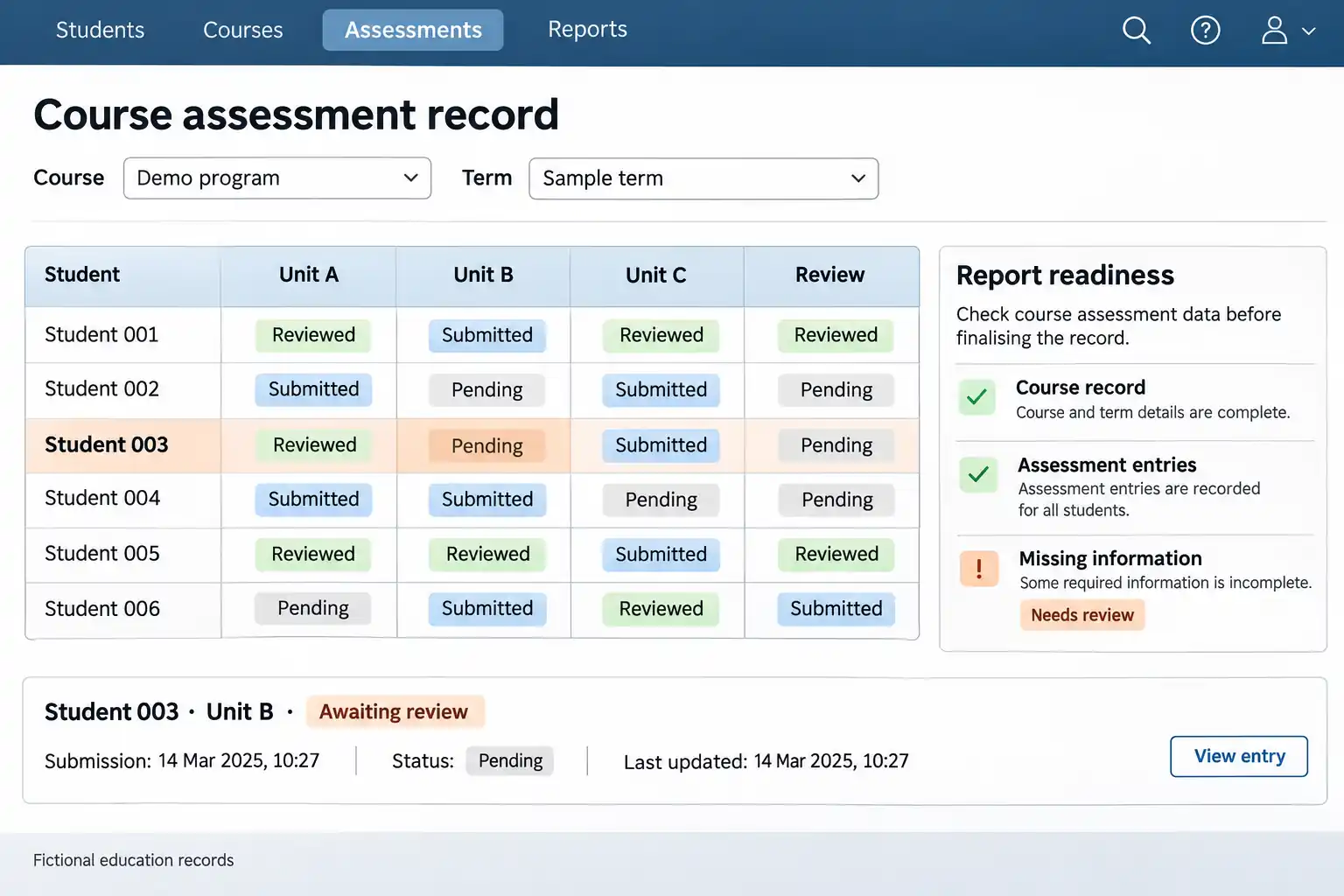
Original reconstruction using fictional student references and course units. No real school records or official approval marks are shown. View full-size interface (new tab)
The operating challenge
The new team needed to determine what the existing code did, which parts could be retained, and which essential functions were missing. Without that assessment, a new feature list would have rested on an uncertain foundation.
The product also needed coherent student records, assessment information, and reports for its intended education setting. Those requirements had to be discussed with a customer who could explain the business but could not supply a complete technical specification.
The delivery decisions
The team gathered the available code and materials, investigated dependencies and configuration, and recovered the ability to run and develop the system. This created a practical basis for testing the inherited work.
Existing functions, data structures, and business logic were reviewed to identify implemented behavior and gaps. The resulting assessment gave the customer a concrete description of the project rather than an assumed completion percentage.
An intensive workshop used that assessment to agree priorities and the remaining product scope. The team kept usable code and reworked the parts that needed improvement, then completed student, course, assessment, and reporting capabilities.
Development, testing, and customer feedback continued through product completion. The team supported the required review work and prepared the system for use in real education settings.
The working detail
The project team reports completing the initial analysis in about a week and producing more than one hundred pages of system and requirements findings. Its value was the shared understanding it created: the customer could discuss known functions and missing work instead of restarting from vague expectations.
A subsequent workshop translated that understanding into a delivery plan. This kept the recovery connected to a usable student-management product, with school records and reporting as the core workflow.
The delivered result
The stalled system regained a functioning development and test foundation.
The agreed student, course, assessment, and reporting functions were completed.
The project team reports pilot deployment at four schools after the relevant review was completed.
The school-pilot and review outcomes are historical project-team reports. They are not a claim of current certification, continuing regulatory approval, or subsequent commercial scale.
Case taxonomy
Discuss your project
Tell us how your business works and where your software needs to change.
Get in touch
Tell us what you need to build, modernize, automate, or augment with AI. We can start with a focused discussion or a no-risk 1-week trial.
“A fantastic company to work with.” After the initial rapid development project, American Shipping Co. kept two Shinetech developers embedded for nearly four years, supporting internal and external tools and new AI initiatives.
 CEO, American Shipping Co. - 5-star Google Review