Research rebuilt
Regional search, indicators, historical charts, maps, reports, and public interfaces form the renewed platform.


Real Estate · Research platform
A property data business rebuilt its research platform while maintaining an existing subscription product and progressively handing over the data work behind both.
The business context
A property researcher may begin with a broad region, narrow the search by market indicators, compare locations, inspect historical changes, and produce a report. Those steps depend on consistent geography and data periods as well as the tools on the screen. The business sells access to that research through products with subscription and usage-based charging.
The client needed a renewed research application while an established product continued to operate. Shinetech’s engagement grew across three connected areas: rebuilding the research experience, improving the existing system and its subscription handling, and taking on specific data-processing responsibilities in stages.
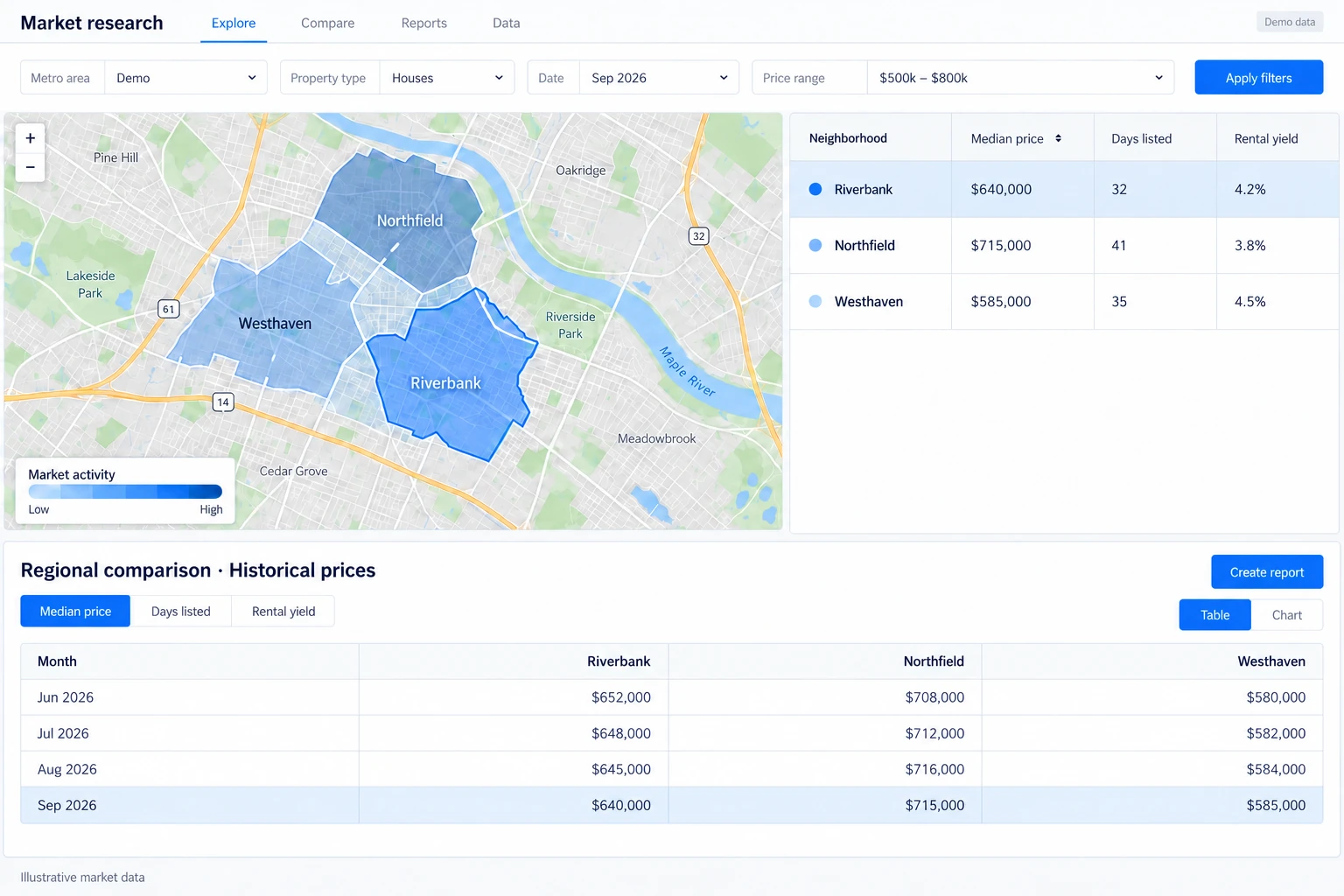
A researcher moves from a regional shortlist to a historical comparison. Places, prices, yields, and historical figures are invented for this reconstruction; they are not market evidence or investment recommendations. View full-size interface (new tab)
The operating challenge
Markets, regions, indicators, historical series, report scope, and user permissions were already related through the existing applications and database. Rebuilding the research platform meant carrying those relationships into a new application structure. Otherwise a familiar-looking search or chart could represent a different set of data from the one the user expected.
At the same time, the existing product’s subscription integration needed to move to a newer payment interface. That change touched first purchase, confirmation, renewal, cancellation, payment notices, invoices, receipts, and access. Replacing the payment button would have left much of the actual subscription workflow untouched.
The delivery decisions
Shinetech rebuilt the core research application with market search, regional indicators, historical charts, maps, and report management. Public data interfaces and documentation support access beyond the website. Work on the underlying database methods and structures accompanied application development, keeping the existing business rules in view as the product changed.
The subscription work connected creation and customer confirmation to payment notifications, renewal, cancellation, and membership handling. Duplicate notices and failure retries also needed controls. Financial records and service entitlements were considered together; relevant caches were refreshed when payment or service state changed, so a successful update would not leave an old access state in circulation.
The team progressively took on collection checks, source-file preparation, imports, validation, regional reference updates, and supplier inputs. Specific deliveries and operating records supported the handover. This approach transferred defined routines while further monthly processing remained in transition, instead of treating all data operations as complete once the new application was available.
How the workflow holds together
The illustrative workspace shows a researcher comparing regions and opening a historical view. Behind that action are several different responsibilities: the region must be defined consistently, the data needs to belong to the intended period, and the user must have the appropriate access. A change in any one of those areas can affect the usefulness of the result.
The engagement therefore continued on both the new platform and the established system. Legacy-code improvements, database work, subscription behavior, and operational data tasks were handled as parts of the same service. Some email work was moved out of the request flow, and repeated data reads were cached with attention to when those cached results needed to change.
The delivered result
Regional search, indicators, historical charts, maps, reports, and public interfaces form the renewed platform.
Payment events, financial records, and membership access are handled across the subscription lifecycle.
Defined collection, import, validation, and reference-data tasks have moved into team delivery.
The existing product remains in operation, and development and data handover continue. The evidence does not establish a completed migration of every system or measured investment returns for users.
Case taxonomy
Discuss your project
Tell us how your business works and where your software needs to change.
Get in touch
Tell us what you need to build, modernize, automate, or augment with AI. We can start with a focused discussion or a no-risk 1-week trial.

“A fantastic company to work with.” After the initial rapid development project, American Shipping Co. kept two Shinetech developers embedded for nearly four years, supporting internal and external tools and new AI initiatives.
 CEO, American Shipping Co. - 5-star Google Review