Mixed fulfillment
Research could be delivered by digital download or scheduled physical shipment, so subscriptions needed more than a standard checkout.


Financial publishing case study
A financial-research publisher needed to replace manual report fulfillment with a tailored subscription platform that matched how it sold, delivered, renewed, and administered specialized research.
The situation
The publisher had built a substantial catalog of financial-industry research for different audiences. Delivering that value involved more than putting files on a website: customers needed the right report categories, payment choices, fulfillment methods, and renewal path.
Behind the storefront, staff also needed one dependable way to manage products, customers, orders, coupons, subscriptions, and administrative controls without breaking the publisher’s established workflow.
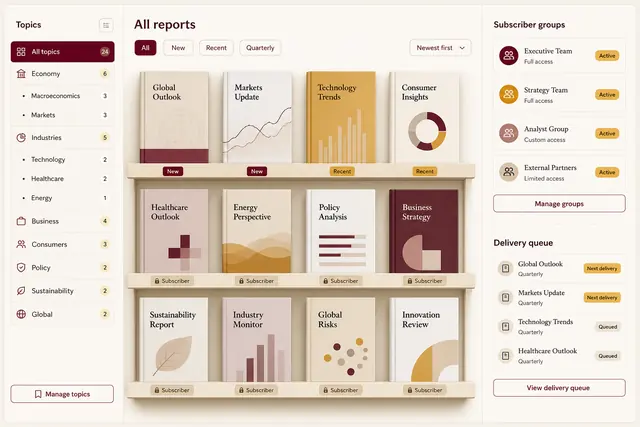
The product challenge
The platform had to make purchasing simple for readers while giving staff practical control over every recurring operational step.
Research could be delivered by digital download or scheduled physical shipment, so subscriptions needed more than a standard checkout.
Payments, renewals, order history, and coupons had to remain connected to the same customer and product records.
The back office needed to reflect the publisher’s categories and processes instead of forcing a generic commerce workflow.
The solution
The team analyzed requirements, designed the database and prototype, and implemented a front office and back office around the publisher’s real subscription process.
Organize reports by audience, provide a shopping cart, support online payment, and present the available fulfillment choices.
Connect customers, orders, coupons, subscriptions, renewals, products, and administrative controls in one operating model.
Use a layered MVC structure on Linux, Apache, MySQL, and PHP so presentation, business rules, and data concerns remain clear.

How we worked
Requirements analysis established how research was categorized, purchased, fulfilled, and renewed. A prototype and database design then made those relationships visible before full implementation.
The storefront and administration areas were treated as two views of the same lifecycle rather than separate products.
The open LAMP stack supported a layered application while keeping the operating model closely aligned with the client’s existing business process.
Map reports, customers, payments, fulfillment, and renewal.
Validate the storefront and administration workflow.
Build shared product, order, and subscription records.
Give staff direct control of recurring delivery activity.
The result
The documented solution replaced disconnected manual steps with a secure, maintainable subscription system shaped around the publisher’s business process.
Readers could browse relevant report categories, purchase access, and receive the selected form of delivery.
Staff could manage the product catalog, customer records, orders, coupons, subscriptions, and administrative settings.
The system automated repetitive work without discarding the workflow the publisher already understood.
Case taxonomy
Connect the recurring customer journey
Get in touch
Tell us what you need to build, modernize, automate, or augment with AI. We can start with a focused discussion or a no-risk 1-week trial.

“A fantastic company to work with.” After the initial rapid development project, American Shipping Co. kept two Shinetech developers embedded for nearly four years, supporting internal and external tools and new AI initiatives.
 CEO, American Shipping Co. - 5-star Google Review