Local handling
Gateway filtering, threshold checks, alarm outputs, and buffering were part of the delivered scope.


Manufacturing · Gas monitoring and response
An industrial gas-monitoring system kept threshold checks and local alarm actions at the edge, while connecting device events with control-room notification, acknowledgment, and response records.
The business context
A manufacturing site had several areas where hazardous gases needed monitoring. Collecting a concentration reading answered only part of the operating question. Control-room staff also needed to know which area was involved, whether people were present, who had been notified, and whether someone had acknowledged the event.
The existing process depended on people checking readings and relaying information. As the monitored area grew, those handoffs became harder to follow. Shinetech helped connect fixed detectors, wearable tags, edge gateways, and monitoring software so that local events could become part of a shared response record.
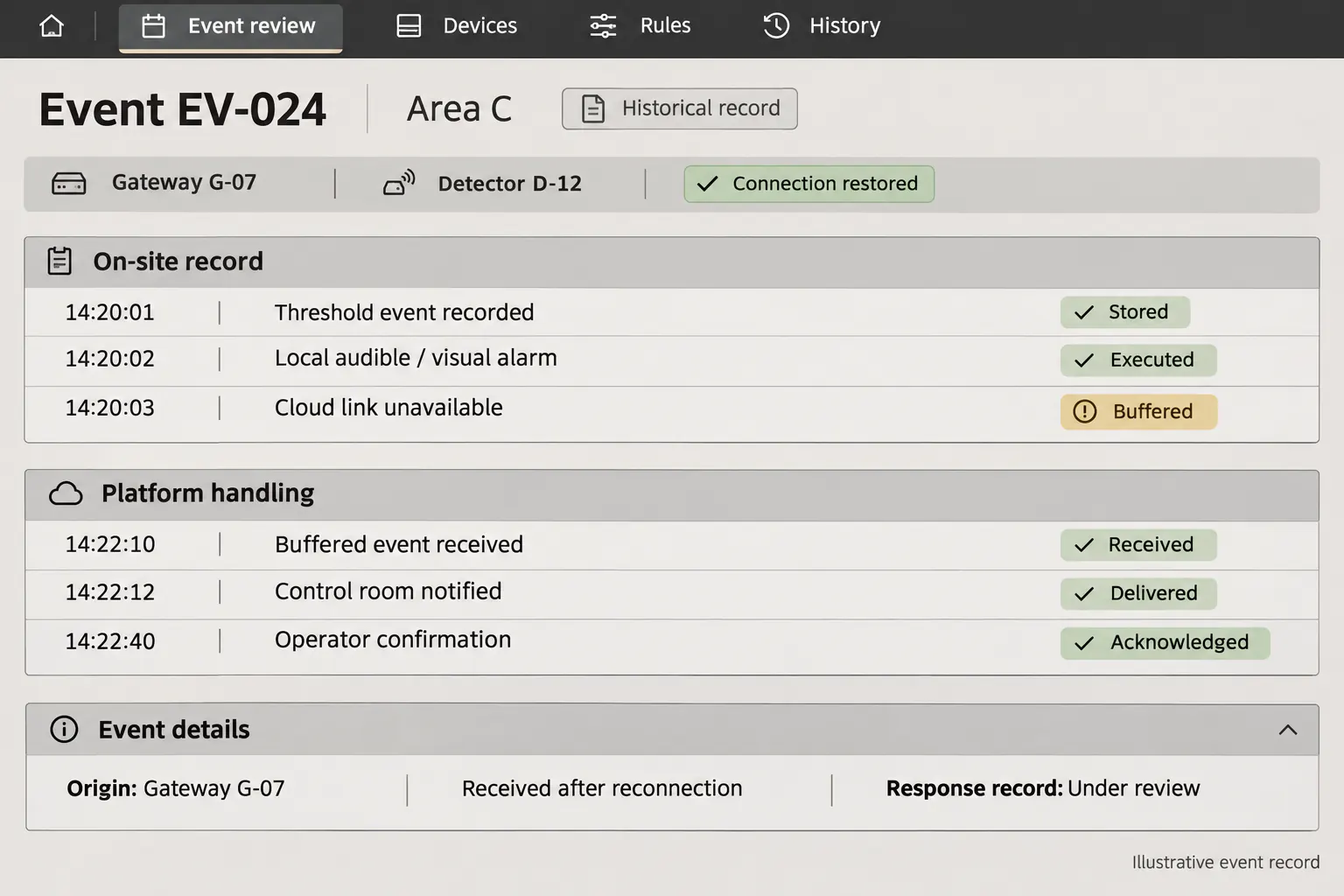
Concept reconstruction of a fictional historical event after reconnection. Times and states illustrate the handoff; they are not measured performance, operational thresholds, or response instructions. View full-size interface (new tab)
The operating challenge
An on-site alarm action could not depend entirely on an uninterrupted cloud connection. The gateway needed to filter incoming signals, evaluate configured thresholds, trigger local audible and visual alarms, and retain event information when the upstream link was unavailable.
The platform had a separate job: coordinating people and preserving the history around an event. A notification being delivered was different from an operator acknowledging it. The system needed to connect those states with the originating device and area, while supporting the roles involved in escalation and response.
The delivery decisions
Fixed detectors and wearable tags fed a common device and event model. Area, device health, personnel presence, motion, and fall information helped control-room staff interpret a signal in the context of the place and people it concerned.
Signal filtering, threshold evaluation, local alarm outputs, and event buffering ran at the edge. This kept those functions available during a cloud-link interruption and preserved information for the wider monitoring workflow.
The platform connected alarm levels and areas with notification paths for control-room, field, and management roles. Confirmation, escalation, and response records gave the team a history it could inspect after the immediate event.
The working detail
Event buffering matters because the gateway and the platform do not always see the same thing at the same time. The useful engineering boundary is between what the local equipment executed and what the platform has received, notified, and had acknowledged.
The delivered workflow connected those responsibilities with device, rule, and history management. Reviewing alarm, notification, and confirmation records gave the site a basis for incident review and maintenance discussions. The application supported the people responsible for response; it did not establish a substitute for site procedures or certified safety equipment.
The delivered result
Gateway filtering, threshold checks, alarm outputs, and buffering were part of the delivered scope.
The monitoring platform connected areas, devices, personnel information, and alarm history.
Notification, acknowledgment, escalation, and response records supported later review.
The delivery covered monitoring and response software with on-site gateway behavior. No incident-reduction, response-time, safety-certification, or uptime claim is made here.
Case taxonomy
Discuss your project
Tell us how your business works and where your software needs to change.
Get in touch
Tell us what you need to build, modernize, automate, or augment with AI. We can start with a focused discussion or a no-risk 1-week trial.

“A fantastic company to work with.” After the initial rapid development project, American Shipping Co. kept two Shinetech developers embedded for nearly four years, supporting internal and external tools and new AI initiatives.
 CEO, American Shipping Co. - 5-star Google Review