Commercial capabilities
Employers could purchase promotion, plans, and résumé-related services within the recruitment platform.


Human Resources · Recruitment marketplace
A recruitment marketplace connected paid job promotion, employer plans, and résumé access with multiple payment channels, keeping subscription and access states manageable as the platform evolved.
The business context
On a recruitment marketplace, paying can mean several different things: promoting a vacancy, subscribing to an employer plan, or gaining access to résumés. Job seekers have their own profiles and application workflows, while some users move between employer and candidate roles.
The client’s platform supported these activities across web and mobile experiences. Shinetech developed the product’s commercial and operational capabilities so that a purchase could be understood in terms of the access or service the customer expected.
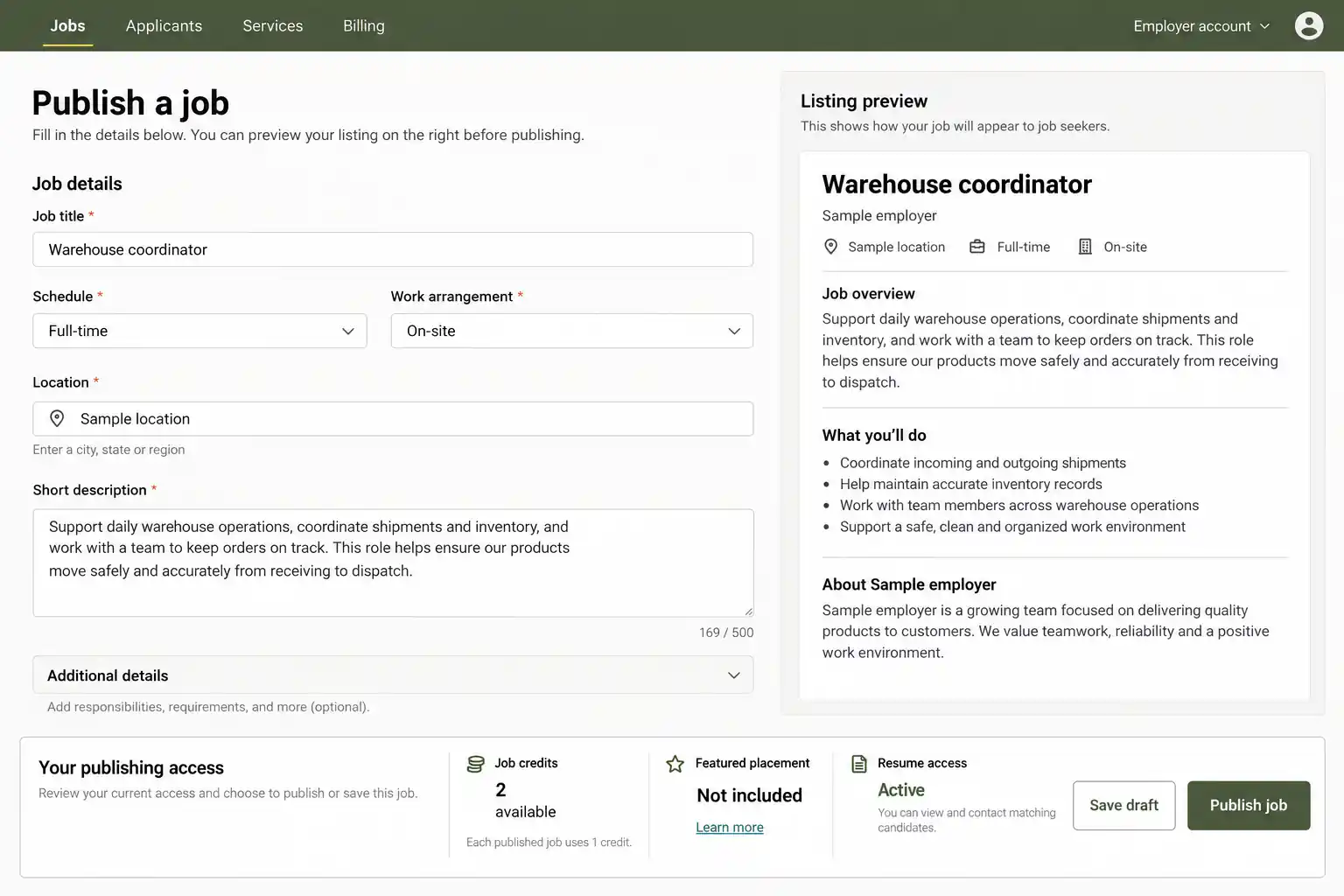
Fictional employer and job data illustrate how posting tools relate to purchased services. Plan names, balances, and access states are sample content, not the client’s commercial terms. View full-size interface (new tab)
The operating challenge
Web payments, regional payment methods, and mobile in-app subscriptions did not produce identical events. Renewals, delayed notifications, and repeated callbacks could leave an entitlement out of step with the payment record if each channel updated the product independently.
The platform also needed to evolve without breaking older interfaces used by existing clients. Authentication, payment, and administration were being separated into modules, while role-specific permissions and the distinction between employer and candidate data had to remain intact.
The delivery decisions
Promotion packages, employer plans, résumé services, and résumé-viewing subscriptions were modeled as product capabilities. This gave the application a business-level interpretation of payment rather than making access depend directly on a provider-specific screen or event.
Web and in-app subscriptions fed a common subscription model. Notification verification, transaction routing, and idempotent handling addressed repeated or delayed events, while invoicing integration connected the purchase to the financial record.
The team used a modular .NET application for authentication, payments, administration, and marketplace functions. Explicit contracts and compatibility across API versions supported ongoing mobile use while responsibilities were separated within the codebase.
How the workflow holds together
A renewal or purchase notification can be delivered more than once. Processing it again should not create a second commercial effect. The implementation used provider identifiers and notification deduplication as part of keeping subscription state coherent across channels.
Operational tools, audit records, and queued communications supported the staff responsible for resolving account questions. Multilingual routes and content made the public marketplace accessible across markets, but the central engineering concern remained the same: preserve the relationship between a user’s role, the product purchased, and the rights that follow.
The delivered result
Employers could purchase promotion, plans, and résumé-related services within the recruitment platform.
Different payment channels fed an operating model that staff could manage together.
Modular refactoring retained support for existing interfaces and mobile clients.
The platform supports marketplace functions, payments, subscriptions, and invoicing, with continuing product evolution across web and mobile interfaces.
Case taxonomy
Discuss your project
Tell us how your business works and where your software needs to change.
Get in touch
Tell us what you need to build, modernize, automate, or augment with AI. We can start with a focused discussion or a no-risk 1-week trial.
“A fantastic company to work with.” After the initial rapid development project, American Shipping Co. kept two Shinetech developers embedded for nearly four years, supporting internal and external tools and new AI initiatives.
 CEO, American Shipping Co. - 5-star Google Review