Multi-tenant context
Data and configuration needed to remain scoped to the correct customer organization.


HR software case study
An HR software provider needed to turn a broad set of employee-administration functions into a multi-tenant online service that its own team could operate.
The situation
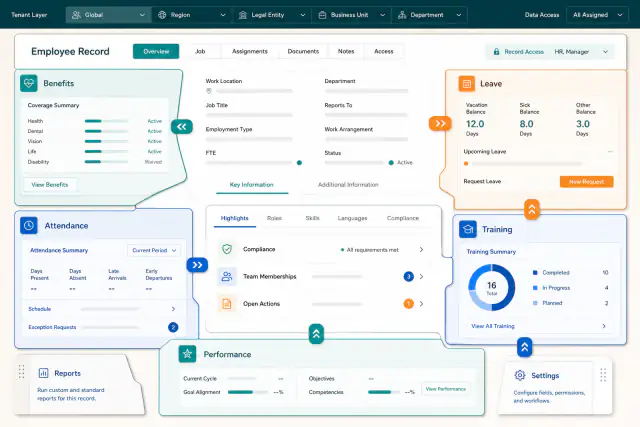
Core employee information was only one part of the service. Benefits, leave, attendance, training, performance, reporting, settings, and dashboards also needed a consistent product model.
The provider intended to offer the product as an online subscription service, which made tenant separation, permissions, configuration, and operational handoff part of the delivery problem.
The challenge
Shared employee records, tenant context, permissions, and reporting had to connect functions with different rules and priorities.
Data and configuration needed to remain scoped to the correct customer organization.
Benefits, leave, attendance, training, and performance each introduced different workflows.
The provider's team needed working software, visibility into progress, and a usable handoff.
The solution
Agile delivery kept priorities visible while Entity Framework and SQL Server supported the product's structured information.
Define tenant scope, employee records, module boundaries, permissions, reports, and settings.
Estimate and implement the most valuable functions in short, demonstrable increments.
Use continuous integration, demonstrations, and knowledge transfer so the provider could operate the service.
How the work was structured
The client-side business role and delivery leadership maintained priorities and estimates as the product evolved.
Daily communication and regular demonstrations gave stakeholders a concrete view of employee, benefit, leave, attendance, training, and performance functions.
Continuous integration kept changes moving through a shared engineering path, and final knowledge transfer prepared the provider's operating team to take ownership.
Order tenant, record, and module needs.
Deliver working HR functions in increments.
Review behavior and adjust priorities.
Transfer product and operating knowledge.
The result
The documented delivery brought the major HRIS modules into one SaaS product and concluded with handoff to the provider's own operating team.
Benefits, leave, attendance, training, and performance could relate to the same administrative record.
Priorities, estimates, increments, and demonstrations gave stakeholders regular product feedback.
Knowledge transfer supported the provider's ability to operate the delivered SaaS product.
Case taxonomy
Turn HR workflows into one service
Get in touch
Tell us what you need to build, modernize, automate, or augment with AI. We can start with a focused discussion or a no-risk 1-week trial.

“A fantastic company to work with.” After the initial rapid development project, American Shipping Co. kept two Shinetech developers embedded for nearly four years, supporting internal and external tools and new AI initiatives.
 CEO, American Shipping Co. - 5-star Google Review