



Most companies know how to evaluate whether a software team can start a project. They review technical skills, portfolio examples, proposed timelines, rates, and team size.
The harder question is whether that team can still make good decisions after the first release—when the easy requirements are gone, business rules have accumulated, integrations have become interdependent, and the cost of losing context is much higher.
A software development partner should do more than supply capacity. The right partner understands why the software exists, preserves knowledge across releases, reduces management overhead, and helps the system improve as the business changes.
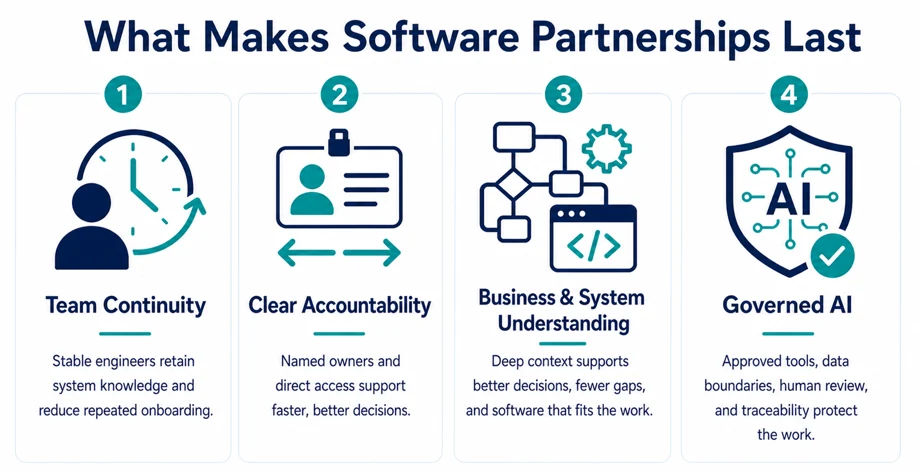
Before choosing a software development partner, evaluate four structural factors:
- How long the engineers assigned to your system are likely to stay.
- Who owns technical and delivery outcomes.
- How deeply the team understands your business and the system behind it.
- How secure development and AI-assisted work are governed.
These questions reveal more about long-term fit than a polished proposal or a long list of technologies.
1. Will the Engineers Who Learn Your System Stay With It?
Software knowledge is cumulative. A developer who has worked inside a platform for several years understands more than its architecture. They know why exceptions exist, which workflows are commercially critical, where integrations are fragile, and which apparently simple changes could create downstream problems.
When that developer leaves, documentation helps, but it does not preserve every decision or piece of operating context. The replacement must rebuild that knowledge while the company pays for onboarding, reviews, and slower delivery.
Team continuity is therefore a business measure, not simply an HR statistic.
A development partner should be able to explain team stability with specific numbers, named people, and a clear transition process. Company age is not enough: a firm can have decades of history while rotating engineers through a client account every year.
What to ask
- What is the average tenure of individual engineers at your company?
- What has annual voluntary turnover been for the last three years?
- How many people who would start on our project are expected to remain dedicated to it?
- Can team members be reassigned without our approval?
- What happens if a key engineer leaves?
- Is transition time charged to us?
- How is architectural and business context documented?
Ask for answers in writing and distinguish company age from employee tenure. What matters is whether the people who understand your system are likely to remain close to it.
What continuity looks like at Shinetech
Shinetech reports an average developer tenure of more than eight years and more than 420 long-term partnerships. Its model is designed around dedicated engineers who understand a client's systems and remain close to the work as it evolves.
For a major property and retail company, a Shinetech team has supported an 11-plus-year partnership, delivered more than 60 production releases, and helped support systems used across more than 300 locations. The value in a relationship like that is not only delivery capacity. It is the context retained across releases, integrations, and changes in business priorities.
2. Who Owns the Outcome?
A project manager or business analyst can add real value on a complex program. The problem is not the existence of those roles. The problem is an opaque relay chain in which the people making technical decisions never speak directly with the people who understand the business need.
That structure creates predictable failure modes:
- Requirements lose context as they pass through multiple handoffs.
- Technical constraints surface late.
- Questions wait for the next scheduled meeting instead of being resolved quickly.
- The client knows who reports status but not who can make a decision.
- Delivery appears on track until the completed work is reviewed against the real need.
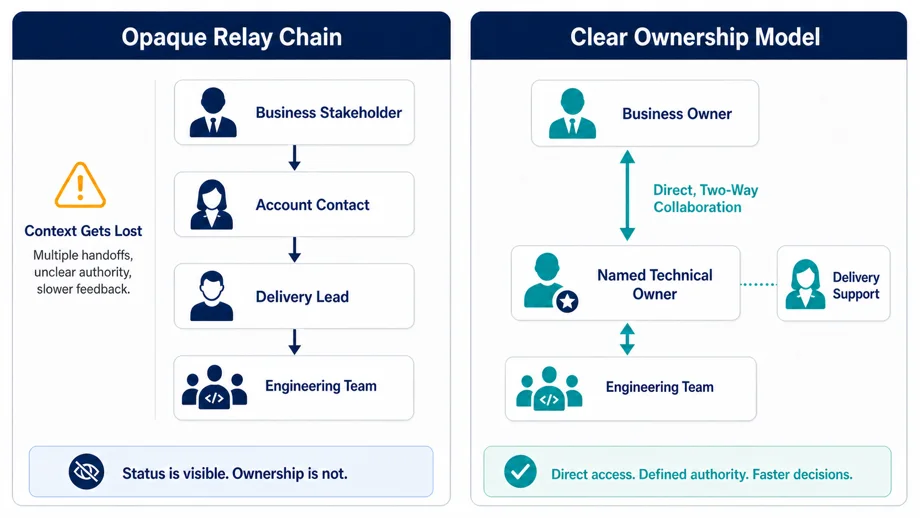
Companies should be able to identify a named owner for product alignment, technical decisions, delivery, and escalation. In a small engagement, one senior engineer may cover several of those responsibilities. In a larger program, the roles may be distributed. What matters is that the structure is explicit.
What to ask
- Who will we speak with during discovery and day-to-day delivery?
- Will our product owner have direct access to the engineers building the software?
- Who can challenge a requirement or propose a better approach?
- Who owns architecture decisions?
- Who is accountable when a release misses an agreed outcome?
- Which decisions require escalation, and how long does escalation normally take?
Request a simple responsibility map. It should show who is responsible, who approves decisions, who must be consulted, and who receives updates. If a provider cannot draw that map clearly before the work starts, the operating model is unlikely to become clearer after the contract is signed.
What direct accountability looks like at Shinetech
Shinetech's partnership model emphasizes direct collaboration, named engineers, transparent delivery, and shared ownership. Clients work with the people doing the work, while delivery support is added where it helps the engagement rather than used as a barrier between the client and the technical team.
3. Do They Understand the Business Behind the Software?
A development team can implement a requirement correctly and still build the wrong thing.
The difference often comes down to context. A request such as "automate the approval process" may involve permission rules, audit history, exceptions, financial controls, customer commitments, and workarounds that exist for good reasons. A team that sees only the ticket will optimize the visible step. A partner who understands the workflow will ask what the change is meant to improve and what must not break.
Business and system understanding affects everyday technical decisions:
- Which requirements should be challenged before they become code.
- Which workflows create revenue, control cost, or protect customer experience.
- Which legacy behaviors encode important business rules.
- Where an integration, automation, or AI feature will create operational risk.
- How a proposed architecture will affect the people who use the system.
- Which improvements matter now and which can wait.
This knowledge cannot live only with an account manager. The engineers making design and implementation decisions need enough context to connect technical choices to business outcomes.
What to ask
- How will the proposed team understand our workflows before development begins?
- Who translates a business objective into technical options?
- Can the engineers challenge a requirement directly?
- How is business context preserved across releases?
- What experience does the team have with systems, workflows, or industries like ours?
- Can you show an example where understanding the business changed the proposed solution?
Listen for examples of decisions, tradeoffs, and outcomes—not only technology lists. A credible partner should be able to explain how business context changed what the team built.
What business understanding looks like at Shinetech
Shinetech engineers work directly with client teams and stay close to the systems they build and maintain. That continuity allows knowledge of workflows, users, integrations, and operating constraints to compound rather than reset with every release.
The goal is not to turn every developer into a business executive. It is to give the people making technical decisions enough context to identify weak assumptions, propose better options, and build software that fits how the business actually operates.
4. Is AI-Assisted Delivery Secure and Governed?
AI coding tools are becoming part of normal software delivery. The relevant question is no longer simply whether a partner uses AI. It is whether the partner can explain where AI is used, what information the tools can access, and how generated output is reviewed.
The U.S. National Institute of Standards and Technology's AI Risk Management Framework organizes AI risk work around four functions: govern, map, measure, and manage. NIST's Secure Software Development Framework also provides practices for reducing software vulnerabilities, with additional guidance for generative AI and dual-use foundation models.
Those frameworks point toward practical questions for any development partnership:
- Which AI tools and models are approved?
- Are client code, prompts, or business data retained by a model provider or used for training?
- Can developers submit source code, logs, tickets, or production data to public AI tools?
- Are enterprise accounts and client-controlled configurations required?
- What repository and file access can an AI tool receive?
- How are secrets and personal data detected before information is sent to a model?
- What human review, testing, security scanning, and license checks apply to generated code?
- Are AI-assisted changes traceable through normal pull-request and audit processes?
- How are AI-related incidents reported?
"Our developers use AI to move faster" is not a governance answer. A credible partner should be able to show an approved-use policy, technical controls, review requirements, and a clear boundary around client information.
AI also does not replace system knowledge. A tool can help a capable engineer draft tests, analyze code, or accelerate a well-defined implementation. It does not automatically know why a five-year-old workflow behaves differently for a specific customer segment. AI is most useful when paired with engineers who already understand the system and are accountable for the result.
What governed AI delivery looks like at Shinetech
Shinetech uses AI-assisted workflows to support engineering work while maintaining human oversight around architecture, security, quality, and business fit. Its public security commitments include NDAs, client-controlled environments where required, ISO 27001 certification, and Cyber Essentials Plus certification.
Buyers should still validate the controls that apply to their own engagement. A certification is useful evidence, but it does not replace a project-specific review of access, data flow, tools, and contractual responsibilities.
A Better Way to Compare Software Development Partners
Swipe horizontally to compare all columns →
| Evaluation factor | Weak evidence | Strong evidence | Shinetech's published model |
|---|---|---|---|
| Team continuity | Company founding year or vague claims about retention | Average engineer tenure, recent turnover, named team, and a written replacement process | 8+ years average developer tenure; 420+ long-term partnerships |
| Accountability | A sales contact and generic delivery diagram | Direct access to engineers, named technical owner, clear decision rights, and an escalation path | Direct collaboration with dedicated engineers and transparent delivery |
| Business and system understanding | A technology list and generic discovery workshop | Direct engineer involvement, workflow knowledge, relevant examples, and evidence that context changes technical decisions | Long-term engineers who work directly with clients and retain system and workflow knowledge |
| AI and software security | "We use AI" or a certification logo alone | Approved-tool policy, data boundaries, secure development practices, human review, and traceability | AI-assisted delivery with human oversight; ISO 27001 and Cyber Essentials Plus |
All Shinetech figures in this table are company-reported. Buyers should verify any provider's claims during due diligence.
Software Development Partner Evaluation Scorecard
Score each category from 1 to 5.
Swipe horizontally to review the full scorecard →
| Category | Score | What a 5 requires |
|---|---|---|
| Team continuity | 5 | Verifiable tenure data, named team, stable allocation, and a no-cost or clearly defined transition process |
| Accountability | 5 | Direct access, named owners, documented decision rights, and a tested escalation path |
| Business and system understanding | 5 | Direct engineer involvement, clear discovery, relevant workflow experience, and examples of business context changing the solution |
| AI and secure-development governance | 5 | Approved tools, documented data boundaries, human review, testing, traceability, and incident handling |
| Total | 20 |
How to interpret the score
The score is a screening tool, not a substitute for technical, security, legal, or financial due diligence.
10 Questions to Ask Before Signing
- What is the average tenure of your individual engineers, and how is it calculated?
- Who are the actual people proposed for our project, and what responsibilities will each person own?
- Can any of those engineers be reassigned without our approval?
- Who owns technical decisions, delivery outcomes, and escalation?
- How will the team understand our workflows, users, and business rules?
- Can you show an example where business context changed the technical solution?
- How will the team work inside our tools, repositories, review process, and engineering standards?
- Which security, IP, access, and incident-notification terms will appear in the contract?
- Which AI tools may be used, and what information are they prohibited from receiving?
- Can we test the working model with the proposed engineers before making a longer commitment?
Specific answers are more valuable than confident answers. Ask for names, numbers, documents, and examples.
Test the Partnership With Real Work
Proposals and presentations show what a provider says. A short, controlled trial shows how the team actually works.
Use a bounded task that is representative of the future engagement but does not expose unnecessary production risk. Before the trial, define what you will evaluate:
- How quickly the engineer understands the business objective.
- The quality of clarifying questions.
- Communication during normal delivery work.
- Ability to work in your tools and standards.
- Code quality, testing, security, and documentation.
- Willingness to challenge a weak assumption.
- Quality of the handoff and explanation.
The trial should use the engineers proposed for the long-term work. A demonstration by a separate presales team does not validate the delivery model.
Shinetech offers a 1-week trial under NDA so companies can evaluate technical fit, communication, and delivery quality before making a longer commitment.
Frequently Asked Questions
What makes a good software development partner?
A strong software development partner combines stable engineers, clear ownership, business and system understanding, secure delivery practices, and the ability to improve the software after the first release.
How is a software development partner different from a project vendor?
A project vendor is usually measured against a defined scope and handoff. A development partner stays close to the system, understands the business context behind requirements, and helps make decisions as the product and priorities evolve.
Should price be the main factor when choosing a development partner?
Price matters, but an hourly rate does not show how much management, rework, onboarding, or knowledge loss the engagement may create. Compare total delivery value, continuity, decision quality, and long-term maintainability alongside cost.
How can we tell whether the proposed engineers will stay?
Ask for average individual engineer tenure, recent voluntary turnover, named team members, reassignment rules, and the written process for replacement and knowledge transfer.
What should we ask about AI-assisted software development?
Ask which tools are approved, what code or data they can access, whether information is retained or used for training, how generated code is reviewed and tested, and how AI-assisted changes remain traceable.
How is Shinetech different from a staffing marketplace?
Shinetech provides dedicated engineers and software teams designed for long-term collaboration rather than one-time placement. Its published model emphasizes eight-plus-year average developer tenure, direct client-engineer collaboration, business context, more than 420 long-term partnerships, and a 1-week trial with a proposed developer.
Choose a Partner, Not Just a Provider
The strongest software development partner is not necessarily the one with the lowest rate, the largest talent pool, or the most elaborate sales process. It is the one that can show who will do the work, how long they are likely to stay, how they will understand the business, who owns the outcome, and how secure and AI-assisted delivery are governed.
Treat those answers as operating requirements, not marketing details. Put them in writing, speak with current clients, and test the model with real work before committing.
If you are evaluating a software development partner, Shinetech can walk you through its delivery, continuity, security, and AI-governance approach or let you evaluate a dedicated engineer through a 1-week trial.
Sources
AI and secure software development
- U.S. National Institute of Standards and Technology. AI Risk Management Framework.
- U.S. National Institute of Standards and Technology. Artificial Intelligence Risk Management Framework: Generative Artificial Intelligence Profile.
- U.S. National Institute of Standards and Technology. Secure Software Development Framework.
Shinetech proof points
- Shinetech Software. About Shinetech.
- Shinetech Software. How We Partner.
- Shinetech Software. AI-Ready Dedicated Developers and Teams.
- Shinetech Software. Real Estate Software Development: U.S. Property and Retail Case Study.
- Shinetech Software. Cyber Essentials Plus Certification.
- Shinetech Software. 1-Week Free Trial.