


Imagine a distributor asking for an order dashboard. The development team delivers every feature: filters, alerts, reports, a clean interface. AI helps them finish sooner. Yet orders still wait for approval, employees still reenter information, and customers still call to ask where their shipments are.
The software works. The business problem remains.
This example raises an important question for any business investing in AI-assisted software development: when building becomes easier, how do we make sure we are building something that improves the business?
Our starting point is simple:
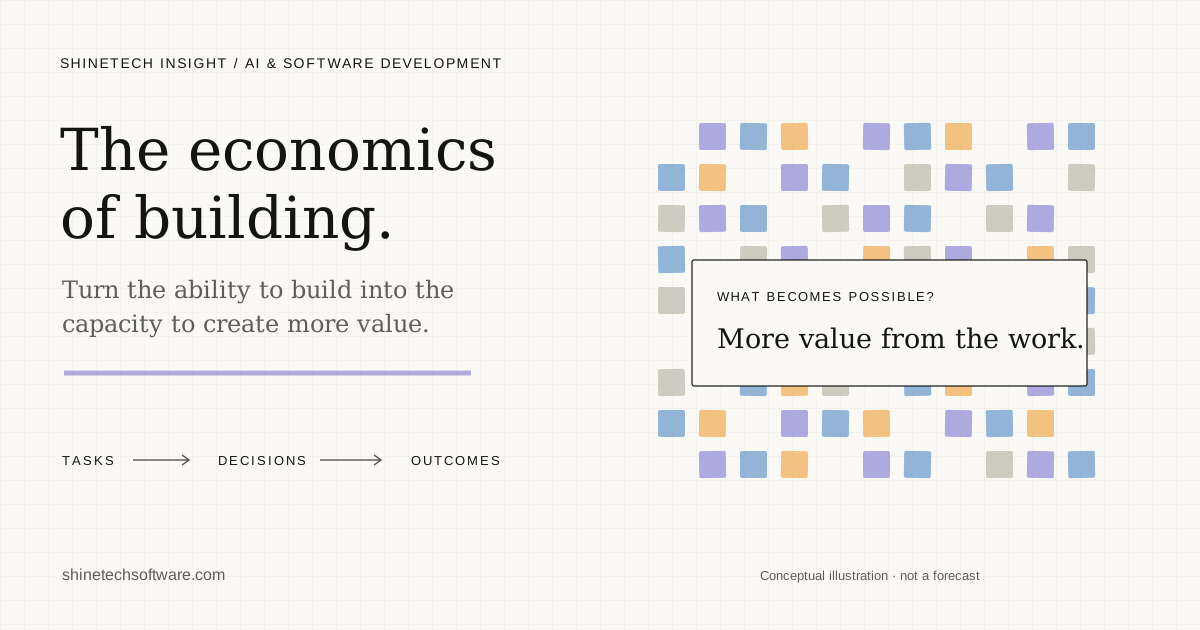
The economics of building is about turning the ability to build into the capacity to create more value.
Here, “building” means developing software and putting it to work in a business. The economic question is what that work costs, which opportunities it makes viable, and whether the value it creates justifies the investment.
A task map reveals where the work can change
Shinetech’s interactive Developer Tasks map explores 73 tasks across nine phases, from discovery and requirements to delivery and operations. It also introduces four categories of work involving AI, including agent development and enterprise knowledge bases.
The map shows how much software development involves work beyond writing code: understanding a client’s business, setting priorities, defining acceptance criteria, coordinating dependencies, and supporting people after launch.
Its participation percentages and 2030 outlook are hypothetical scenarios, not measured time savings or forecasts of job losses. Each square represents a task, not an equal share of a working day.
Use the map to ask what happens after a task becomes easier. If preparing a requirements document takes less time, does the team use that capacity to understand the problem better? If generating tests becomes faster, does the team investigate more ways the system could fail?
The answer determines whether an efficiency gain becomes useful capacity.
More productivity does not guarantee more value for everyone
The research paper Economic Scenarios for Transformative AI offers a broader perspective. Anton Korinek, Charles I. Jones and their coauthors model how different paths of AI capability and adoption could affect the U.S. economy through 2030.
In their substantial-change scenario, GDP is 8.3% above a hypothetical no-AI path by the start of 2030, while wages in cognitive occupations are 0.3% below that path. These are conditional model results, not predictions, and the authors assign no probabilities to their scenarios.
The distinction matters: a more productive economy does not automatically reward every worker or team. The paper examines aggregate outcomes; our application to software teams is an interpretation, not a finding that the model directly tests.
For a team, the practical question is how to use the time AI frees up. Producing the same output in fewer hours can reduce costs. Creating additional value means putting that time to work on another business need.
Look for the business bottleneck behind the feature request
Return to the distributor. “Build an order dashboard” describes a deliverable. “Reduce the time from order receipt to confirmed shipment” describes an outcome the business can examine.
Investigating that outcome might reveal that the real delay comes from missing customer information or a pricing exception waiting for approval. A better dashboard could make the delay more visible without shortening it.
A team responsible for the outcome can propose a smaller, more useful intervention: validate information at entry, connect the relevant systems, or route exceptions to the right person. AI may help implement and test it, but selecting the intervention depends on understanding the workflow.
Before development begins, agree on the baseline, the expected change, and the evidence that would justify further investment. After release, check whether people actually use the new process and whether the result improves.
Economic value can mean more orders handled with existing capacity, less rework, faster cash collection, or fewer costly failures. Reliability and maintenance belong in that calculation too. Growth depends on systems that keep working.

Lower development costs can make more projects viable
There is another source of opportunity: work that businesses have wanted to improve but could not justify funding.
A specialized workflow used by a small group of customers may not have justified the cost of custom software. A small integration project may not have offered enough value to justify the investment. If AI reduces the total cost of building and running these systems, some could become viable.
This is a route from productivity to growth: serving customers who were previously too expensive to serve, improving neglected processes, or testing an offer that once required too much upfront investment.
Demand still needs to be demonstrated. Review, integration, training, support, and ongoing AI costs all belong in the business case. A prototype that is cheap to generate may still be expensive to operate.
Give teams the conditions to own an outcome
Moving toward economic outcomes changes the relationship between business leaders and developers. Teams need access to users and operational context, permission to question a proposed solution, and feedback after delivery.
Responsibility must come with decision rights. A developer cannot reasonably own an improvement in order processing while being denied access to the people who process orders. Business owners must remain involved in priorities and trade-offs.
Value creation and value capture also deserve separate attention. Customers may gain through lower costs or better service, while employees and suppliers receive little of that benefit. Greater responsibility alone does not guarantee higher pay or healthier margins.
For Shinetech, this suggests a standard for useful engineering collaboration: understand the business constraint, deliver a dependable change, and help the client determine whether it made a difference. Meeting the agreed requirements is an important measure of delivery. Business success also depends on what improves after launch.
Start with one workflow
Open the Developer Tasks map with a real project in mind. Identify a task AI could help your team complete faster, estimate the time that would free up, and choose a business outcome the team could use that time to improve.
Then choose one measure you can check after delivery. The opportunity begins when a team can connect a completed task to a better result for the business.
Explore the 73-task map and share your view, or talk with Shinetech about a workflow you want to improve.
Which task would you rethink first?
Bring one real workflow to the map. Identify where AI could free up your team’s time, then decide how to use it to improve the business.
Sources and Further Reading
- Korinek et al. (2026), Economic Scenarios for Transformative AI, The Anthropic Institute Working Paper No. 2026-02, pp. 3 and 31 (Table 3). Scenario outcomes are conditional and relative to a no-AI baseline.
- Shinetech Software, Developer Tasks. Task participation shares and the 2030 outlook are hypothetical; they do not measure working hours or employment effects.
The distributor example is illustrative, not a customer case study. The business interpretation is Shinetech editorial analysis; it is not a claim of endorsement by the research authors.