Complex inputs
Environmental information needed to be represented in a form suitable for deep-learning analysis.


Environmental data intelligence case study
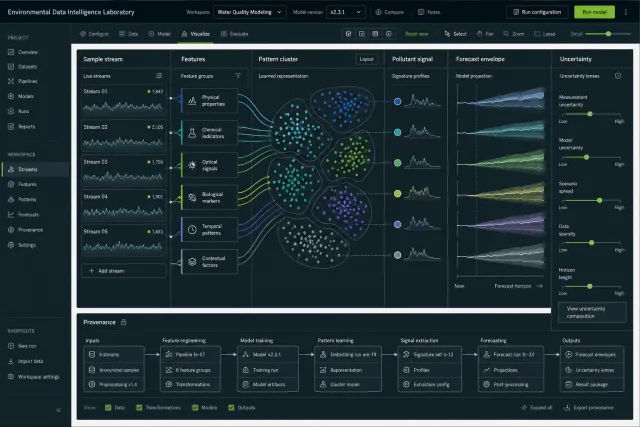
Deep-learning models analyzed complex environmental data, identified pollutant patterns, and supported predictive scientific decision-making.
The situation
The documented work centered on using deep learning to analyze environmental information.
The objective was not only to identify patterns but also to support predictive decisions.
The challenge
Analysis, pattern recognition, and prediction needed to form one coherent scientific workflow.
Environmental information needed to be represented in a form suitable for deep-learning analysis.
Model output needed to surface pollutant relationships rather than remain an opaque computation.
Recognized patterns needed to inform, not replace, scientific decision-making.
The solution
The published evidence supports a focused model-assisted path from complex data to scientific interpretation.
Apply deep-learning models to the documented environmental information.
Surface pollutant signals and relationships within the model output.
Present pattern evidence for forward-looking scientific decisions.
How the work was structured
Environmental data formed the analytical input.
Deep learning provided the pattern-identification capability.
Predictive evidence supported scientific review and decision-making.
Process complex environmental data.
Identify pollutant patterns.
Review the model-supported evidence.
Use it in predictive scientific work.
The result
The documented work used deep-learning analysis to identify environmental pollutant patterns and connect those findings to forward-looking decision support.
Complex environmental information became input to model-assisted analysis.
Deep learning helped identify pollutant relationships in the available data.
Predictive evidence remained part of a scientific review process.
Case taxonomy
Turn complex scientific data into reviewable model evidence
Get in touch
Tell us what you need to build, modernize, automate, or augment with AI. We can start with a focused discussion or a no-risk 1-week trial.

“A fantastic company to work with.” After the initial rapid development project, American Shipping Co. kept two Shinetech developers embedded for nearly four years, supporting internal and external tools and new AI initiatives.
 CEO, American Shipping Co. - 5-star Google Review