Role boundaries
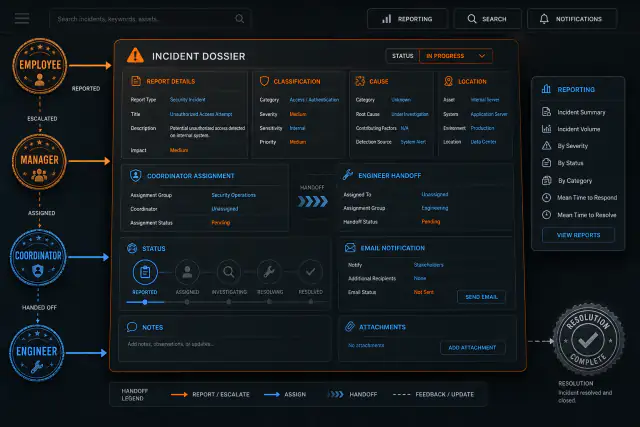
Employees, managers, coordinators, and engineers needed distinct actions and access.


Security operations case study
A services organization needed one role-based workflow for reporting incidents, classifying them, assigning responders, and tracking work to resolution.
The situation
Employees needed to record what happened, where it was detected, its status, cause, and other operational details.
Managers, coordinators, and engineers then needed different permissions and actions as an incident moved from intake to classification, assignment, investigation, and closure.
The challenge
The application had to make handoffs visible while keeping data access, status changes, notifications, and reporting consistent.
Employees, managers, coordinators, and engineers needed distinct actions and access.
Classification and assignment had to stay connected to the original incident record.
The layered product required functional, integration, security, and load verification.
The solution
The design connected intake data, classification, coordination, assignment, status, communications, search, and reports.
Collect the type, nature, cause, location, timing, and detection details needed for review.
Let managers classify the record and coordinators select internal or external response resources.
Keep assignments, status, email notifications, search, and reports attached to the same record.
How the work was structured
The application used layered design and an MVC approach to separate role-specific interfaces from business behavior and persistence.
Role-based authentication controlled access, while the data layer supported transactions and object caching around the SQL Server database.
Testing covered individual functions and components as well as security, integration, and load behavior.
Record the incident and its context.
Review type, cause, and priority.
Coordinate an internal or external responder.
Update status, notify stakeholders, and report.
The result
The documented product connected the full response lifecycle in one role-based workflow and gave each participant a defined place in the handoff.
Classification, assignment, communications, and resolution stayed attached to the originating record.
Each participant could act within a defined responsibility instead of sharing one unrestricted interface.
Multiple test types supported the layered application's documented quality process.
Case taxonomy
Make operational handoffs visible
Get in touch
Tell us what you need to build, modernize, automate, or augment with AI. We can start with a focused discussion or a no-risk 1-week trial.

“A fantastic company to work with.” After the initial rapid development project, American Shipping Co. kept two Shinetech developers embedded for nearly four years, supporting internal and external tools and new AI initiatives.
 CEO, American Shipping Co. - 5-star Google Review