

Business Software · Assessment Method method case
Turning Salesforce health checks into an improvement roadmap
This assessment-method case follows reported Salesforce issues into evidence, ownership, and a prioritized improvement plan. Worked examples illustrate the review; implementing the corrections is a separate stage.
The situation
Workarounds hid the real order of priorities
Consider three reported symptoms: conflicting sales reports, service requests routed to the wrong queue, and a manually checked integration job. Each problem has a workaround, so the team keeps operating while the list of concerns grows.
A business owner facing those symptoms needs to know what to fix first, which team should act and whether the problem requires configuration, data correction or wider development. The assessment turns that uncertainty into a prioritized set of decisions.
The challenge
A familiar symptom may have more than one cause
Different report totals can reflect bad data or different business definitions. A routing workaround can hide overlapping rules. Priorities need operating evidence and business context so an assumption does not become an expensive change request.
The solution
Each reported problem leads to evidence
| What a user reports | What the review examines | Decision the evidence supports |
|---|---|---|
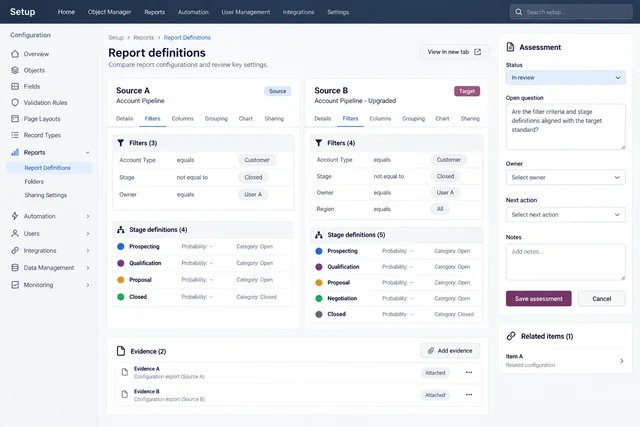
| “These pipeline totals do not agree.” | Report filters, stage definitions and representative opportunity records. | Whether to align a definition, correct data or investigate the calculation. |
| “This request reached the wrong team.” | Routing conditions, overlapping automation and the affected case history. | Which rule owns the decision and what examples must pass after a change. |
| “We keep checking this update manually.” | Job failures, source responses and the reconciliation process. | Whether a contained fix is sufficient or the interface needs separate work. |
Workflow detail
Worked example: two pipeline reports show different totals
Illustrative diagnostic example. It shows how an assessment can guide a later correction.
| Check | What it can reveal | Next decision |
|---|---|---|
| Compare report filters, dates and stage definitions | The reports may describe different populations. | Agree the business definition before changing records. |
| Compare the same underlying opportunities | Differences may remain even after the definitions match. | Investigate the affected values, calculations or automation. |
| Record a reproducible example and expected total | The future correction needs a clear acceptance check. | Assign the correction and retest the same records after implementation. |
Workflow detail
The roadmap follows business impact and evidence
- First
Stabilize current work
Name the operating owner, agree a response and retain outstanding reconciliation.
- Next
Deliver contained improvements
Resolve definitions and dependencies, then use clear acceptance examples.
- Then
Scope the larger change
Define the wider integration, development or implementation requirement.
How we work
Reproduce, trace and classify each reported issue
Shinetech starts with a user’s example and the business task it affects. For conflicting pipeline totals, the review compares report filters, stage definitions and representative opportunity records. For misrouting, it follows the affected case through routing conditions and overlapping automation. For delayed updates, it checks job failures, source responses and reconciliation steps.
Each finding records the evidence, remaining uncertainty, business consequence, owner and recommended next action. Business and technical owners then distinguish an immediate operating response, a contained correction and a larger change that needs separate scope and acceptance criteria.
Assessment output
Assessment output: evidence, ownership and next steps
Before the review
The starting examples show conflicting totals, misrouted requests and manual update checks without an agreed cause, owner or order of priority.
After the review
The roadmap records the evidence or open question for each issue, its owner and the recommended next action.
The immediate value is a justified next step for each issue, with an owner and a way to check the later correction. Completing those corrections is a separate stage from the assessment described here.
Case taxonomy
Explore the industry, technology, and business need.
Industry and product
- Cross-Industry
Technology and delivery
- Salesforce Platform
- Org Assessment
Business need
- Health Check
- Root-Cause Analysis
- Improvement Roadmap
- Technical Debt
Discuss your business systems
Need Salesforce to fit the way your team works?
Get in touch
Ready to build software that fits your business?
Tell us what you need to build, modernize, automate, or augment with AI. We can start with a focused discussion or a no-risk 1-week trial.

“A fantastic company to work with.” After the initial rapid development project, American Shipping Co. kept two Shinetech developers embedded for nearly four years, supporting internal and external tools and new AI initiatives.
 CEO, American Shipping Co. - 5-star Google Review