Moving assets
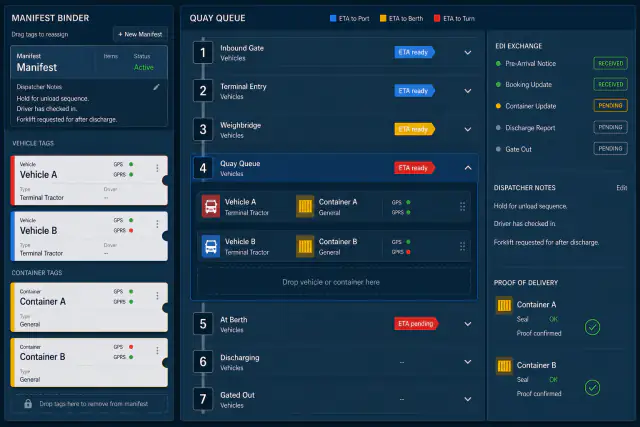
Vehicle and container assignments changed as work progressed through port stages.


Logistics technology case study
A port logistics operation needed live visibility into vehicle and container movements, coordinated control-center and mobile work, data exchange, arrival estimates, and proof of delivery.
The situation
The control center needed to see where vehicles and containers were in the operating process and estimate arrival at the next point.
Mobile terminals needed to exchange instructions and status with the central product, while EDI and electronic proof of delivery connected operational events with surrounding business processes.
The challenge
Tracking, mobile communication, mapping, EDI, and proof of delivery had to represent the same operational reality.
Vehicle and container assignments changed as work progressed through port stages.
Control-center web functions, mobile terminals, mapping, and EDI formed separate but connected workstreams.
Reusable components, builds, tests, and interfaces had to stay aligned across the product.
The solution
GPS, GPRS, GIS, web services, EDI, and electronic proof of delivery were organized around shared vehicle and container work.
Connect manifests, vehicles, containers, stages, dispatch instructions, and estimated arrival.
Use mobile terminals and wireless communication to exchange status and work information.
Connect EDI exchanges and electronic proof of delivery with the central operational record.
How the work was structured
Early prototypes helped stakeholders review the concept and operational interactions before full implementation.
Web, mobile-terminal, and EDI workstreams used a shared architecture, component model, interfaces, and delivery coordination.
Automated coding support, testing, and builds helped keep the integrated product moving through repeated implementation and validation.
Pair the operating work with vehicles and containers.
Receive location and movement status.
Synchronize mobile and EDI information.
Record arrival and electronic proof of delivery.
The result
The documented product combined live tracking, arrival estimates, mobile communication, business-data exchange, and electronic delivery confirmation in one extensible logistics platform.
Manifest, vehicle, container, stage, and status information stayed connected.
Mobile communication linked operating staff with the central control workflow.
Component and service-based design supported connections to mapping, EDI, and surrounding systems.
Case taxonomy
Connect physical movement and business data
Get in touch
Tell us what you need to build, modernize, automate, or augment with AI. We can start with a focused discussion or a no-risk 1-week trial.

“A fantastic company to work with.” After the initial rapid development project, American Shipping Co. kept two Shinetech developers embedded for nearly four years, supporting internal and external tools and new AI initiatives.
 CEO, American Shipping Co. - 5-star Google Review