Fragmented context
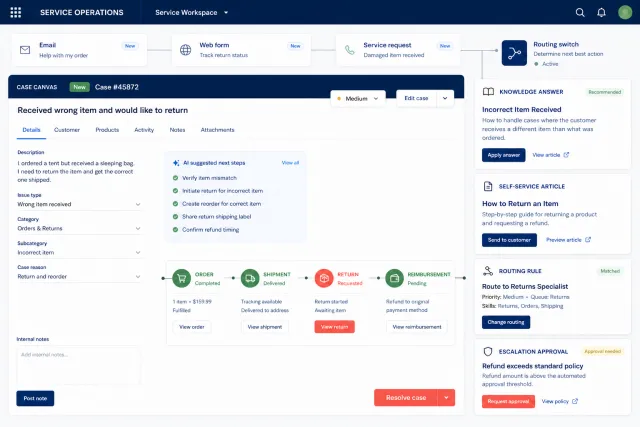
Agents needed customer, order, shipment, return, and reimbursement information in the same working view.


E-commerce service operations case study
Salesforce Service Cloud connected customer requests with commerce transactions, routing, escalation, knowledge, and self-service so support teams could resolve work with better context.
The situation
Customer information and transaction details were scattered, slowing case resolution and making order follow-through harder during busy periods.
The growing service operation also needed stronger self-service, knowledge management, and a platform that could scale with the commerce environment.
The challenge
Routing, approvals, self-service, and transaction synchronization all had to work as parts of one service workflow.
Agents needed customer, order, shipment, return, and reimbursement information in the same working view.
Rules, escalation, and approvals had to direct cases to the right service path.
The service platform needed reliable synchronization with the existing e-commerce system.
The solution
Configuration and integration were developed together so each support case could carry the transaction context needed for resolution.
Implement case routing, escalation, customer views, transaction views, and request-and-approval processes.
Synchronize customer requests and transaction data through REST and OData integration services.
Improve knowledge content, request visibility, and customer paths that do not require agent intervention.
How the work was structured
A combined local and remote team used Kanban, daily coordination, code review, and retrospectives.
Commerce synchronization was treated as part of the service workflow rather than a separate reporting feed.
Case outcomes remained trackable so the support process could be evaluated and refined.
Capture a customer request.
Apply ownership and escalation rules.
Use commerce and knowledge context.
Review service outcomes.
The result
The documented platform supported faster access to customer and transaction information while preserving case history for service review.
Customer requests and transaction data came together in one case workflow.
Knowledge and request options reduced dependence on manual support for every step.
Completed service work remained available for evaluation and refinement.
Case taxonomy
Connect every service case to the context behind it
Get in touch
Tell us what you need to build, modernize, automate, or augment with AI. We can start with a focused discussion or a no-risk 1-week trial.

“A fantastic company to work with.” After the initial rapid development project, American Shipping Co. kept two Shinetech developers embedded for nearly four years, supporting internal and external tools and new AI initiatives.
 CEO, American Shipping Co. - 5-star Google Review