Clinical workflow context
Engineers had to understand how appointment, symptom, medication, and therapy information fit together.


Healthcare software case study
A medication-management SaaS provider needed to expand delivery while improving security, performance, and usability across the therapy journey.
The situation
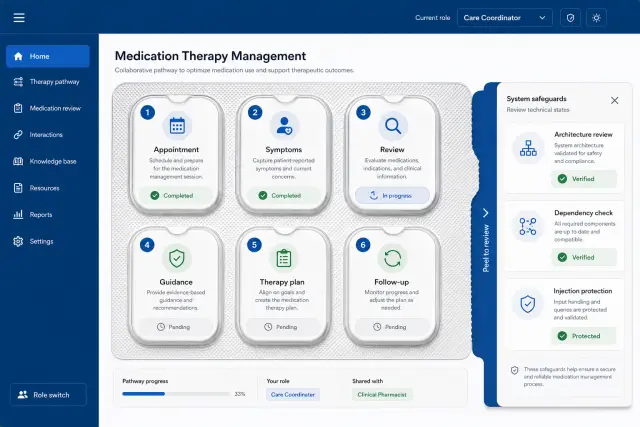
The SaaS product coordinated appointments, symptom information, medication guidance, and the broader therapy-management process.
The client needed additional engineering capacity, but the new team also had to understand a complex clinical workflow and improve the inherited technical foundation.
The challenge
The work combined product continuity with architecture and security improvement.
Engineers had to understand how appointment, symptom, medication, and therapy information fit together.
Performance concerns and a documented injection vulnerability required focused technical review.
Product improvements still had to move through a dependable delivery rhythm while the team gained context.
The solution
Delivery leadership, engineering, analysis, and quality practices were organized around one medication-management roadmap.
Use structured knowledge transfer and regular team communication to understand the end-to-end therapy workflow.
Review architecture, performance, dependencies, and input handling; address the documented injection risk.
Deliver successive changes aimed at clearer workflows, fewer avoidable user errors, and easier product operation.
How the work was structured
The team combined product discovery with technical investigation instead of treating the inherited codebase as a black box.
Security findings were connected to architecture and implementation decisions, then checked within the regular delivery process.
Short feedback cycles kept therapy-workflow behavior visible while engineering changes moved through review and release.
Map product, architecture, and risk.
Build shared workflow knowledge.
Address security and performance.
Deliver reviewed improvements.
The result
The documented engagement connected product releases with architecture, performance, security, and usability work.
Knowledge transfer reduced the separation between technical work and therapy-management behavior.
Architecture and input-handling risk were reviewed as part of product engineering.
Successive releases focused on making the product clearer and easier to operate.
Case taxonomy
Strengthen the product while delivery continues
Get in touch
Tell us what you need to build, modernize, automate, or augment with AI. We can start with a focused discussion or a no-risk 1-week trial.

“A fantastic company to work with.” After the initial rapid development project, American Shipping Co. kept two Shinetech developers embedded for nearly four years, supporting internal and external tools and new AI initiatives.
 CEO, American Shipping Co. - 5-star Google Review