Preserve core behavior
Existing formulation and ingredient capabilities had to remain represented.


Process manufacturing case study
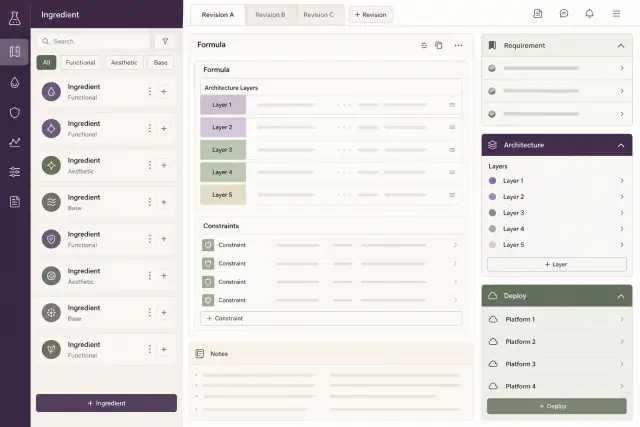
A vertical ERP product for ingredient and formulation businesses needed a new architecture that preserved existing capabilities while creating room for planned product features.
The situation
The existing software supported ingredient and formulation businesses with established domain capabilities.
Modernization had to preserve that behavior, account for planned features, and support deployment across Windows, Linux, and AIX environments.
The challenge
The work spanned business modeling, product vision, requirements, architecture, implementation, and deployment.
Existing formulation and ingredient capabilities had to remain represented.
Planned features needed to become explicit requirements and architectural responsibilities.
The Java product needed to operate across multiple server platforms.
The solution
RUP practices organized requirements, design, implementation, and deployment around a shared product model.
Capture formulation concepts, ingredient relationships, and established ERP behavior.
Translate the product vision and planned capabilities into reviewable requirements.
Implement a Java and AJAX architecture for WebSphere and supported operating environments.
How the product work was structured
Business modeling established the concepts and relationships that the ERP needed to represent.
Product vision and requirements engineering aligned current capabilities with planned additions.
Architecture, implementation, and cross-platform deployment then followed the same model instead of becoming separate interpretation steps.
Describe formulation and ingredient behavior.
Turn vision into product requirements.
Create the cross-platform Java foundation.
Implement and deploy the modernized product.
The result
The documented work covered business modeling, product vision, requirements, architecture, implementation, and deployment using Java, AJAX, WebSphere, and RUP.
The new product model accounted for established ERP capabilities.
Future product ideas became requirements and architectural decisions.
Modeling, requirements, implementation, and deployment remained connected.
Case taxonomy
Connect product vision with an implementable foundation
Get in touch
Tell us what you need to build, modernize, automate, or augment with AI. We can start with a focused discussion or a no-risk 1-week trial.

“A fantastic company to work with.” After the initial rapid development project, American Shipping Co. kept two Shinetech developers embedded for nearly four years, supporting internal and external tools and new AI initiatives.
 CEO, American Shipping Co. - 5-star Google Review