Protect counterpart identities
Buyer and vendor addresses had to remain hidden from one another throughout the exchange.


Professional services case study
A project-coordination company needed buyers and vendors to communicate through shared project threads without exposing either party’s real email address or losing the history behind each engagement.
The situation
The coordinator’s work depended on smooth communication among buyers, its own project team, and offshore vendors. Every message needed to remain connected to the right project so participants could understand the history and current status.
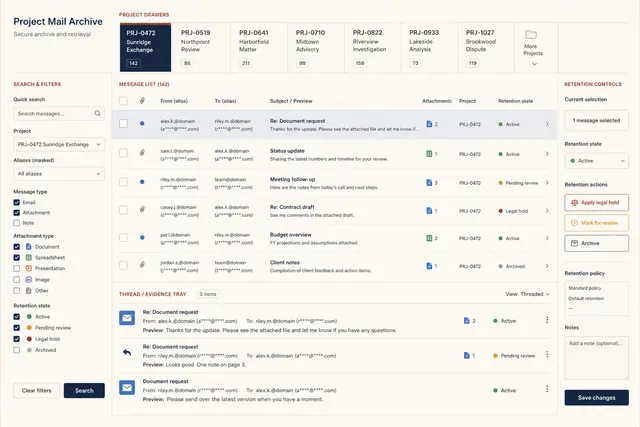
At the same time, buyers and vendors were not supposed to see one another’s real email addresses. The system needed to preserve privacy, define who could communicate on each project, and retain an auditable project-level archive.
The workflow challenge
The solution could not require participants to abandon email, yet every message needed controlled routing, searchable history, and clear project permissions.
Buyer and vendor addresses had to remain hidden from one another throughout the exchange.
Messages sent and received by different parties needed to remain visible as one chronological project conversation.
The coordinator needed to define who could communicate within each project and distribute progress information to the right people.
The solution
Messages were preprocessed before delivery so participants could use email while the system controlled identity exposure and project classification.
Translate the sender and recipient into coordinator-managed addresses before a message leaves the relay.
Send an identified copy of each project message to a designated mailbox and organize it under the correct project folder.
Use configuration, participant permissions, wildcard search, and scheduled reports to keep communication manageable.

How we worked
The team translated the three-party communication policy into a technical specification and structured the server around configurable rules.
Address processing, project identification, archive copies, and permission checks were designed as parts of one message path.
Testing was performed in the client’s server environment so mail behavior and configuration could be evaluated where the workflow would operate.
Attach the message to the correct project and participant.
Replace exposed addresses with coordinator-managed identities.
Deliver the message only to permitted project recipients.
Store a project copy and issue scheduled progress communication.
The result
The documented system preserved email as the working channel while adding address masking, project archives, participant permissions, flexible search, and scheduled reporting.
Participants could continue using email instead of learning an unrelated messaging product.
Archived copies kept the conversation associated with the project that produced it.
Identity protection was handled by the mail workflow rather than left to individual users.
Case taxonomy
Keep project communication controlled
Get in touch
Tell us what you need to build, modernize, automate, or augment with AI. We can start with a focused discussion or a no-risk 1-week trial.

“A fantastic company to work with.” After the initial rapid development project, American Shipping Co. kept two Shinetech developers embedded for nearly four years, supporting internal and external tools and new AI initiatives.
 CEO, American Shipping Co. - 5-star Google Review