

Business Software · Support Method method case
Organizing Salesforce incident recovery and controlled change
This service-method case illustrates how Salesforce support can separate incident recovery and reconciliation from planned workflow changes. The examples describe the operating method, not measured results for a named client.
The situation
Daily reliability depends on finding issues and controlling change
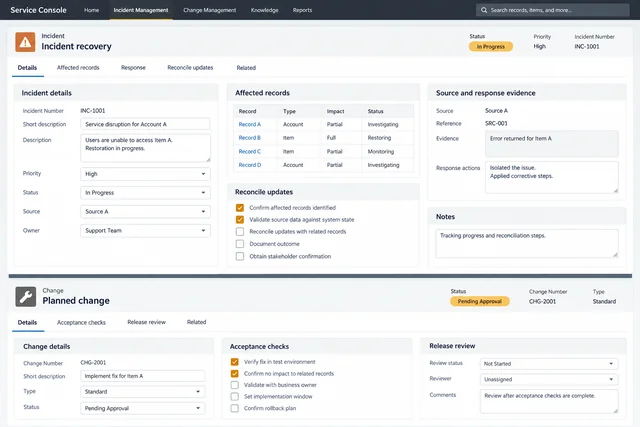
As Salesforce evolves, new routing rules, permissions and interfaces can affect work already in progress. A recurring support need is to notice incomplete processing, establish its business impact and improve the underlying workflow. Consider an order status that has stopped updating while a new routing rule is also being requested.
An outdated status affects work already in progress. A routing change needs a business decision, development and a release. Both requests enter support intake, but the routing change belongs in the planned improvement backlog.
The challenge
Connect operational signals to a business owner and response
A failed job or interface response is useful only when someone can identify the affected customer task and decide what to do next. Routine review should connect those signals to ownership, recovery and reconciliation. Requested changes also need controlled release so that fixing one workflow does not disrupt another.
The solution
Routine review, incident recovery, and change follow defined paths
Order update fault
- Review job status and source responses
- Identify affected records and a workaround
- Restore the connection and reconcile updates
Routing request
- Agree the new business rule
- Test representative cases and a recovery plan
- Release and review the result with users
The support method uses job, permission and interface checks to give the team operating context. An incident stays open through recovery and reconciliation; a routing change needs a separate acceptance decision.
Workflow detail
What a proactive operating review can examine
Illustrative operating checks for the support method. The response depends on the available evidence and agreed support scope.
| Signal | Business question | Response to define |
|---|---|---|
| Failed jobs or interface errors | Which records and customer tasks are affected? | Assign an owner, trace the source response and reconcile incomplete work. |
| Repeated manual corrections | Is a recurring rule or mapping issue creating avoidable work? | Review the pattern and scope a corrective change with acceptance checks. |
| A retry or recovery request | Could repeating the operation create a duplicate or inconsistent record? | Confirm processing state before retrying; use human review when the outcome is uncertain. |
Workflow detail
Recurring work informs the next release
- 01
Review the evidence
Look at repeat faults and manual work.
- 02
Agree the priority
Weigh business impact, effort and dependencies.
- 03
Release the change
Use acceptance examples and a recovery plan.
- 04
Check the task
Confirm the affected workflow with users.
A recurring order-update issue may need a contained correction, better exception handling or a separately scoped interface change.
How we work
Move from evidence to recovery, then plan improvements
Service onboarding records connected systems, access, job status, logs, business owners and escalation contacts. During routine upkeep, the team reviews the jobs and interfaces that affect customer work. For a fault, the support owner traces source responses, identifies affected records, agrees a workaround, restores service and reconciles outstanding updates with the business owner.
Recurring faults and manual work are reviewed in the improvement backlog. A requested routing change follows its own rule definition, test examples, release decision and user review. The documented response steps keep recovery, reconciliation and follow-up visible to the business owner.
Method output
Recovery and change leave a record the next team can use
The support backlog separates immediate incidents, routine upkeep and planned improvements. An incident records the source response, affected task, workaround and reconciliation; a change records its business rule, acceptance examples and release outcome.
The operating record provides a basis for identifying repeat faults and deciding where process or integration changes are needed. The aim is more dependable daily work and easier support, with prevention and recovery decisions grounded in the operating record.
Case taxonomy
Explore the industry, technology, and business need.
Industry and product
- Cross-Industry
Technology and delivery
- Salesforce Platform
- Support & Managed Services
Business need
- Proactive Review
- Incident Recovery
- Controlled Release
- Continuous Improvement
Discuss your business systems
Need Salesforce to fit the way your team works?
Get in touch
Ready to build software that fits your business?
Tell us what you need to build, modernize, automate, or augment with AI. We can start with a focused discussion or a no-risk 1-week trial.

“A fantastic company to work with.” After the initial rapid development project, American Shipping Co. kept two Shinetech developers embedded for nearly four years, supporting internal and external tools and new AI initiatives.
 CEO, American Shipping Co. - 5-star Google Review