Desktop logic discovery
Existing functions and business processes had to be understood before they could be represented accurately on the web.


EHS and sustainability case study
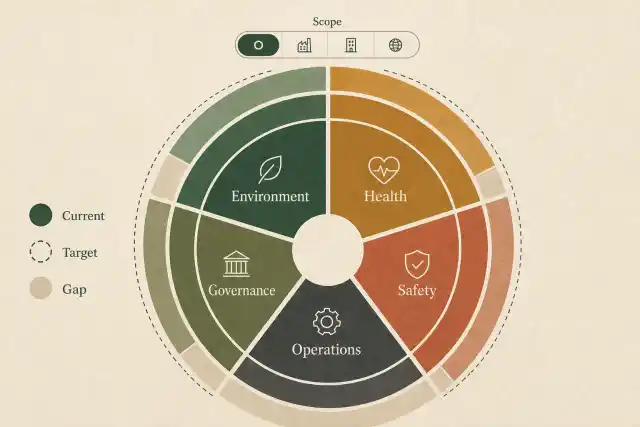
An EHS advisory provider needed to move a desktop planning tool to the web so groups across an organization could define scope, assess current practices, set goals, evaluate gaps, and turn strategy into action plans.
The situation
The existing MS Access application helped structure environmental, health, safety, and sustainable-business thinking, but it remained tied to a traditional desktop model.
The client wanted a web application that could guide multiple groups through the same strategic process while controlling access and preserving the business logic of the established tool.
The product challenge
The migration required a careful understanding of the desktop tool, a clearer collaborative workflow, and an architecture suitable for a permission-controlled web product.
Existing functions and business processes had to be understood before they could be represented accurately on the web.
Users needed a coherent path from selecting scope to assessment, goals, gap analysis, business value, and action planning.
Different groups needed web access without removing the permissions required for responsible planning.
The solution
The team studied the existing application, documented use cases, built a prototype, and implemented the web experience through distinct presentation, business, and persistence layers.
Translate the desktop processes into use cases that connect scope, assessment, goals, gaps, value, and action.
Test an interface that explains EHS elements in context and keeps the guided workflow understandable.
Use Struts for the web layer, EJB for persistence and transaction concerns, DB2 for data, and permission controls for access.

How we worked
Discovery focused first on how the existing desktop application worked and why its users relied on each part of the process.
Use cases and a prototype created a shared model of the new web experience before full implementation.
The layered architecture separated interface, business, transaction, persistence, and access-control concerns so the product could remain maintainable.
Understand the desktop tool and business process.
Create use cases for the planning journey.
Validate the web interaction.
Build layered services, data access, and permissions.
The result
The documented outcome provided an intuitive web interface with permission control and a stable layered foundation for assessing current practices, setting targets, understanding gaps, and developing action plans.
The workflow connected broad sustainability goals to specific gaps, potential business value, and actions.
The web experience was designed to be clear and usable with minimal training.
Layered Java components separated web, transaction, persistence, data, and permission responsibilities.
Case taxonomy
Move domain tools to the web
Get in touch
Tell us what you need to build, modernize, automate, or augment with AI. We can start with a focused discussion or a no-risk 1-week trial.

“A fantastic company to work with.” After the initial rapid development project, American Shipping Co. kept two Shinetech developers embedded for nearly four years, supporting internal and external tools and new AI initiatives.
 CEO, American Shipping Co. - 5-star Google Review