Valuable embedded rules
Ordering, fulfillment, returns, catalog access, and back-office behavior already represented years of business learning.


Automotive commerce case study
An automotive software provider needed to improve a stable but aging marketplace without discarding the parts knowledge, order workflows, and operational rules already embedded in it.
The situation
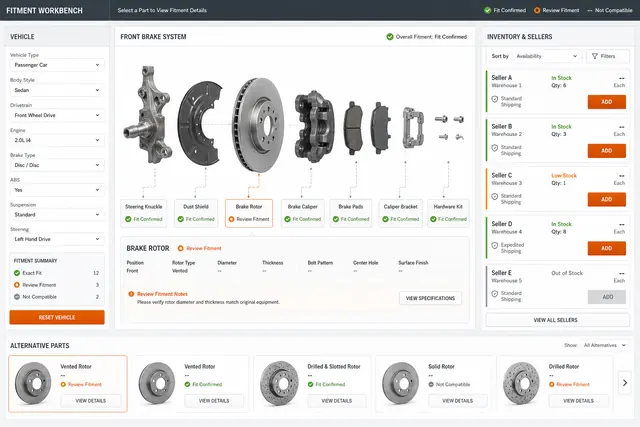
Manufacturers, dealers, and consumers used the platform for parts information and commerce. Its suite included part and accessory ordering, order fulfillment and electronic returns, controlled access to catalog information, and back-office operations.
The platform was stable, but its user experience and underlying technology needed improvement. A complete rebuild risked losing proven functions and domain rules, so the client chose maintenance-led modernization.
The modernization challenge
The work had to respect a stable production platform, several connected subsystems, and a niche legacy technology stack.
Ordering, fulfillment, returns, catalog access, and back-office behavior already represented years of business learning.
Changes could cross the parts storefront, fulfillment and returns, information access, and administration.
The Java enterprise platform also relied on ColdFusion/CFML knowledge that the incoming team needed to build.
The solution
Architecture and business-process ownership stayed with the client while the delivery team learned the application, maintenance routines, and technology in a controlled sequence.
Review the code, application structure, technologies, business process, navigation, and day-to-day maintenance routines.
Complete assigned changes under client supervision until the team could operate safely inside the established platform.
Add practical functions and preventive maintenance while the client’s specialists focused on the broader modernization plan.

How we worked
The engagement began with structured knowledge acquisition rather than immediate feature production.
An assisted-performance phase let the client review how the new team navigated the system and applied its established methods.
Once the operating context was understood, the team moved into regular maintenance and enhancement work while staying integrated with the client’s product organization.
Study code, architecture, workflows, and maintenance routines.
Build Java and ColdFusion/CFML product knowledge.
Deliver scoped work under client guidance.
Own maintenance and add targeted marketplace functions.
The result
The documented engagement allowed internal specialists to focus on the wider modernization plan while the delivery team maintained the existing product and added coupon matching, dealer tracking, and external data exchange.
Knowledge transfer and assisted work reduced the risk of changing a stable production platform too quickly.
The client could direct more of its own engineering attention toward architecture and new business requirements.
Useful functions and hard-earned domain knowledge remained available while the product continued to improve.
Case taxonomy
Modernize without discarding what works
Get in touch
Tell us what you need to build, modernize, automate, or augment with AI. We can start with a focused discussion or a no-risk 1-week trial.

“A fantastic company to work with.” After the initial rapid development project, American Shipping Co. kept two Shinetech developers embedded for nearly four years, supporting internal and external tools and new AI initiatives.
 CEO, American Shipping Co. - 5-star Google Review